cours en vidéo, nombres premiers
Understanding Prime Numbers
Introduction to Prime Numbers
- The video focuses on the arithmetic chapter about prime numbers, specifically part 2 of the chapter.
- It begins with an explanation of how to recognize a prime number using examples: 6, 7, and 31.
Identifying Divisors
- The method involves finding all divisors of a chosen number by identifying products of two integers that equal that number.
- For example, the divisors of 6 are identified as 1, 2, 3, and 6; while for 7 and 31, they are only divisible by themselves and one.
Definition of Prime Numbers
- A prime number is defined in mathematics as a positive integer greater than one that has exactly two distinct positive divisors: itself and one.
- Examples include:
- 7: Divisors are only 1 and 7 (prime).
- 31: Divisors are only 1 and 31 (prime).
- 6: Has additional divisors (not prime).
Special Cases: Zero and One
- Zero has infinite divisors (not prime), while one has only one divisor (itself), thus also not considered a prime number.
List of Prime Numbers Below One Hundred
- A comprehensive list is provided:
- First few primes include:
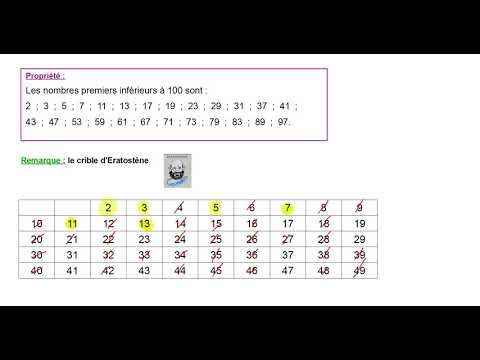
- 2, 3, 5, 7, 11, 13, up to 97.
Methods for Finding Prime Numbers
Sieve of Eratosthenes
- Introduces the ancient Greek mathematician Eratosthenes' method for identifying primes up to a certain limit.
Steps in the Sieve Method
- Start with listing all positive integers up to a specified limit (e.g., up to 50).
- Eliminate multiples of each found prime starting from the first prime (2), marking them as non-prime.
Continuing the Process
- After eliminating multiples of each successive prime (like multiples of three), continue until reaching higher primes such as five or seven.
Finalizing Primes Up To Desired Limit
- This systematic elimination allows you to identify all primes below your chosen upper limit effectively.
Conclusion on Infinite Primes
- Emphasizes that there is an infinite quantity of prime numbers. To determine if larger numbers are prime, test their divisibility against known smaller primes.
Understanding Prime Numbers and Their Factorization
Identifying Prime Numbers
- A number is considered prime if it is not divisible by any prime numbers less than or equal to its square root. For example, 178 is not prime as it is divisible by 2.
- The speaker examines the number 223, initially noting that it does not appear to have obvious divisors. It’s checked against small primes: 2, 3, 4, 5, etc.
- The square root of 223 is approximately 14.9; thus, the relevant primes for testing divisibility are: 2, 3, 5, 7, 11, and 13.
Divisibility Tests
- Testing shows that:
- Not divisible by:
- 2 (as it's odd)
- 3 (sum of digits isn't a multiple of three)
- 5 (last digit isn’t zero or five)
- Further tests with primes up to √223 confirm no divisibility.
- Division by each prime confirms that none divide evenly into 223; hence it is concluded that 223 is a prime number.
Unique Factorization Theorem
- Every integer greater than one can be expressed uniquely as a product of prime factors. This property ensures that factorization into primes will always yield the same result regardless of order.
Example of Factorization
Factorizing the Number 60
- Starting with the number 60, initial factors include non-prime numbers which need further breakdown:
- 10 = 2 times 5
- 60 = (2 times 3) times (2 times 5), leading to 60 = 2^2 times 3^1 times 5^1.
Alternative Method for Factorization
- Another method involves using a tree diagram where you repeatedly divide by known primes until only primes remain:
- Start with 60, divide by 2, yielding 30.
- Continue dividing until reaching all prime factors.
Additional Example: Factorizing the Number 2088
- The process begins similarly since 2088 is even:
- Divide successively by two until reaching smaller composite numbers like 261.
- Recognize 261’s divisibility by three leads to further breakdown into 87, which can then be factored down to its prime components.
Conclusion on Methods
- Both methods—stepwise division and tree diagrams—are valid for finding prime factorization. Calculators can also assist in verifying results efficiently.
Understanding Irreducible Fractions and Prime Factorization
Introduction to Prime Factorization
- The process begins with decomposing numbers into their prime factors, illustrated through an example of 288 yards. This involves using the Euclidean division method to display the decomposition on-screen.
- The result of this factorization is expressed as powers, specifically noting that 3^2 times 29 is a key manipulation to remember for future calculations.
Application in Simplifying Fractions
- A practical application of prime factorization is demonstrated by simplifying fractions. For instance, when simplifying the fraction 792, one must decompose both the numerator and denominator into their prime factors.
- Using a calculator aids in identifying these factors efficiently, allowing for easier elimination of common factors between the numerator and denominator.
Example of Fraction Simplification
- In the simplification process, common factors are identified: if a factor appears in both the numerator and denominator (e.g., 3), it can be eliminated from both sides.
- After removing common factors such as 3 (which has duplicates in both parts), what remains simplifies down to 3/4 , showcasing how effective prime factorization can be in reducing fractions.