¿Quién inventó el ABECEDARIO?
The Origins of the Alphabet
The Importance of Shared Language
- Jorge Luis Borges emphasized that language is a shared system of symbols, requiring common understanding among interlocutors.
- Communication relies on a shared code or alphabet, which raises questions about the origins of these letters.
Early Writing Systems
- The first writing systems were numerical representations and pictograms, developed around 3200 B.C. in Mesopotamia.
- Pictograms evolved into cuneiform writing, created by pressing a reed stylus into wet clay tablets. This method preserved many ancient texts.
Deciphering Cuneiform
- Georg Friedrich Grotefend successfully deciphered cuneiform inscriptions using poor copies from Persepolis, proving they were not mere decorations but actual writing.
- He identified the structure of cuneiform writing and established an alphabet with 30 letters used for various records over two millennia.
Hieroglyphics and Other Ancient Scripts
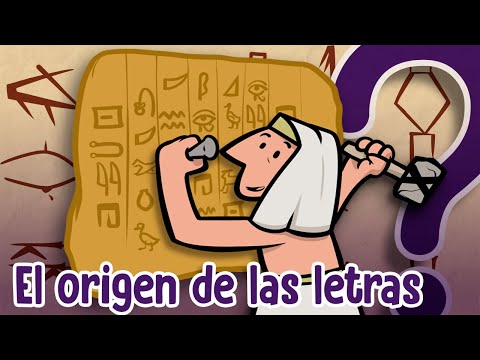
- Egyptian hieroglyphics emerged around 3200 B.C., derived from Greek words meaning "sacred writing." Similar systems existed in Mayan culture and among the Hittites in Asia Minor.
- Only select individuals like priests and scribes could read and write these complex scripts due to their vast number of symbols (over 700 in Egyptian hieroglyphics).
The Rosetta Stone Breakthrough
- In 1799, soldiers discovered the Rosetta Stone containing text in three scripts: hieroglyphics, demotic Egyptian, and ancient Greek, leading to significant breakthroughs in understanding hieroglyphics by Jean François Champollion in 1822.
- Hieroglyphic reading order depended on the direction characters faced; this flexibility was crucial for interpretation.
Development of Phonetic Alphabets
- Around 1500 B.C., the Caldeans invented a phonetic alphabet with signs representing sounds; it was further refined by Phoenicians to include only consonants (22 letters).
- Greeks later adopted this Phoenician alphabet around 800 B.C., adding vowels to create the foundational structure we recognize today as our modern alphabet.
Evolution of Letters Through Time
- Examples illustrate how early symbols transformed into letters:
- A bull's head became 'A' (ʾālep) through modifications by Phoenicians and Greeks.
- A geometric shape representing a door evolved into 'D' (Dālet).
- An image resembling a shouting figure transitioned into 'E' (Epsilon).
Cultural Variations in Writing Systems
The Evolution and Complexity of Written Language
The Nature of Chinese Characters
- Chinese writing utilizes single characters, with many words formed through combinations. It is the oldest continuously used writing system, maintaining its form over thousands of years.
Codes and Ciphers in Communication
- Various codes, such as Morse code and encrypted alphabets, are designed for limited understanding, often developed during wartime to conceal plans from enemies.
- The Caesar cipher involves substituting each letter with another a fixed distance away; for instance, A becomes D when shifted three positions forward.
Substitution Methods
- Direct substitution can replace the standard alphabet with any collection of symbols or numbers. Examples include the Freemason cipher and Pigpen cipher used in the 18th century.
- Francis Bacon's method substitutes letters with groups of five characters made up of 'a' and 'b', effectively encoding letters into binary-like sequences.
Literary Curiosities: Lipograms and Pangrams
- A lipogram intentionally excludes a specific letter; notable examples include "Gadsby" (1939), which contains over 50,000 words without using 'e'.
- A pangram includes every letter in the alphabet; an example is a sentence by Francisco J. Briz Hidalgo that describes a meal while incorporating all letters.
The Importance of Written Language
- Unlike spoken language, which can lose meaning over time (similar to "telephone game"), written language preserves ideas across generations.