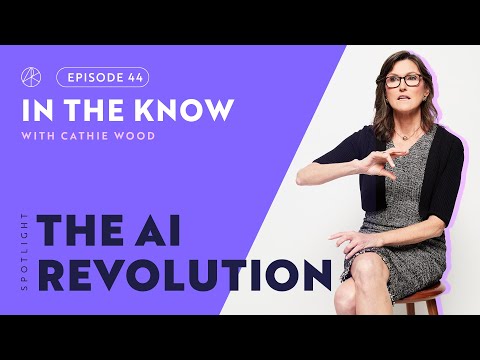
The AI Revolution | ITK with Cathie Wood feat. Frank Downing & Will Summerlin
Introduction
The speaker welcomes the audience and introduces the topic of AI.
- The speaker greets the audience.
Importance of AI
The speaker discusses how AI has captured the imagination of consumers, businesses, and investors.
- AI has captured the imagination of consumers, businesses, and investors.
- Companies are trying to figure out how best to use it.
- Investors are trying to figure out where value will accrue.
- Two analysts at ARC focus on artificial intelligence.
Using AI in Portfolio Analysis
The speaker talks about using an AI lens for portfolio analysis.
- Every stock in their portfolio is analyzed with an AI lens.
- Nvidia is given as an example of a company that was not recognized for its potential in AI early on but has since become a major player in the industry.
Historical Perspective on Computing Architecture Shifts
The speaker provides historical perspective on computing architecture shifts and how they relate to investing in hardware vs software.
- Foundational shifts in computing architecture have occurred over time.
- Hardware companies do well during initial investment cycles, but software companies generate more revenue after that initial surge.
- Transition from PCs to mobile computing saw companies like Qualcomm and ARM do well initially, but value accrued to companies that deployed software and services on top of those mobile phones (e.g., Google or Apple Services).
Where Will Value Accrue Next?
The speaker discusses where value will accrue next in the AI industry.
- Everyone is crowding into companies like Nvidia because there's anticipation of future products and services in the software market that are going to be delivered through hardware purchases today.
- There will be room for Nvidia and others to come into the hardware space and do well, but they're only doing well because of anticipation of future products and services in the software market.
The Potential of AI to Increase Productivity
In this section, the speaker discusses how AI can increase productivity and create value in various job categories.
AI's Impact on Software Engineering
- Software engineers using GitHub copilot are twice as productive as those who do not use AI.
- Up to 80% of new code on the platform Replit is generated by AI coding assistance, resulting in a 5x productivity uplift.
- By 2030, AI could increase the productivity of knowledge workers by more than fourfold, creating over $100 trillion in value.
Value Capture Opportunity for Software Companies
- Enterprise software companies generally capture between 10 and 25 percent of the value created by their software.
- If an enterprise software company saves a customer $10 million a year, they would be able to capture one to two and a half million dollars in revenue.
- In our base case, we assume that software companies will be able to capture about $14 trillion dollars in revenue by 2030.
Investing in AI Companies
In this section, the speaker discusses how they pick companies to invest in based on their ability to create value for customers and proprietary data sets.
Criteria for Picking Companies
- Look for applications that create a lot of value for customers.
- Contact centers are an area where AI can create a lot of value due to high churn rates and cost optimization efforts.
- Best-positioned companies have proprietary data sets that allow them to train or fine-tune models specific to their use case, a data feedback loop that generates insights to continually train the model, and leadership that understands the opportunity and is leaning aggressively into AI.
The Power of Data Feedback Loop and Distribution
In this section, the speakers discuss the power of data feedback loops and distribution in AI. They explain how companies that already own workflows are better positioned to distribute AI features and products more easily than those who are coming in net new as a challenger.
Tesla's Fleet Realizes Blue Stop Signs Are Also Stop Signs
- Every Tesla in the fleet would realize that blue stop signs are also stop signs.
- This is a data feedback loop that's very powerful and hard to compete with.
- It's proprietary data.
Companies That Already Own Workflows Have an Advantage
- Companies that already own workflows have an advantage in distributing AI features and products.
- It's easier for them to upgrade their contact center software to include AI features and functionality.
- A company like Twilio, which already has most of the Fortune 500 as a customer, can easily distribute AI features within its existing customer base.
Leadership Is Key
- Leadership is key when it comes to pursuing opportunities in AI.
- Founders are often better at throwing out everything they knew before and starting over with the context of AI being a new disruptive platform.
- Many of the companies that they invest in are founder-led.
Implications for Productivity Gains
In this section, Kathy talks about how artificial intelligence will unleash productivity gains. She explains why companies will be looking for ways to cut costs due to losing pricing power.
Shocking Productivity Gains from Artificial Intelligence
- We're going to be shocked at the productivity gains that artificial intelligence will unleash.
Companies Will Be Looking for Ways To Cut Costs
- Companies will be looking for ways to cut costs due to losing pricing power.
- The economy is closer to a hard landing, and it is during periods of turmoil and recession that companies and consumers are willing to change the way they're doing things.
Hardware and Software Players in AI
In this section, the speakers discuss hardware and software players in AI. They explain how some surprising companies like Tesla have designed their own AI chips.
Tesla's Special Purpose AI Chip
- Tesla has designed its own special purpose AI chip.
- It's more specialized than a generalized AI chip.
Hardware vs. Software Multiples
- Hardware like Nvidia gets a multiple of 25 or 26 times revenues, whereas many software companies are priced in the single digits as a multiple of revenues.
- This has flipped the world on its head since most investors have gotten used to hardware being lower multiple and software being higher multiple.
Conclusion on Implications from an Economic Point of View
In this section, Kathy concludes her thoughts on the implications from an economic point of view. She explains why we're moving into a moment where companies will really want AI.
Companies Will Really Want AI
- We're moving into a moment where companies will really want AI.
- They'll be looking for ways to cut costs due to losing pricing power.
- The economy is closer to a hard landing, which is when companies and consumers are willing to change the way they're doing things.
The Impact of Innovation on the Market
In this section, Cathie Wood discusses how innovation is impacting the market and why she believes companies will be forced to adopt new technologies faster than they otherwise would.
Bear Market and Innovation
- In 2020, the broader market went into a bear market, with some parts experiencing an extreme bear market.
- Innovation stocks were hurt more in this go-around than they were in the tech and telecom bust when we were not ready for prime time.
- However, now that costs are coming down to an extreme degree, AI training costs are dropping at a rate of 70% per year.
Companies Adopting New Technologies
- Companies who are losing pricing power and experiencing margin pressure will be forced to adopt these new technologies faster than they otherwise would.
- Innovation solves problems, and companies will be looking at a major problem: margin degradation that they will want to protect against.
Home Depot Example
- Home Depot guided down its same-store sales for the entire year down to something like minus zero minus five percent in a range.
- This is both price and units at work here, yet when it revised down that number, the stock really didn't go down that much because we went through a bear market last year.
Interest Rates and Inflation
- The market is beginning to discern that interest rates and inflation are going to come down much more than anyone expects.
- While the market has been very narrowly focused on mega-tech companies, this narrowing gives way to broadening out if the economic backdrop improves.
Fiscal Policy
- President Biden signed a debt deal taking off any worry about default until early 2025.
- The market is enjoying a relief rally associated with that fear going away.
Monetary Policy
- M2 officially dropped 4.6 on a year-over-year basis in April and will continue to accelerate to the downside.
Fed's Focus on Employment
In this section, the speaker discusses the Federal Reserve's focus on employment and how it may impact their decision to raise interest rates.
Employment Numbers
- Non-farm payroll was up 339,000, much stronger than expected.
- Household employment, a leading indicator of employment, was down 310,000.
- The three-month moving average of household employment numbers has gone negative while non-farm payroll numbers continue to increase.
- Payroll employment counts the number of jobs while household employment surveys households. Some workers have multiple jobs but are counted as one employed person. This could explain the divergence between payroll and household employment numbers.
CPI Statistics and Unemployment Rate
In this section, the speaker discusses Consumer Price Index (CPI) statistics and how they may impact the unemployment rate.
CPI Statistics
- The CPI is settling into the 0.1 to 0.3 range compared to last year's May at 0.9 and June at 1.2.
- The comparison from last year will result in dropping off some big numbers in July reported for June.
- The speaker predicts that we will see a decrease in CPI over time.
Unemployment Rate
- The unemployment rate increased from 3.4% to 3.7% due to a decrease in household measure by 310,000 while labor force increased by nearly 150,000 people.
- Total hours worked in the economy have been flat or slightly down since January.
Conflicting Indicators at Turning Points
In this section, the speaker discusses conflicting indicators during turning points in an economy.
Conflicting Indicators
- The speaker notes that there are conflicting indicators in the economy, which is typical during turning points.
- The JOLTS index job openings soared in the last month while initial claims started coming down again.
- The Challenger job survey showed that layoffs surged 287% year over year.
Turning Points
- The speaker believes that we are currently experiencing an extended turning point in the economy due to rolling recessions and negative GDP quarters.
Nominal GDP, Money, and Velocity
The speaker discusses the relationship between nominal GDP, money, and velocity. In Q1 2021, nominal GDP increased by 7%, but money decreased by 2% on average for the quarter. This led to an increase in velocity of 9% to offset the decline in money. However, in Q2 2021, consensus expectations for nominal GDP are 5-6%, but money is expected to be down about 5%. This means that velocity has to accelerate to 10-11% to make the identity work.
- If velocity does not continue to accelerate and instead flattens out from Q1 to Q2, this would translate into a year-over-year increase of only 8%, not the required 10-11% needed for nominal GDP growth.
- The Regional Bank crisis at the end of March is not over yet. Deposits will continue to outflow seeking higher yields in Money Market funds. Crises tend to hurt velocity as businesses and consumers pull back and start cutting budgets.
- If velocity does not continue accelerating or even falls, then something will have to give in nominal GDP either pricing or units or both. Nominal GDP growth on a year-over-year basis may disappoint in Q2 or certainly Q3.
Economic Indicators
The speaker discusses various economic indicators that were surprising on both the upside and downside.
Capital Spending
- Non-defense capital goods orders ex-aircraft was up by 1.4% on a month-to-month basis when expectation was not much change at all.
Job Openings
- The JOLTS index job openings went from roughly 9.6 million to 10.1 million.
Non-Farm Payrolls
- Non-farm payrolls were higher than expected.
Consumer Sentiment Index
- University of Michigan consumer sentiment index relapsed, and we're back into deep COVID and 0809 territory in terms of the sentiment index. Consumers are saying that they think inflation is going up, and gasoline prices did go up.
- Consumers are railing against price increases, so many companies are going to start cutting prices. Home Depot said it was going to start cutting prices in some categories, and Costco also said something happened in March-April, and they're going to cut prices to draw the consumer back in.
ISM New Orders Index
- The ISM new orders index dropped to 42, which is recession territory for manufacturing.
PPI Inflation
- The PPI was less than expected at 0.2% month-to-month, which took it down to 2.3% from 2.7% on a year-over-year basis.
- Commodity prices as measured by the Bloomberg commodity index are down about 29% on a year-over-year basis so that's the pipeline for the PPI.
Market Indicators
The speaker discusses market indicators such as equity markets and fixed income front.
Equity Markets
- The equity market has narrowed with mega-cap tech stocks accounting for around 75% of the market's move this year.
- If the speaker is right on their inflation and interest rate call, then the market will broaden out. Narrowing tends to be negative if sustained as it means we're setting up for a bear market.
Fixed Income Front
- The 10-year treasury yield went up from about 3.5% to 3.7% in the last month due to the debt deal.
- Treasury has not been issuing debt because it had hit up against the debt ceiling and was doing all kinds of fancy maneuvers around cash management to make sure that...
Market Indicators and Flight to Safety
In this section, the speaker discusses various market indicators and their implications for the economy. The speaker also talks about how Bitcoin and crypto have become a flight to safety vehicle.
Treasury Bond Yield and Yield Curve
- The treasury bond yield peaked in October at 4.3%, which is where the speaker is paying close attention.
- The yield curve inversion has diminished due to the FED coming through with the bank facility and shoring up the regional banking system.
- The bond market is saying that the FED should not be tightening because of lower than expected inflation and growth.
Credit Default Swaps and Corporate Bond Yields
- Credit default swaps are somewhat elevated but seem to have settled down.
- The spread in terms of corporate bond yields relative to treasury bond yields is a little elevated but nothing alarming.
Market Indicators
- If we go back to minus 100 115 basis points, then we may see another crack in the system, whether it's regional banks or commercial real estate.
- Commodity prices are down on a year-over-year basis except for gold and silver.
- Oil prices have come straight down from high 70s to low 70s due to demand destruction caused by electric vehicles.
Flight to Safety
- Bitcoin and crypto generally rallied during a crisis like Regional Bank crisis, which was proof positive that they have become flight-to-safety vehicles much like gold.
- Innovation generally, especially AI, will be perceived broadly before all is said and done in this cycle as a flight to safety.
I understand the instructions. Thank you for providing them. I will follow these guidelines to create a clear and concise markdown file that makes use of timestamps when available.
End of Show
The show is ending and will return next Employment Friday in Spring.
End of Show
- The show is ending.
- The show will return next Employment Friday.
- The next episode will be in Spring.