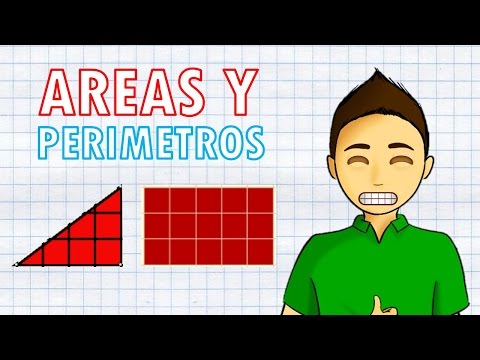
ÁREAS Y PERÍMETROS Super Facil
Understanding Perimeter and Area
Introduction to Perimeter
- Daniel Carrión introduces the concept of perimeter as the sum of the sides of a geometric figure, describing it as the figure's contour.
- He provides an example using a rectangle, explaining that its perimeter is calculated by adding each side together. The formula is stated as: Perimeter = side + side + side + side.
Calculating Rectangle's Perimeter
- In his example, he substitutes numerical values for the sides: 3 cm, 2 cm, 3 cm, and 2 cm.
- The total perimeter calculation results in 10 centimeters, indicating that this is the measurement around the rectangle.
Introduction to Area
- Carrión defines area as the measure of a figure's surface or interior region. It answers how many squares of a certain size fit within that space.
- Using the same rectangle example, he states that area can be calculated with the formula: Area = base × height.
Calculating Rectangle's Area
- By substituting values into this formula (base = 3 cm and height = 2 cm), he calculates an area of 6 square centimeters.
Example with Triangle
- Carrión shifts to discussing a triangle with sides measuring 3 cm and 3.5 cm. He uses the perimeter formula again to find its total perimeter.
- After substituting values (3 + 3 + 3.5), he finds that this triangle has a perimeter of 8.5 centimeters.
Calculating Triangle's Area
- To calculate its area, he applies another formula: Area = (base × height)/2. For this triangle (base = 3 cm and height = 2 cm), it results in an area of 3 square centimeters after performing calculations.
Explanation for Triangle’s Area Calculation
- Carrión clarifies why dividing by two is necessary for triangles; they occupy half the area compared to rectangles with equivalent bases and heights. Thus, while a rectangle may have an area of 6 square centimeters, a triangle will only have half that amount—resulting in an area of 3 square centimeters.