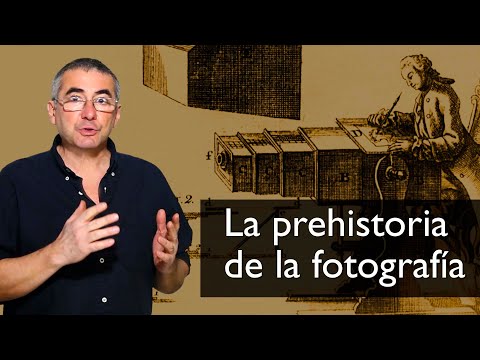
La prehistoria de la fotografía
The Prehistory of Photography
Origins of Photography Concepts
- The intention behind photography stems from the combination of two central ideas: the camera obscura and photosensitivity. This synthesis emerged in the early 19th century, although its roots can be traced back much earlier.
- Aristotle (4th century BC) described how sunlight passing through small openings creates circular light patterns on surfaces, illustrating early observations related to light and vision.
- Euclid also referenced the camera obscura as a demonstration of light's rectilinear propagation, noting how candlelight through a small hole creates illuminated spots on a screen.
Development Through History
- The physicist Alhazen (965 AD), known in the West for his work on optics, further detailed the workings of the camera obscura, contributing to its understanding.
- Leonardo da Vinci provided one of the first descriptions of a camera obscura around 1502, explaining how images could be projected onto walls via a small opening, albeit inverted. He noted that thin paper could capture these images in their natural colors but would appear reversed.
Challenges and Innovations
- A significant challenge was balancing image brightness with clarity; enlarging the aperture increased light but decreased image quality. Solutions were sought to enhance luminosity without sacrificing detail.
- Giovanni Battista della Porta proposed adding lenses to improve image quality while allowing more light into the camera obscura during the Renaissance period. This innovation marked an important step towards modern photography techniques.
Artistic Applications
- By the 17th century, smaller designs of cameras allowed artists to use them externally for accurate sketches based on real-life scenes captured within these devices. Treatises existed detailing their use in painting practices among artists like Johannes Vermeer and others who focused heavily on detail and perspective.
- There is speculation about whether certain artists utilized cameras obscuras for their works; however, it remains uncertain if they directly employed this technology for sketching purposes despite being aware of its capabilities.
General Knowledge and Commercialization
- By the early 18th century, knowledge about camera obscuras became widespread among educated individuals; various models were commercially available for artistic use or drawing assistance. This indicates a growing interest in optical tools within society at large.
- The concept that cameras reproduce human eye structure was established long before photography's invention; artists used them extensively to create realistic representations by tracing images seen through these devices onto paper or canvas. Additionally, ancient knowledge recognized chemical changes caused by light as foundational elements leading toward photographic development later on.
Chemical Foundations Leading to Photography
- Observations regarding skin darkening outdoors and color transformations in materials attributed effects primarily to heat or atmospheric conditions until scientific inquiry revealed otherwise—specifically concerning silver compounds reacting solely under exposure to light rather than temperature or air influences alone around 1725 by Professor Jules in Germany.
- His experiments demonstrated that mixtures containing silver nitrate darkened when exposed directly towards sunlight—a pivotal moment indicating potential photographic processes emerging from chemistry principles rather than mere artistry alone.