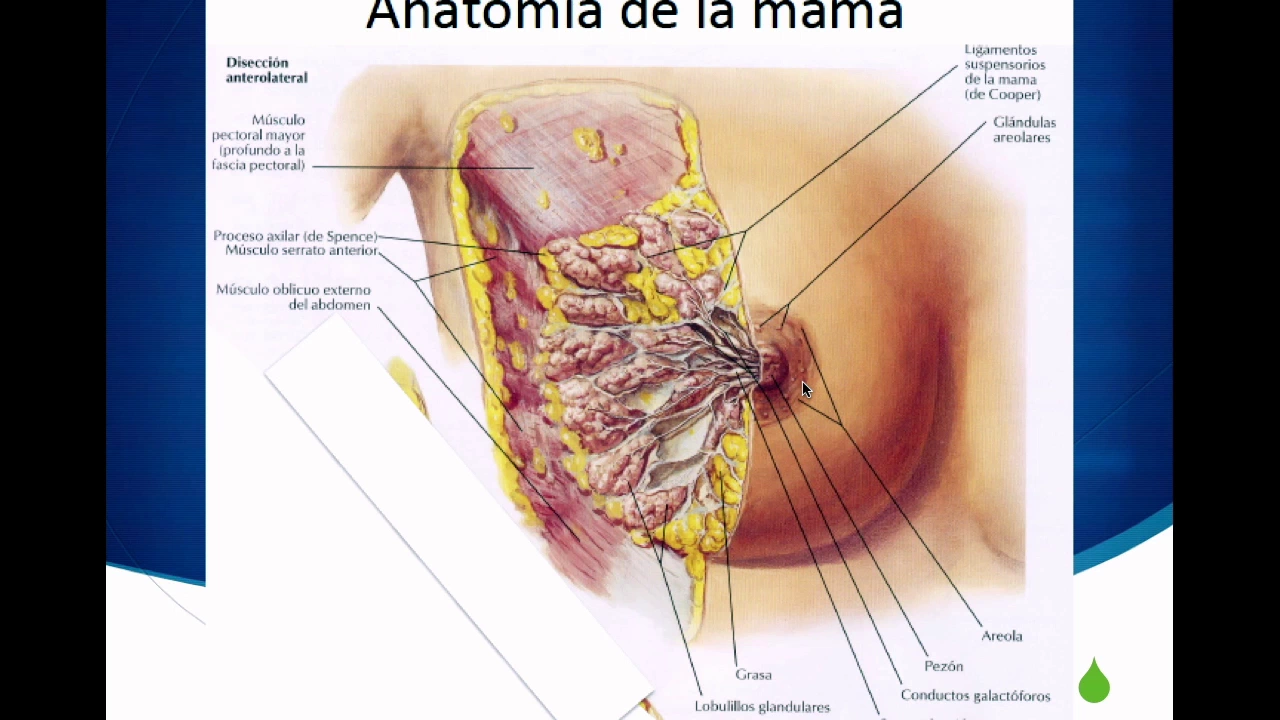
Anatomía de la mama
Anatomy of the Breast
The discussion focuses on the anatomy of the breast, emphasizing its structure, function, and significance in both sexes, with a particular interest in studying the female breast due to its susceptibility to various pathologies diagnosed through imaging techniques.
Mammary Gland Function and Structure
- The mammary gland is responsible for producing and secreting milk to support human nutrition and development during early life stages. It distinguishes mammals as vertebrates.
- In females, the mammary glands are primarily developed for breastfeeding and are located on each side of the sternum between the third and seventh ribs. They typically have a semi-spherical shape.
Development and Characteristics of Female Breasts
- Female breasts develop post-puberty due to hormonal activity, primarily influenced by adipose tissue richness and glandular tissue development. They reach their final size, morphology, and functionality during lactation.
- Throughout life stages like childhood, puberty, pregnancy, lactation, menopause, and senescence, breasts undergo changes in size, elasticity, consistency, and activity levels.
Changes in Breast Consistency
- Breast consistency varies based on factors such as parity status (nulliparous vs. multiparous), age (young vs. elderly), pregnancy history (number of pregnancies), leading to differences in firmness and elasticity.
Breast Tissue Composition
This segment delves into the composition of breast tissues including adipose tissue distribution around mammary regions.
Regions of Mammary Tissue
- The region where each breast is situated is termed as the mammary region which lies atop the hemithorax resting on the rib cage specifically above the pectoralis major muscle.
- Between the pectoralis major muscle and breasts lies a layer of adipose tissue providing structural support separating them from each other.
Subcutaneous Layer Composition
- Beneath the skin surface near areolas and nipples lies a distinct layer of fat deposits that differ from retro-mammary fat layers allowing passage for milk ducts originating from glandular lobes within breasts.
- Peripheral areas exhibit glandular lobes separated by fibrous connective tissue partitions within subcutaneous adipose layers surrounding breasts' periphery.
Anatomy of the Breast
In this section, the anatomy of the breast is discussed in detail, focusing on structures like adipose tissue, fibrous connective tissue, ligaments, and blood supply.
Structures of the Breast
- Adipose tissue forms small cavities called Duret's fat lobules within fibrous connective tissue.
- Fibrous connective tissue extends to the skin as fibro-glandular crests known as Duret's glandular crests.
- Each septum in the breast is named Cooper's ligament.
Ligaments and Tissue Connections
- The suspensory ligament of the breast connects to the clavicle from the retro-mammary layer.
- Some women may have an extension of glandular tissue towards the axilla called axillary tail of Spence.
Mammary Gland Structure and Vascularization
This part delves into mammary gland composition, ductal structure leading to nipples, and vascular supply for nourishment.
Mammary Gland Composition
- Mammary glands consist of lobules separated by fibrous connective tissues with converging lactiferous ducts towards nipples forming galactophorous ducts.
- Galactophorous ducts dilate before reaching nipples forming ampullae or lactiferous sinuses.
Vascular Supply
- Blood supply to breasts includes internal mammary artery branching from subclavian artery and perforating branches from intercostal arteries along with external mammary artery originating from axillary artery.
Radiological Examination of Breasts
This segment covers radiological examinations crucial for breast health assessment including mammography views and their significance.
Radiological Examinations
- Basic mammogram views are craniocaudal and mediolateral oblique projections essential for comprehensive breast evaluation.
- Detailed images show breast profiles aiding in identifying glandular tissues, fatty layers, pectoral muscles, and potential pathologies like tumors.