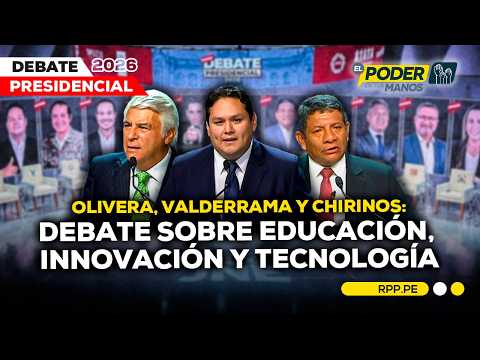
Fernando Olivera, Enrique Valderrama y Walter Chirinos: Debate presidencial sobre educación #EPETM
Debate on Education in Peru
Introduction of Candidates
- The debate begins with the introduction of candidates: Peter Enrique Valderrama Peña from the Aprista Party, Hilmer Chirinos Purizaga from PRIM, and Luis Fernando Olivera Vega from Frente Esperanza 2021.
- Each candidate is allotted one minute for their initial presentation before moving into a debate format.
Candidate Presentations
Peter Enrique Valderrama Peña
- Valderrama shares his background growing up in El Porvenir, Trujillo, highlighting personal experiences with violence and education.
- He advocates for an educational revolution to prevent youth from falling into crime, proposing to increase the education budget from 5.1% to 7.6% over five years.
Hilmer Chirinos Purizaga
- Chirinos criticizes the current educational system for failing youth and promises a radical shift towards practical education aligned with industry needs.
- He emphasizes closing the digital divide by integrating technology in classrooms and ensuring well-trained teachers while transforming universities into centers of innovation.
Luis Fernando Olivera Vega
- Olivera asserts that education liberates people and promotes social justice, pledging to allocate at least 8% of GDP to education.
- He discusses comprehensive support for children starting from prenatal care through school meals, emphasizing early childhood development as crucial.
Transition to Debate Format
- The debate transitions into a discussion phase where candidates can engage more freely with each other’s ideas.
- Each candidate has 2 minutes and 30 seconds total for their contributions during this interactive segment.
Key Discussion Points
Educational Reforms Proposed by Candidates
- Valderrama proposes expanding Beca 18 scholarships significantly and increasing university vacancies while creating new technical institutes across Peru.
- He stresses that true educational reform must start before formal schooling, advocating for improved infrastructure and teacher salaries as essential components of change.
Importance of Values in Education
- Emphasizing moral values alongside academic learning, Valderrama argues that without principles, a nation cannot thrive or invest effectively in its future.
Education Reform and Technological Innovation in Peru
Curriculum Modernization and Language Inclusion
- The candidate emphasizes a commitment to modernizing the national curriculum, incorporating essential languages alongside native ones like Aymara and those from the jungle regions. English will be introduced from early education.
- Sports are highlighted as a crucial subject, aiming to revive youth programs in football, volleyball, and athletics while also including civics classes that reflect Peru's ancient values.
Addressing Corruption in Education Management
- The speaker points out the lack of effective management in Peru's education sector, citing 11 ministerial changes over five years as indicative of instability and corruption.
- Candidate Valderrama addresses teachers directly, promising to pay off their social debt and regulate laws for class preparation payments.
Decentralization of Higher Education
- The focus shifts to decentralizing higher education across all regions of Peru, ensuring that innovation and technology are not limited to Lima but accessible nationwide.
- Each region is encouraged to develop knowledge relevant to its local industries—agro-industry in the north, mining in the sierra, and sustainable development in the jungle.
Technological Infrastructure Development
- Plans include creating regional technological parks linked with businesses and international markets to transform research into employment opportunities.
- There is a call for improved internet access through compliance by telecommunications companies, ensuring connectivity reaches rural areas.
Commitment to Quality Education
- Candidate Valderrama pledges additional emblematic schools per district and aims to double successful educational programs while providing technological bonuses for aspiring students.
- He highlights Peru's low investment in innovation (0.17% of GDP), contrasting it with neighboring countries like Chile (0.34%) and Colombia (0.25%).
Investment in Technology for Educational Growth
- A proposal is made for an annual investment of 1% of GDP towards closing digital gaps, modernizing educational institutions, and establishing decentralized innovation centers.
- Emphasizes that investing in technology is productive expenditure that generates jobs and enhances competitiveness.
Internet Accessibility Challenges
- Candidato Olivera mentions only 39% of public school students have internet access according to UNICEF data; he proposes universal free internet starting with students.
Allegations Against Opponents
- Tensions rise as accusations are exchanged regarding corruption among candidates; Olivera faces direct allegations related to past governance issues.
Debate Dynamics and Candidate Responses
Addressing Accusations and Focus on Proposals
- The speaker accuses candidates of dishonesty, comparing their claims to a "leaf of lies," emphasizing the need for integrity in political discourse.
- A call is made for candidates Valderrama and Olivera to focus on substantive issues rather than personal attacks, highlighting the importance of constructive dialogue.
- The moderator reminds candidates that any grievances expressed will count against their speaking time, reinforcing the need for civility during the debate.
- A mention of "new justice" in Peru suggests a shift towards rehabilitation rather than punitive measures, indicating a progressive approach to justice reform.
- The conclusion of candidate speaking times signals a transition in the debate format, urging participants to adhere strictly to proposed topics.