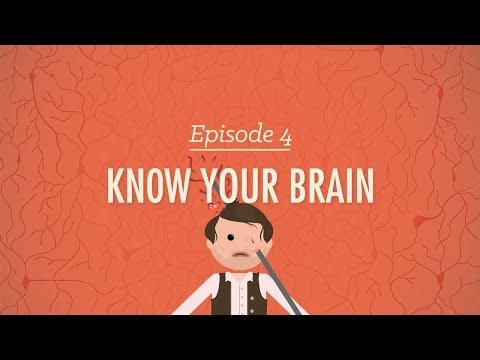
Meet Your Master - Getting to Know Your Brain: Crash Course Psychology #4
Phrenology and the Brain
In this section, we learn about Franz Joseph Gall, the founder of phrenology. We also explore how different parts of the brain control specific aspects of our behavior.
Phrenology
- Franz Joseph Gall believed that a person's personality was linked to their skull morphology.
- Phrenology was widely practiced for decades and Gall became something of a celebrity.
- Eventually, phrenology was dismissed as a cult pseudoscience because it turns out your cranial contours tell us exactly nothing about what's happening inside the brain.
The Brain and Behavior
- Different parts of the brain control specific aspects of our behavior.
- Function is localized in the brain. If you could stimulate different parts of my brain in any way you wanted to, you could control my movements, memories, and even my personality.
- The mind is what the brain does. One of the driving questions of psychology is "How do our brains' functions tie to the behavior of the mind?"
The Nervous System
In this section, we learn about the nervous system and its two main components - central nervous system (CNS) and peripheral nervous system (PNS).
Central Nervous System
- Your CNS makes your body's big decisions. This system is the command center, and if you mess with it, things are gonna get weird.
Peripheral Nervous System
- The PNS is composed of scout-like sensory neurons that gather information and report it back to the CNS.
The Curious Case of Phineas Gage
In this section, we learn about Phineas Gage, a man who survived an accident where an iron rod passed through his head. We explore how the accident affected his personality and behavior.
- After the accident, Phineas was no longer like himself. He became surly, mean-spirited, and vulgar.
- This case shows how physical the roots of our mind and personality are and how concretely our nervous system makes us who we are.
Phineas Gage: A Story of Brain Science
The speaker discusses the story of Phineas Gage, a man who survived an accident that damaged his brain. The speaker explains that while many psychology textbooks present a simplified version of the story, it is important to recognize the complexity and nuance of Phineas's experience.
The Complexity of Brain Function
- The idea that humans only use 10% of their brains is a myth.
- Brain scans show that nearly every region of the brain lights up during even simple tasks like walking and talking.
- Animals' capabilities have developed in part from their brain structures. Less complex animals have simpler brains designed for basic functioning and survival, whereas more complex animals possess brains that feel, remember, reason, and predict.
- The brain can be thought of as a set of Russian nesting dolls. The outermost wooden doll is the newest, most detailed and most complex, but as you go deeper, the dolls become older and smaller, simpler, and more generic.
The Old Brain
- The inner core of the brain is sometimes called the "old brain" or "brainstem." It still performs for us much as it did for our early evolutionary ancestors.
- Above the brainstem are several structures responsible for basic functions such as movement coordination (pons), sensory information processing (thalamus), arousal (reticular formation), non-verbal learning and memory (cerebellum).
The Limbic System
- For higher functions beyond basic survival needs, we look to the limbic system. This includes structures such as amygdala (memory consolidation; fear/aggression response), hypothalamus (regulation of body temperature, circadian rhythms, hunger; pleasure and reward), and hippocampus (memory formation).
Conclusion
- The story of Phineas Gage highlights the complexity of brain function and the importance of recognizing the nuance and mystery of individual experiences.
The Basics of the Central Nervous System
This section provides an overview of the central nervous system, specifically the brain, which can be understood in terms of old or more evolutionary ancestral structures along with new structures.
The Brain and Its Hemispheres
- The two hemispheres of your cerebrum make up about eighty-five percent of your brain weight.
- Language production is controlled largely by the left hemisphere while certain creative functions are controlled by the right.
- A statement as general as "artistic people use their right brains" is as useless as saying "artistic people have particularly bumpy heads".
- The cerebral cortex's left and right sides are subdivided into four lobes: the frontal, parietal, occipital, and temporal.
Lobes and Their Functions
- Each lobe does indeed have its own set of duties. For example, the frontal lobes are involved in speaking, planning, judging, abstract thinking.
- The parietal lobes receive and process your sense of touch and body position.
- At the back of your head, the occipital lobes receive information related to sight.
- And the temporal lobes just above your ears process sound including speech comprehension.
Association Areas
- Your grey matter is made up of association areas that are related to higher mental functions like remembering, thinking,
learning, and speaking.
- Association areas deal with things like interpreting and integrating sensory input
and linking up with memories.
- They prevail throughout all four lobes so brain damage to different areas will cause very different results.
Conclusion
- The basics of the central nervous system, specifically the brain, which can be understood in terms of old or more evolutionary ancestral structures along with new structures.
- Thanks for watching this lesson in Crash Course Psychology.