Osificacion ( Histologia)
Dosificación y Osificación
The section discusses the process of dosification, which is the formation of bone in the embryo. It explains the two types of ossification: intramembranous and endochondral, detailing their histological composition and developmental differences.
Dosificación Process
- Intra membranosa vs. intra cartilaginosa ossification:
- Both processes have the same histological composition but differ in development.
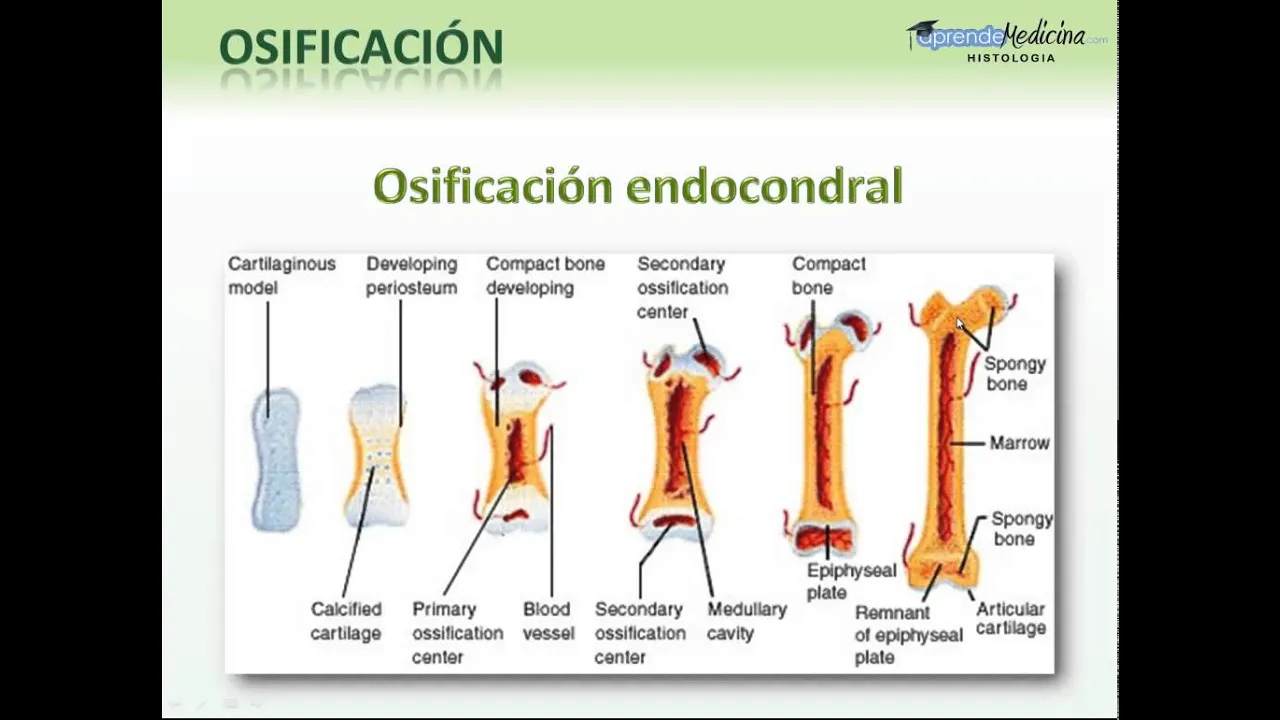
- Endochondral ossification:
- Formation of bone from cartilage, except on joint surfaces.
- Major process for bone formation in the body, especially visible in long bones.
Five Steps of Osificación
- Development of cartilaginous model:
- Shapes future bone structure.
- Growth of cartilaginous model:
- Length and width expansion leading to primary ossification center development.
- Formation of secondary ossification centers:
- Located at ends (epiphyses) and middle (diaphysis) of bones.
- Creation of epiphyseal plate and articular cartilage:
- Responsible for longitudinal bone growth until closure around age 24.
- Summary of five stages:
- Model development, growth, primary center appearance, secondary centers emergence, and x area formation.
Transición en la Osificación Endocondral
This part delves into the transition during endochondral ossification from normal cartilage to bone tissue through five distinct zones.
Transition Phases
- Five zones observed during transition:
- Normal cartilage zone, serially arranged cartilage zone, hypertrophied cartilage zone, calcified cartilage zone, and osteoid zone.
- Changes across zones:
- From typical cartilage to columnar chondrocytes to calcified matrix to immature bone matrix deposition.
Dosificación Intramembranosa
Discusses intramembranous ossification occurring directly in connective tissue without a cartilaginous mold. It leads to flat bones like those in the skull.
Intramembranous Ossification Process
- Cell differentiation into osteoblasts: