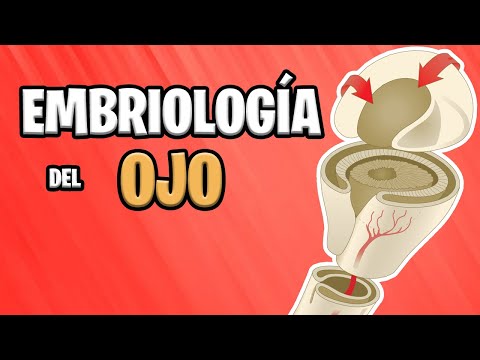
✅ EMBRIOLOGÍA del OJO 👁🎨
Introduction to Lembriology of the Eye
Overview of the Topic
- The speaker welcomes viewers and introduces the topic of lembriology, specifically focusing on eye development in a concise and practical manner.
Development of Optical Structures
- At 22 days, the lojo (eye structure) shows shallow grooves on either side of the prosencephalon, which later form optical vesicles as the neural tube closes.
- These optical vesicles interact with superficial ectoderm to initiate changes necessary for lens formation. They begin to fold into a double-walled optic cup.
Formation of Key Eye Components
- By week seven, the edges of the choroidal fissure fuse, creating a round opening known as the future pupil.
- The outer layer of the optic cup becomes known as the retinal pigment epithelium characterized by pigment granules.
Retinal Structure and Function
Inner Retina Development
- The inner layer (neural retina) is more complex; it consists mainly of photoreceptor cells (rods and cones), with rods being more numerous but not color-sensitive like cones.
Neuronal Layers in Retina
- Surrounding layers include external nuclear layer, internal nuclear layer, and ganglion cell layer. Fibrous layers contain axons from deeper neurons converging at the optic disc.
Iris and Ciliary Body Formation
Iris Development
- The anterior part of the inner retina retains thickness; it divides into two parts: iris and ciliary body.
Mesenchyme Role in Eye Structure
- Between optic cup and overlying epithelium lies loose mesenchyme that forms muscles controlling pupil size.
Lens Development Process
Lens Fiber Formation
- After forming, lens vesicle cells elongate to create long fibers filling its cavity by week seven. Secondary fibers continue to develop towards central nucleus.
Choroid, Sclera, and Cornea Formation
Choroidal Layer Creation
- By week five, mesenchyme surrounds eye primordium differentiating into an internal vascularized choroid layer while an external scleral layer connects with dura mater around optic nerve.
Anterior Chamber Structure
- Anterior chamber forms through differentiation into pupillary membrane in front of lens and corneal stroma behind it.
Fluid Dynamics within Eye Chambers
Aqueous Humor Production
- Posterior chamber filled with aqueous humor produced by ciliary body circulates through pupil into anterior chamber providing nutrients to avascular structures like cornea.
Vitreous Body Formation
Vitreous Body Composition
Development of the Optic Nerve
Connection to the Brain
- The optic cup connects to the brain via the optic stalk, which features a ventral groove known as the choroidal fissure. This fissure houses blood vessels and nerves returning to the brain.
Developmental Changes
- By the seventh week of development, the choroidal fissure closes, forming a narrow tunnel within the stalk. The increasing number of nerve fibers causes growth in both internal and external walls of the stalk.
Formation of Neuroglia
- Internal layer cells contribute to a network of neuroglia that supports optic nerve fibers, leading to the transformation of the optic stalk into what will become the optic nerve.
Vascularization
- The center of this structure will later develop an artery known as the central retinal artery, surrounded by extensions from both choroids and protective membranes (arachnoid and dura mater).
Conclusion
Convierte cualquier video en un resumen como este
Videos de YouTube, reuniones, clases. Con transcripción, búsqueda y chat.