Impact: Coefficient of Restitution (learn to solve any problem)
Understanding Impact and Momentum in Physics
Types of Impact
- The discussion begins with the concept of impact between two particles, distinguishing between central impact (head-on collision) and oblique impact (non-head-on collision).
Plane of Contact and Line of Impact
- When two objects collide, a plane of contact is established where they touch. A line drawn perpendicular to this plane through their center of mass is referred to as the line of impact.
Coefficient of Restitution
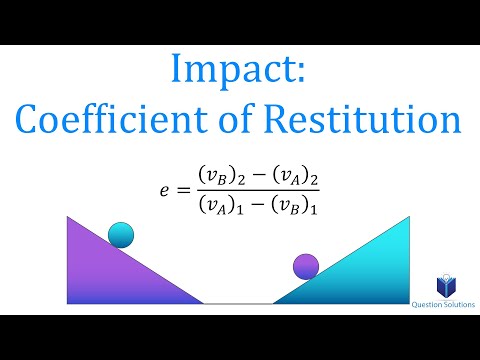
- The coefficient of restitution, denoted as 'e', measures the ratio of final velocity to initial velocity after an impact. It ranges from 0 (perfectly inelastic collision) to 1 (perfectly elastic collision).
- In real-life scenarios, energy loss occurs due to sound and heat; thus, perfectly elastic collisions are theoretical.
Conservation of Momentum
- To determine post-impact velocities, conservation of momentum equations are utilized. The equation incorporates masses and initial velocities for both colliding objects.
Solving for Velocities Post-Collision
- By applying the coefficient of restitution alongside conservation laws, one can derive equations that allow solving for unknown velocities after a collision.
Analyzing Bouncing Balls: Kinematics Applications
Maximum Height Calculation After Bounce
- An example illustrates how to find the maximum height reached by a ball after bouncing once using kinematic equations.
Vertical Velocity at Point B
- The vertical component at point B is calculated considering gravitational acceleration. Initial conditions are set based on the origin's position.
Speed After Ground Impact
- Using the coefficient of restitution again helps determine the speed at which the ball rebounds after hitting the ground.
Final Height Calculation Post-Bounce
- Another kinematic equation is employed to calculate maximum height achieved post-bounce, noting that vertical velocity will be zero at this peak.
Impact Dynamics on Surfaces
Ball Striking Table Edge
- Analyzing a scenario where a ball strikes an edge at a 45-degree angle allows calculation of its y-component velocity before impact.
Coefficient Application Post-Hit
- After striking point A on the table, only y-component velocity is considered when applying the coefficient of restitution since x-component remains unchanged.
Velocity Analysis After Edge Strike
- Upon hitting point B on the table edge, focus shifts back to x-component velocity while maintaining positive direction assumptions for calculations.
Understanding Velocity Components
Analyzing Velocity in Motion
- The initial velocity is established as zero, which is crucial for subsequent calculations.
- The x component of velocity needs to be solved, while the y component remains unchanged from previous steps.
- With both components identified, the overall velocity can be determined by calculating its magnitude.
- This process leads to a comprehensive understanding of how to derive velocity from its components.
Turn any video into a summary like this
YouTube links, meetings, lectures. With transcripts, search, and chat.