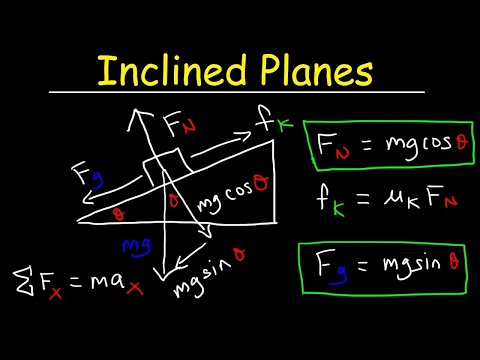
Introduction to Inclined Planes
Inclined Planes: Key Formulas and Concepts
Understanding Forces on Inclined Planes
- The video begins with a review of essential formulas related to inclined planes, focusing on the forces acting on a box resting on an incline.
- The relationship between angles in a right triangle is explained, emphasizing that the angle of inclination corresponds to specific components of force.
- Introduction to trigonometric functions (sine, cosine, tangent) as they relate to the sides of the triangle formed by the incline and gravitational force.
Normal Force and Weight Components
- The normal force is defined as equal to mg cos(theta) , where m is mass and g is acceleration due to gravity. This equation is crucial for solving inclined plane problems.
- The component of weight acting down the incline (parallel to it) is given by mg sin(theta) , which accelerates the block downwards.
Acceleration Down a Frictionless Incline
- For a frictionless incline, only gravitational force affects acceleration; thus, acceleration can be expressed as g sin(theta) .
- Newton's second law states that net force equals mass times acceleration. In this case, mass cancels out when calculating acceleration.
Incorporating Friction into Calculations
- When friction is present, kinetic friction opposes motion. The net force equation becomes F_g - F_k = ma , where F_k = mu_k N.
- The formula for acceleration with friction included becomes gsin(theta)-mu_k gcos(theta).
Analyzing Motion Up an Incline
- If a block slides up an incline against gravity and friction, both forces act in opposition. Thus, their contributions are negative in terms of net force.
- When moving up against these forces, the resulting acceleration formula changes sign but retains its structure: positive contributions from both forces lead to different outcomes.
Example Problem: Block Sliding Down an Incline
- A practical example illustrates how to calculate the acceleration of a block sliding down a 30-degree incline starting from rest using known values.
- To find final speed after traveling 200 meters under constant acceleration (4.9 m/s^2), kinematic equations are applied effectively.
Further Example: Block Moving Up an Incline
- Another scenario involves calculating how far up a 25-degree incline a block will travel before stopping when initially moving at 14 m/s.
- (1033)s Kinematic equations help determine distance traveled before coming to rest based on initial speed and calculated deceleration due to gravity's influence along with sine function adjustments.
This structured approach provides clarity on key concepts regarding inclined planes while linking directly back to relevant timestamps for further exploration or review.