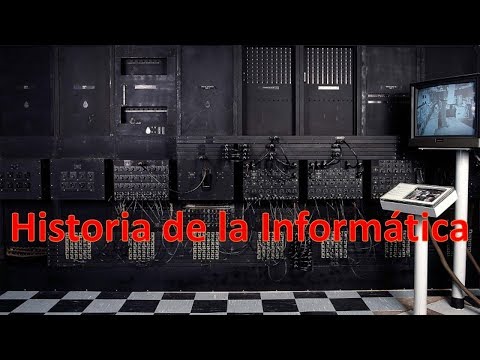
Historia de la Informática
History of Computing: From Ancient Tools to Modern Machines
Origins of Computing Concepts
- The term "informatics" originated in France during the 1960s, combining "information" and "automatic," focusing on aiding tasks involving information management.
- Early mechanical calculation traces back to ancient Babylon around 3000 BC, where small balls made from seeds or stones were used for counting.
- The Inca Empire (1300-1500 BC) utilized a knot-based system on colored strings for inventory tracking, showcasing early record-keeping methods.
Development of Calculation Devices
- Egyptians invented a calculating device using beads threaded on wires around 500 BC; this was later improved by the Chinese in the 2nd century AD with a tray-like support.
- John Napier published his work on logarithms in 1614, which facilitated complex calculations like multiplication and division through innovative tools.
Advancements in Mechanical Calculators
- In 1623, Wilhelm Schickard created a calculating clock capable of adding and subtracting six digits; it featured an alert mechanism for overflow results.
- Blaise Pascal developed the Pascaline in 1642, a machine that could sum numbers but was less advanced than Schickard's clock yet gained more popularity.
Evolution Towards Programmable Machines
- By 1672, Gottfried Wilhelm Leibniz invented a calculator that performed all four basic operations plus square roots, marking significant progress in computational devices.
- Joseph Marie Jacquard introduced the automatic loom in 1801 using punched cards for data input, considered one of the first programmable machines.
Pioneering Computer Designs
- Charles Babbage conceptualized the Difference Engine in 1822 as a mechanical device to compute scientific tables but faced technological limitations preventing its construction.
- George Boole's invention of Boolean algebra in 1848 laid foundational concepts crucial for future computer development nearly a century later.
Industrialization and Data Processing Innovations
- The U.S. Census of 1880 took seven years due to manual calculations; this prompted innovations leading to efficient data processing methods via tabulating machines.
- Konrad Zuse built the Z3 computer during WWII primarily for message encoding; however, it was destroyed during wartime events.
Breakthrough Computers During WWII Era
- The Colossus machine was developed by British engineers to decode secret messages during WWII and processed approximately 1000 characters per second using valves.
- Mark I emerged as one of the first electromechanical computers post-war; it measured about 18 meters long and weighed around 70 tons with extensive wiring.
Transition to Electronic Computers
- John von Neumann proposed an electronic storage-based computing model that allowed user-defined programming rather than pre-set instructions.
Early Computer Innovations and Their Impact
The Development of Early Computers
- The first computers utilized heavy components, such as valves weighing 30 tons, which were capable of consuming 150 kilobytes. Despite their size, they achieved speeds surpassing other computers by a factor of a thousand, performing up to 5,000 operations per second in 1947.
- In 1951, the UNIVAC emerged as the first commercially available computer. It occupied an area of 25 square meters and employed a processor with 5,000 valves. This machine could execute 8,333 additions or 555 multiplications per second while storing data on magnetic tapes.
Generational Distinctions in Computing History