How computers are learning to be creative | Blaise Agüera y Arcas
Introduction to Machine Intelligence and Neuroscience
In this section, the speaker introduces their role at Google in machine intelligence and their interest in neuroscience. They highlight the connection between perception, creativity, and the brain.
Machine Intelligence and Perception
- Machine intelligence focuses on making computers perform tasks similar to human brains.
- Perception is the process of turning sounds and images into concepts in the mind.
- Machine perception algorithms enable features like searchable photos on Google Photos.
Connection Between Perception and Creativity
- Creativity involves turning a concept into something tangible.
- The speaker's work on machine perception has unexpectedly connected with machine creativity and art.
- Michelangelo's quote emphasizes that creation is an act of perceiving.
The Brain as the Thinking Organ
- The brain is responsible for thinking, perceiving, and imagining.
- Understanding brains has been historically challenging due to their complexity.
History of Brain Understanding
This section provides a brief history of our understanding of brains. It highlights early anatomists' limited knowledge and Santiago Ramón y Cajal's contributions through microscopy.
Limited Knowledge from Early Anatomists
- Early anatomists gave superficial structures fanciful names but lacked deeper understanding.
- Merely looking at a brain does not reveal much about its functioning.
Santiago Ramón y Cajal's Insights
- Santiago Ramón y Cajal used microscopy to study individual cells in the brain.
- His drawings of neurons provided insights into their morphologies.
- These drawings are still considered remarkable even today.
Advancements in Brain Imaging
This section discusses advancements in brain imaging techniques that allow researchers to study brain tissue at a microscopic level. It mentions electron microscopy and 3D reconstructions of neurons.
Imaging Brain Tissue
- Collaborators at the Max Planck Institute of Neuroscience use electron microscopy to image brain tissue.
- The sample size is about one cubic millimeter, and the shown piece is much smaller than a strand of hair.
- Structures like mitochondria can be observed in consecutive slices.
3D Reconstructions of Neurons
- Serial electron microscopy slices allow for reconstructions of neurons in 3D.
- These reconstructions resemble the style of Ramón y Cajal's drawings.
- Only a few neurons are lit up to visualize their structures clearly.
Progress on Understanding the Brain
This section highlights that progress on understanding the brain was slow until World War II. It mentions the use of electrical experiments on live neurons and the parallel development of computers.
Slow Progress on Brain Understanding
- Progress on understanding the brain was limited until World War II.
- Neurons were known to use electricity, but deeper insights were lacking.
Electrical Experiments and Computer Development
- During World War II, real electrical experiments on live neurons began.
- Computers were also being developed based on modeling the brain's intelligence.
The transcript provided does not include further sections or timestamps beyond this point.
Understanding Visual Information Processing
In this section, the speaker discusses how visual information is processed in the brain and introduces the concept of neural networks.
The Circuit Diagram of Visual Cortex
- McCulloch and Pitts's circuit diagram is not entirely accurate, but it conveys the idea that visual cortex works as a series of computational elements passing information in a cascade.
Model for Processing Visual Information
- The task of perception is to identify objects in an image. While humans can easily recognize objects like birds, computers have struggled with this task.
- Visual information processing involves a neural network connected by synapses with different weights. The behavior of the network is determined by these synaptic strengths. At the end, specific neurons light up to indicate object recognition.
Variables in Neural Networks
- Three variables are used to represent visual information processing: x (input pixels), w (synaptic weights), and y (output). There are millions of x's (pixels), billions or trillions of w's (weights), and a small number of y's (outputs).
Inference and Learning
- Inference involves figuring out what an image represents given known inputs (x) and weights (w). This can be solved using mathematical operations within the neural network model.
- Learning refers to solving for the weights (w) in order to improve inference accuracy. It requires minimizing errors through iterative approximation processes performed by computers.
Solving Equations without Division Operator
Here, the speaker explains how equations can be solved without using division operators.
Non-linear Operations
- Multiplication is a non-linear operation that lacks an inverse, making division challenging.
- An algebraic trick can be used to move the equation around and minimize errors. The error represents the difference between the actual output and the desired output. Computers can make guesses to reduce this error and approximate the correct weights (w).
Approximating Weights
- By taking initial guesses for w, computers can iteratively drive down the error close to zero, obtaining successive approximations for w. This process allows for learning in neural networks.
Learning Process and Neural Networks
In this section, the speaker discusses the learning process and how it relates to neural networks. They explain that learning involves solving for the weights (w) in a network by using known inputs (x) and outputs (y). The iterative process of error minimization is compared to how humans learn through examples.
Learning Process
- The learning process involves taking known inputs (x) and outputs (y) and solving for the weights (w) in the middle. This is done through an iterative process of error minimization.
- Humans also learn in a similar way, starting with many examples as babies and being told what things are. This iterative learning process helps us solve for connections in our brain.
Solving for x instead of y
- Normally, we hold x and w fixed to solve for y, which represents everyday perception. However, by experimenting with solving for x given a known w and y, interesting results can be obtained.
- By using the same error-minimization procedure used to train a network to recognize birds, it is possible to generate a picture of birds just by solving for x instead of y iteratively.
Generating Images with Neural Networks
In this section, the speaker explores how neural networks can be used to generate images based on different inputs or parameters. They showcase examples where networks trained on specific categories can generate images related to those categories.
Animal Parade
- A network designed to recognize different animals from each other can be used to generate morphing images between animals by varying the input parameter (y). This creates an Escher-like transformation from one animal to another.
- By reducing the input parameter (y) to a two-dimensional space, a visual map of all the recognized animals can be created. This map shows the different positions of animals in the network's recognition space.
Face Recognition
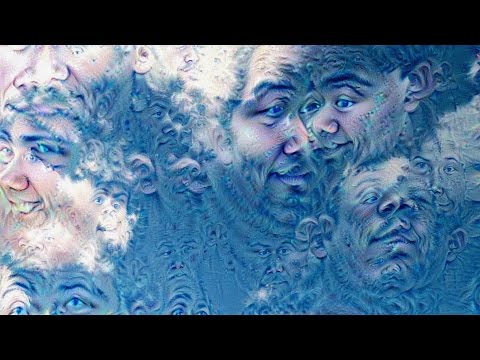
- A network trained to recognize faces can generate surreal and cubist-like images by inputting parameters related to the speaker's own face. The network is designed to remove ambiguity in facial poses and lighting conditions, resulting in multiple perspectives being represented simultaneously.
- By using guide images or statistics during the optimization process, more coherent reconstructions of faces can be achieved. However, there is still room for improvement in optimizing this process.
Image Synthesis
- Neural networks can also be used for image synthesis by starting with an existing image and optimizing it based on a specific category or concept. For example, a network designed to categorize objects can transform a picture of clouds into recognizable objects through optimization.
- The longer you look at these synthesized images, the more details and interpretations you may discover within them. Additionally, combining different networks or inputs can lead to even more creative and abstract results.
Exploring Network Fugue State
In this section, the speaker discusses experiments where neural networks are pushed into a "fugue state" by continuously hallucinating and zooming into generated images based on previous iterations.
- By repeatedly hallucinating and zooming into generated images based on previous iterations, neural networks enter a "fugue state" where they continuously generate new interpretations based on what they think they see next. This creates a sort of free association or self-referential loop within the network's own generated imagery.
- These experiments demonstrate how neural networks can create unique and unexpected visual outputs when pushed to explore their own generated content.
Conclusion
The speaker concludes by emphasizing that the technology showcased is not limited to visual applications and can be applied in various domains. They mention experiments involving cameras and highlight the potential for further advancements in optimizing the generation process.
- The technology demonstrated is not restricted to visual applications, as shown by experiments involving cameras.
- There is still ongoing work to optimize the generation process and improve the quality of synthesized images. However, the possibilities for creative exploration and application are vast.
Perception and Creativity
In this section, the speaker discusses the connection between perception and creativity, highlighting how neural networks trained to recognize objects can also generate new content. The speaker suggests that any being capable of perceiving can also engage in creative acts.
Neural Networks and Creativity
- Neural networks trained for object recognition can be run in reverse to generate new content.
- This suggests that Michelangelo's ability to see sculptures within blocks of stone is not unique to humans but a result of the same perceptual machinery used by other creatures.
- Computer models are now able to perform similar perceptual and creative tasks, further supporting the idea that perception and creativity are not exclusive to humans.
Computing and Intelligence
- Computing initially aimed at designing intelligent machinery, inspired by the goal of making machines intelligent like humans.
- The field of computing allows us to better understand our own minds and extend their capabilities.
The language used in this section is English as specified in the transcript.
Turn any video into a summary like this
YouTube links, meetings, lectures. With transcripts, search, and chat.