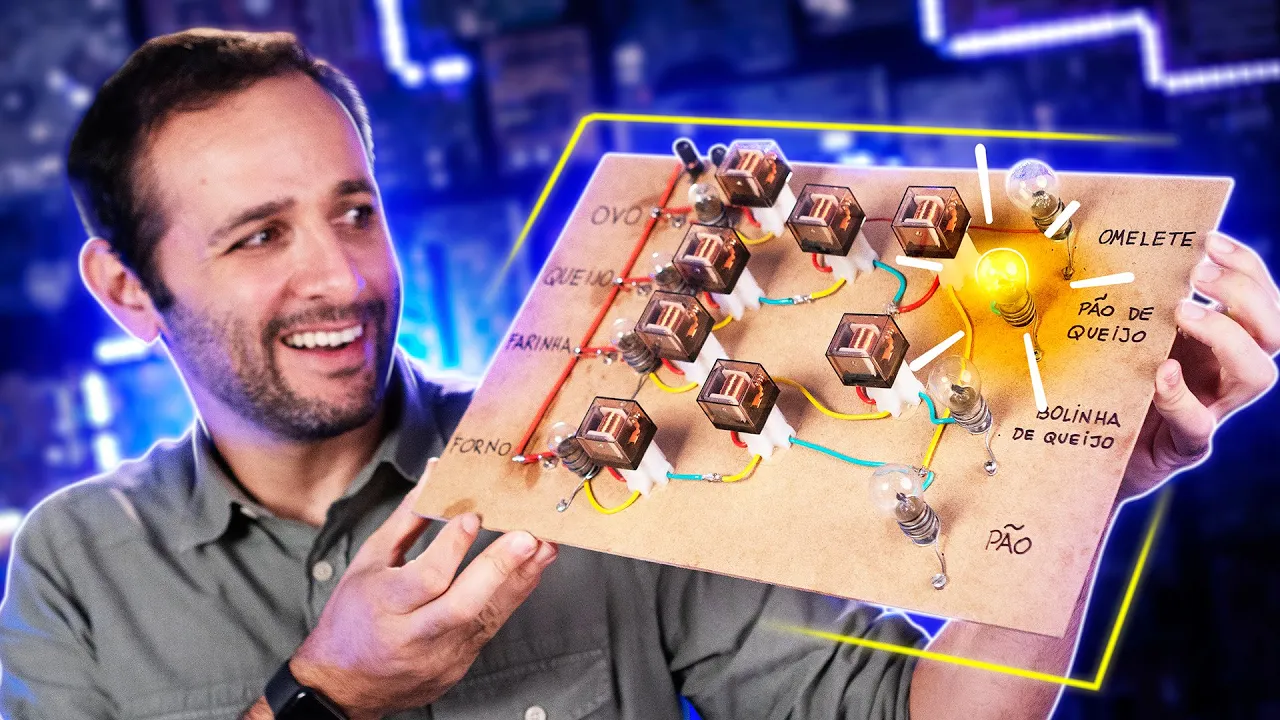
A REVOLUÇÃO ELÉTRICA #SagaDosComputadores Ep.2
Computers: From Mechanics to Electricity
The episode delves into the transition of computers from mechanical systems to electricity, exploring the development of programmable electric circuits and the impact of electricity on society in the 19th century.
Evolution from Mechanical to Electric Systems
- In the late 1800s, electricity began to be widely adopted, leading to innovations like electric lamps, motors, and telephones that transformed society.
- The advent of electricity sparked a fierce competition known as the "War of Currents," driving technological advancements and societal changes.
- Electricity emerged as a futuristic technology in the 19th century, paving the way for electromechanical machines combining mechanical and electrical components.
- Electromechanical devices like relays played a crucial role in enabling the integration of electrical components into machines, facilitating automation.
Programmable Electric Circuits
- Relays acted as switches controlled by electricity rather than manual operation, demonstrating how electrical circuits could be programmed for specific functions.
- By utilizing relays in circuits with multiple components such as lamps, it became possible to create programmable sequences by controlling the flow of electricity.
- The separation of electrical circuits allowed for different voltage levels without interference, showcasing the versatility and potential applications of electric systems.
Transition to Logical Thinking
- Early electromechanical computers utilized relays but lacked true computing capabilities until Claude Shannon proposed applying logical thinking based on binary states (on/off).
- Prior to Shannon's work in 1937, complex calculations required numerous mechanical gears due to decimal-based systems; Shannon advocated for binary logic as a more efficient approach.
Application of Binary Logic
- Shannon's thesis emphasized shifting from human-like thinking to binary logic for efficient computation using simple on/off signals instead of intricate mechanical mechanisms.
- Analogies like ID verification at events illustrated how binary logic operates in everyday scenarios through logical operations such as AND (both conditions must be met), OR (either condition is sufficient), and NOT (negating a condition).
Understanding Logical Operations in Circuits
In this section, the speaker discusses logical operations using everyday examples like driving a car and relates them to electrical circuits to explain complex concepts.
Linking Everyday Scenarios to Logical Operations
- Driving a car analogy: Needing both keys and gasoline simultaneously to drive parallels logical operations where certain conditions must be met for an action.
- Binary language comparison: Drawing parallels between binary (0 and 1) in computers and everyday scenarios, simplifying complex ideas for better understanding.
Implementing Logic in Electrical Circuits
- Utilizing logic in electrical circuits: Demonstrating how logical operations can be applied in circuit design, making machines respond to specific conditions effectively.
- Parallel switches analogy: Explaining the concept of parallel switches using the example of needing both an ID card and driver's license to attend an event, showcasing logical decision-making processes.
Advancing Complexity with Decision Trees
- Decision tree complexity: Introducing decision trees as a more intricate way of making decisions, requiring multiple steps based on various conditions before reaching a conclusion.
- Enabling further actions through indicators: Discussing how indicators or signals enable subsequent actions based on previous conditions being met, enhancing the decision-making process.
Programming Complex Systems
- Programming complexity example: Illustrating a restaurant scenario where a computer program assists a chef in deciding menus based on available ingredients and operational status, showcasing practical application of logic in programming.
Computers Evolution in the 20th Century
This section discusses the evolution of computers in the 20th century, starting with the creation of the first electromechanical computers and their functionalities.
The Invention of Z2 Computer by Konrad Zuse
- The first electromechanical computer, Z2, was invented by Konrad Zuse in 1940.
- Z2 operated on binary logic (0s and 1s) and weighed 300 kg, consuming around 4000 watts.
- It was an advancement from its predecessor, Z1, which was a limited electromechanical calculator.
Development of Computers for Aviation Purposes
- Z3, a successor to Z2, was funded for construction after a successful demonstration at a German aviation laboratory.
- This computer weighed one ton, consumed 4000 watts, and could perform calculations rapidly.
- It became the first fully programmable digital computer that could solve various tasks efficiently.
Harvard Mark I - Advancements in Computing
This part delves into the development of Harvard Mark I as a significant advancement in computing during World War II.
Introduction of Harvard Mark I
- In 1944, the United States developed Harvard Mark I as a digital programmable electromechanical computer.
- It played a crucial role in calculating data for building atomic bombs during wartime projects.
- Harvard Mark I utilized paper tapes and relays for computations and output results through typewriters controlled by the computer.
Challenges Faced During World War II
This section highlights challenges faced during World War II regarding code-breaking due to limitations in existing technology.
Need for Faster Computing Systems
- During World War II, breaking coded messages internally communicated by Nazi Germany posed challenges for Allied forces.