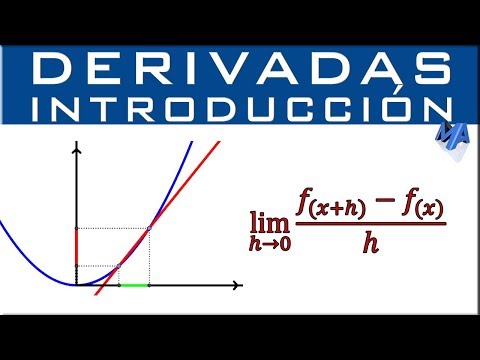
Qué es la derivada? | Concepto de derivada
Understanding Derivatives Through Average and Instantaneous Velocity
Introduction to Derivatives
- The concept of derivatives is closely linked to understanding average and instantaneous velocity, which are foundational in calculus.
Average Velocity Explained
- A practical example involves two cars racing over a distance of 100 meters, where the blue car finishes in 5 seconds while the red car covers only 80 meters in the same time frame.
- The average velocity for each car is calculated:
- Blue Car: frac100 text m5 text s = 20 text m/s
- Red Car: frac80 text m5 text s = 16 text m/s .
Graphical Representation of Velocity
- A position vs. time graph illustrates that the steeper the line, the higher the speed; thus, the blue car's line is steeper than that of the red car.
- It’s noted that both cars start from rest (velocity = 0) and accelerate over time until reaching their maximum speeds at the finish line.
Transitioning from Average to Instantaneous Velocity
- To find an exact speed at a specific moment (e.g., after 2 seconds), we need to use derivatives rather than just average velocity calculations. This highlights how derivatives provide more precise information about motion at any given point in time.
- The discussion emphasizes that while average velocity gives a general idea over an interval, instantaneous velocity can be determined using derivative concepts applied to specific points on a graph.
Calculating Instantaneous Velocity
Understanding Time and Space in Motion
Analyzing Coordinates and Time Intervals
- The discussion begins with the importance of determining the coordinates of a point, which can vary in position. In this case, the coordinates are noted as 5 seconds and 100 meters.
- The time elapsed between two points is introduced as "h," representing the increment in time from second 2 to second 5. This concept is crucial for understanding motion.
- If a point is labeled as x, then the time at that point plus h gives us x + h, indicating how we calculate time intervals in motion analysis.
Calculating Distance and Velocity
- To find velocity between two points, one must consider both the elapsed time (h) and the distance traveled. The distance is calculated by subtracting f(x) from f(x + h).
- The space covered during this interval is defined as f(x + h) - f(x), emphasizing that accurate calculations depend on precise definitions of these functions.
Approaching Exact Velocity
- For exact velocity at a specific point, it’s essential to minimize the distance (h). As h approaches zero, we derive an exact value for velocity at that instant.
- This process leads to finding the tangent line at a given point on a curve, illustrating how limits play a role in calculus.
Derivatives: Key Concept for Motion Analysis
- The limit process when h tends to zero allows us to define derivatives formally. This mathematical tool helps determine instantaneous rates of change or velocities.
- Conclusively, derivatives not only provide insights into speed but also help identify tangent lines to functions—an essential concept in calculus.
Turn any video into a summary like this
YouTube links, meetings, lectures — with transcripts, search, and chat.