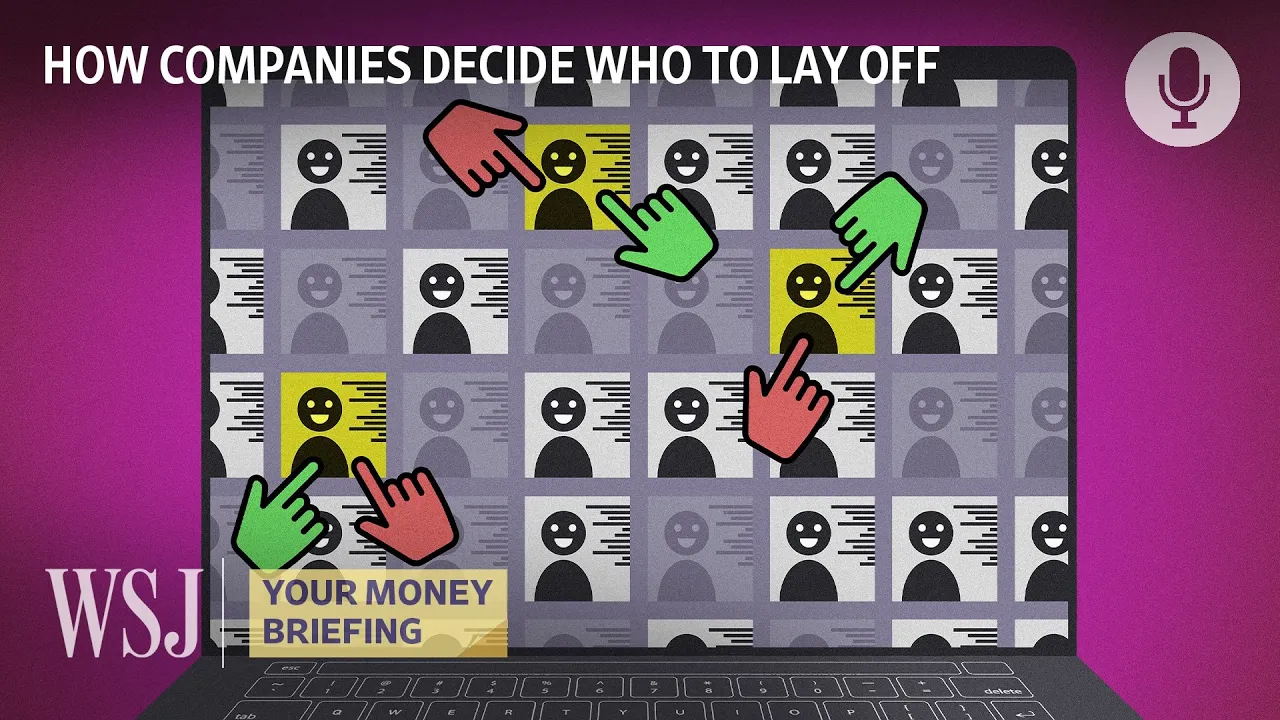
Layoffs: How Companies Decide Whose Job Is Cut | WSJ Your Money Briefing
How Companies Decide Who to Lay Off
In this video, WSJ workplace reporter Chip Cutter discusses how companies decide which employees to lay off. He explains that the process is often initiated by top leaders who set high-level criteria for layoffs, and then divisional leaders and department heads are tasked with deciding which employees to eliminate based on a set of criteria.
Factors That Go Into Instituting Layoffs
- Top leaders such as the CEO or CFO set high-level criteria for layoffs.
- Divisional leaders and department heads are responsible for deciding which employees to eliminate based on a set of criteria.
- Criteria may include low performance ratings or recent hires.
- Companies also consider an employee's potential to adapt and take on new jobs in the future.
Seniority vs. Skills-Based Layoffs
- Companies today conduct layoffs based more on skills than seniority.
- An employee's recent performance will factor into this decision more than their length of time at a company.
- HR does not select individual employees to terminate; it is often divisional or department heads who suggest names of employees to target.
Scrubbing the List and Negotiation
- Once individual employees are identified, HR scrubs the list looking for any possible red flags such as discrimination against certain groups.
- There is often room for negotiation during the finalization of the layoff list, with debates about which layer of management should be cut or whether frontline workers should be let go instead.
Example from OCTA
- OCTA, a business software company, recently cut 300 employees or 5% of its staff.
- Different departments across the company were given specific financial cost-cutting targets to meet and they did so in different ways.
- Some teams gave priority to keeping people who are working on projects that seem achievable in a three-year timeline versus a five-year one.
Introduction to the Transcript
The transcript begins with J.R Whalen introducing the Wall Street Journal workplace reporter, Chip Cutter. They discuss what a company needs to focus on over the next couple of years.
Music
Conclusion
The transcript ends with J.R Whalen thanking the audience for listening to Your Money Briefing from the Wall Street Journal.
Turn any video into a summary like this
YouTube links, meetings, lectures. With transcripts, search, and chat.