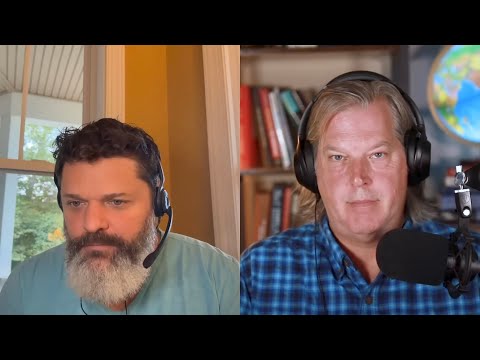
Daniel Schmachtenberger: "Modeling the Drivers of the Metacrisis” | The Great Simplification #42
The Nuances of Humans with Our Relationship with Energy, Materials and Technology
In this section, Daniel Schmachtenberger discusses the ultimate intent of framing our macroeconomic human predicament. He talks about understanding the game board of the constraints and challenges which then inform the opportunities so that we can navigate coming centuries and educate, inform and inspire more humans to play a role at various scales of the challenges we face.
Recap of Previous Conversations
- Recap of first conversation on energy, money, economic growth basis of modern early 21st century society.
- Recap of second conversation on maximum power.
- Recap of last conversation on different meta macroeconomic framings.
The Global Economy is Running into Lots of Risks and Headwinds
- The standard story taught in macroeconomics in the world's business schools and colleges doesn't really have an explanatory story that makes sense of where we are and where we might go forward.
- Humans in aggregate are functioning as a kind of blind amoeba or a super organism that self-organizes because we use the market as the arbiter of our decisions.
- We create monetary overlays on this whole system which is not being controlled by billionaires or by politicians but it has its own emergent momentum and metabolism.
Runaway Train
- We're in this like runaway train and we're shoveling fuel into the engine.
- If something breaks in the ecosystems of the world, we will keep growing until something breaks or stop growing and then we have a geopolitical social response to a smaller pie where everyone has less, or on average everyone has less.
Materials, Money, Behavior, Technology Fit Together
In this section, Daniel Schmachtenberger and Nate Hagens discuss the dynamics that underlie various types of risks humanity faces. They explore how materials, money, behavior and technology fit together and inform possible choices and changes in governance and constraints for the future.
Dynamics of Catastrophic Risk
- The speakers look at biodiversity loss, species extinction, ocean acidification, climate change, planetary boundaries and war as common issues that are driving catastrophic risk.
- They view these issues through different lenses but agree that they are looking at the same thing.
- The system of macroeconomics is a lens that all problems have in common.
- Profit often comes at the expense of others or the environment as a whole.
Arms Race to Convert Natural World into Profit
- Profit equals not just security and survivability but also game theoretic advantage of their ability to influence their own fate in the world.
- There is an arms race to convert the natural world into profit faster and increase relative game theory.
- Modern economic theory states that profit is a measure of production. However, it does not include extraction or externalization costs.
- GDP counts goods but doesn't include bads.
Perverse Incentives
- Profit is not just a measure of added production but also extraction and externalization.
- The cost of what the environment took to make something isn't included in pricing.
- The cost doesn't include harm to the environment from burning oil or manufacturing products.
- There is a meta perverse incentive to overemphasize the opportunity and under-emphasize the risk of any new technology or venture.
Developing New Technologies
In this section, the speakers discuss the importance of balancing the opportunities and risks associated with developing new technologies. They highlight how focusing too much on either side can lead to negative consequences.
Balancing Opportunities and Risks
- When developing new technologies, it is important to balance the opportunities and risks associated with them.
- Focusing too much on the opportunities can lead to moving too fast without fully understanding potential risks.
- Focusing too much on the risks can also be problematic as it may prevent progress towards solving real problems.
- A comprehensive risk assessment is necessary to ensure that technology development is net good for society.
Risk Assessment and Economic Incentives
This section discusses how economic incentives can impact risk assessment when developing new technologies. The speakers highlight how corporations may prioritize profit over ethical considerations, leading to inadequate risk assessments.
Limited Liability Corporations
- Corporations may prioritize profit over ethical considerations when developing new technologies.
- Limited liability corporation type laws protect corporations from financial responsibility for any harms caused by their products or services.
- Plausible deniability box checking risk assessments are often used instead of deep or honest risk assessments due to perverse incentives associated with profit metrics.
Comprehensive Risk Analysis
This section discusses how comprehensive risk analysis could lead to fewer products being developed but a better world overall. The speakers also discuss how the game theory of risk assessment is difficult due to the need for everyone to participate.
Ethical Considerations
- Comprehensive risk analysis could lead to fewer products being developed but a better world overall.
- The game theory of risk assessment is difficult because unless everyone participates, those who do comprehensive risk assessments lose out economically.
- Even ethical individuals may prioritize winning the race over doing the ethical thing due to economic incentives.
Colonialism, Effective Dominance, and the Multipolar Trap
In this section, Daniel Schmachtenberger discusses how colonialism was based on effective dominance rather than ethical considerations. He explains that what wins in a short-term sense may not be good in an ethical or long-term viability sense. This leads to the multipolar trap where everyone races towards a goal that ultimately causes the system to self-terminate.
The Basis of Colonialism
- Colonialism was based on effective dominance rather than ethical considerations.
- Effective dominance is a combination of violence and economic productive capacity.
Short-Term Wins vs Long-Term Viability
- What wins in a short-term sense may not be good in an ethical or long-term viability sense.
- Everyone racing towards a goal that ultimately causes the system to self-terminate is known as the multipolar trap.
The Multipolar Trap
- The multipolar trap is expressed in various scenarios such as tragedy of the commons, military arms race, and market race to the bottom.
- It can be defined as a property of the super organism to exploit all energy in its environment and then hit a cliff.
Human Presence on Biosphere: A Cancer-Like Behavior?
In this section, Daniel Schmachtenberger draws an analogy between human presence on biosphere and cancer cells. He explains how cancer cells individually utilize metabolic resources faster than other cells but end up killing their host. Similarly, humans are maximizing extraction from their environment which is breaking down the substrate they depend upon.
Cancer Cells vs Human Presence on Biosphere
- Cancer cells individually utilize metabolic resources faster than other cells but end up killing their host.
- Human presence on biosphere looks a lot like cancer where it is maximizing its extraction from that which it depends upon in a way that is actually breaking the substrate it depends upon.
Educating and Influencing Cancer Cells
- The purpose of the conversation is to educate and influence cancer cells to become self-aware and change their behaviors.
- Cancer cell behavior follows rational self-interest defined by game theory.
Hopeful Examples of Change
In this section, Daniel Schmachtenberger discusses examples where people out of concern for the commons have gone against some profit stream and won. He explains how these examples are different in kind than what we're facing now.
Examples of Change
- People out of concern for the commons have gone against some profit stream and won in cases such as cigarettes, mothers against drunk driving and seat belts, HFCs CFCs in ozone.
- These examples are different in scale and kind than what we're facing now.
The Impact of Energy on the Economy and Climate Change
In this section, the speaker discusses how energy is connected to the economy and climate change.
Energy and Tobacco Industry Comparison
- The tobacco industry was not the engine of creation for the economy as a whole, unlike energy which is required by every industry.
- The sale of tobacco was regulated after many people died from lung cancer due to vested interests that knew it was wrong.
- Energy is connected to the machine of creation rather than one little area.
Difficulty in Addressing Climate Change
- Every industry requires energy, making it difficult to address climate change since it's a byproduct of using energy itself.
- Changing something at the heart of macroeconomics itself is challenging because vested interests will resist anything that would decrease their relative power capacity.
- Power itself is bound to energy, so every nation state's geopolitical position requires it.
Multipolar Traps and Global Governance
- Inside a nation state, multipolar traps can be prevented through rule of law and monopoly of force and enforcement.
- There is a need for effective global governance to deal with global multipolar traps such as climate change.
- Effective global governance does not have to be a government but can be a decentralized process that allows us to solve multipolar traps.
Pressure for Economic Growth Despite Negative Impacts
In this section, Nate Hagens pushes back on the idea that effective global governance can solve issues related to economic growth and negative impacts.
Pressure for Economic Growth
- Even within countries, there is pressure to continue economic growth despite understanding and caring about the negative impacts of decisions.
- Countries are compelled to get energy to keep their industries going, even if it means importing coal or taking down old growth forests.
The transcript ends abruptly after this section.
How Many Countries Have Real Strategic Decisions?
In this section, Nate Hagens and Daniel Schmachtenberger discuss the concept of total sovereignty of a country and how many countries can make real strategic decisions.
Number of Countries with Real Strategic Decisions
- According to Samo, there are only about 10 countries that can make real strategic decisions.
- One hypothesis is that only countries with nukes have real strategic power. Another hypothesis is that countries with nukes and critical control over an aspect of the global supply chain have fundamental power.
- External pressures force every nation to keep up with growth, which leads to a destructive way of keeping up with the Joneses.
The Multipolar Trap
In this section, Nate Hagens discusses how external pressures force nations into a multipolar trap.
The Multipolar Trap
- External pressures force every nation to keep up with growth, leading to a destructive way of keeping up with the Joneses.
- A country can bind a multipolar trap if it has rule of law and a monopoly on violence.
- No nation has properly priced oil because they would be at an economic disadvantage compared to other nations in terms of building militaries or keeping up with trade.
Self-Organization for Resilience
In this section, Nate Hagens and Daniel Schmachtenberger discuss self-organization as a means for resilience.
Self-Organization for Resilience
- A country that chooses or is forced to simplify first and beat the rush may experience major economic and social pain now but could be more resilient in 20, 30, or 40 years based on what they were forced to do.
- The challenge is the gap between when a country starts to do something and how much advantage everyone else gets in that time before the thing pays off.
- Competitive interests force nations to keep up with the game or lose in ways that are intolerable before the ROI of their new investment happens.
International Monopoly of Force
In this section, Nate Hagens and Daniel Schmachtenberger discuss the lack of an international monopoly of force.
Lack of International Monopoly of Force
- There is no international monopoly of force because it's difficult to enforce a deterrent on countries that have nukes in critical parts of your supply chain.
- The answer is for major players to come to an agreement and decide to accept constraints on their own behavior, knowing that other nations will also accept constraints on their behavior.
The Cost of Deterrent
In this section, the speakers discuss the cost of deterrent and how it affects international agreements.
International Agreements
- Nations cannot force each other to reach agreements.
- The alternative to reaching agreements is much worse.
- People in powerful countries must make choices that bring about a different, better, long-term world situation.
- It would require people in those 10 real countries that hold the reigns; US, China, Russia, France, Germany, UK and a couple others.
Individual Behaviors
In this section, the speakers discuss whether individuals can change their behaviors and plans to get out of the trap of growth.
Changing Behaviors
- Individuals can change their behaviors regarding their consideration of where products come from and how they affect the environment.
- These choices will not make much difference to the whole but if enough people do it then it can change culture and status enough that cumulative effects are meaningful.
Tricky Stuff
- There is a lot of tricky stuff to consider like everyone's incentive to virtue signal which oftentimes actually produces more backlash than anything.
- A lot of people who are smart and caring get hopeless around their own personal behavior for a couple reasons.
Impact Maximization
- They are trying to maximize their impact not minimize their impact.
- Every single product has some input from global supply chains so living in the forest is not going to radically influence the world.
- Decreased consumption is not going to affect the overall story.
The Challenge of Being Perfect
In this section, Nate Hagens and Daniel Schmachtenberger discuss the challenge of trying to be perfect in ethical alignment with the environment.
Striving for Perfection
- Trying to be perfect in ethical alignment is not possible.
- One should endeavor to do their best in a number of areas.
Complicity with the World System
- Individuals are complicit with the world system every time they use their phone, money, or drive on a road.
- One cannot think of themselves as an individual separate from the whole.
Humility and Interconnectivity
- There is something more humble and interconnecting about recognizing one's complicity with the world system.
- It is important to recognize that helping the species as a whole move forward is more important than striving for perfection independently.
Making Ethical Choices
In this section, Nate Hagens and Daniel Schmachtenberger discuss making ethical choices in regards to environmental impact.
Impact of Traveling by Plane
- Both individuals understand how environmentally bad it is when using planes but still travel by plane when interacting with governments or major corporations to try to help them do better.
Avoiding Hopelessness
- Some people can become hopeless when trying to be perfect in ethical alignment while others become hopeless when recognizing that most harm comes from military behavior or major corporations rather than consumer behavior alone.
- It's important to earnestly consider one's impact on the environment without becoming hopeless about it.
Transforming the Human Presence on Earth
In this section, Nate Hagens and Daniel Schmachtenberger discuss transforming the human presence on earth to be compatible with the biosphere.
Accounting for Externalities
- The economy as we understand it is incompatible with the biosphere.
- Profit is both a measure of production and extraction/externalization.
- If all externalities were internalized, most industries on the planet would be unprofitable.
Changing Economic Systems
- Changes that would look nothing like capitalism or socialism are required to transform the human techno-sphere social sphere complex to actually be compatible with the biosphere that it depends upon.
- Getting accounting right is essential in creating an economy that makes sense.
Creating a New System
In this section, the speakers discuss the need to create a new system that doesn't self-terminate and how understanding alternatives is key.
The Importance of Understanding Alternatives
- Nate Hagens asks how we got here and emphasizes the importance of understanding how everything fits together.
- Daniel Schmachtenberger highlights the unique qualities of humans relative to other species, which started with early hominids that had early tool making.
- The reason for sapiens dominance over other hominids is inter-species inter-tribal warfare, which could be seen as the beginning of our current trajectory.
Humans and Nature
In this section, the speakers discuss the distinction between humans and nature and why humans must be stewards for it.
Stewardship for Nature
- Humans don't exist without nature, so we have to be stewards for it.
- What is different about us allows us to destroy all of nature in a way that nothing else in nature can. Therefore, we have to be stewards or we don't continue to exist.
- The adaptive advantage every other animal has is due to genetics resulting from evolutionary process. However, what makes humans unique is not genetic but rather our ability to destroy all of nature.
Evolutionary Process
In this section, the speakers discuss how major speciation changes occur through lots of compounding mutations over a long period of time.
Genetic Mutation Occurs
- Major speciation changes occur through lots of compounding mutations over a long period of time.
- Co-selective process occurs when a mutation makes a predator slightly faster, it's going to be slightly better at hunting the prey animal.
Competitive Forces and Adaptive Capacity
In this section, Daniel Schmachtenberger discusses the competitive forces that lead to meta-stability of a system and upregulation. He also talks about how humans increased their adaptive capacity through abstraction, tool making, and abstract coordination mechanisms.
Competitive Forces and Meta-Stability
- Competitive forces lead to meta-stability of the whole system.
- Slow but systemic upregulation of the whole occurs due to these competitive forces.
Humans' Adaptive Capacity
- Humans increased their adaptive capacity not through genetic mutation but through abstraction, tool making, and abstract coordination mechanisms.
- Animals make tools too, but they are extracorporeal adaptations that they use. They do not evolve their tool set or recursively make changes on how they do that tooling.
- The ability for recursive abstraction allows us to make a better tool and then see how to make it again and again. This occurred with some degree of complexity of recursive abstraction process where probably chimpanzee was right here and just on the other side of a line of neural development was homo habilis.
Origins of Super Organism
In this section, Daniel Schmachtenberger talks about the origins of super organism. He explains that humans were behaving as apex predators in almost every single environment in the world 10,000 years ago due to our ability to become not only adaptive but apex predators in every environment.
Origins of Super Organism
- The origin of the super organism is much earlier than 10,000 years ago when we found agriculture and started optimizing for surplus.
- Before agriculture happened, humans were already behaving as apex predators in almost every single environment in the world 10,000 years ago.
- Humans were able to become the apex predator of every single environment due to tool making, putting on clothes, and creating shelters.
Ultra Social Behavior
In this section, Nate Hagens and Daniel Schmachtenberger discuss how humans are ultra social and have behavioral attributes of social insects. They copy, coordinate, and collaborate in ways that other species don't.
Ultra Social Behavior
- Humans are ultra social and have a lot of behavioral attributes of the social insects.
- Jonathan Haidt says that humans are 95% ape and 5% bee.
- Humans copy, coordinate, and collaborate in ways that other species don't.
The Evolution of Human Coordination
In this section, the speaker discusses how humans have evolved their coordination mechanisms through recursive abstraction and technology.
Abstractions and Social Coordination
- Humans apply abstractions recursively to their coordination mechanisms.
- Language allows for a type of sociality, while written language and formal hierarchies are technologies of social coordination.
- Coordination is not just about an animal's adaptive capacity but also its ability to coordinate with others.
Recursive Abstraction and Coordination Mechanisms
- Humans can change their coordination mechanisms based on technology that allows more specialization and division of labor.
- Around 10,000 years ago, humans started to regularly pass the Dunbar number due to formalized methods of animal husbandry and agrarian revolution.
- Stone tools, language, and fire were massive jumps that distinguished humans from everything else.
Increasing Predative Capacity
- Stone tools allowed humans to extend their corporeal capacity into instruments by applying recursive abstraction to the domain of atoms.
- Humans increased their predative capacity faster than anything else in nature could increase its resilience through tool making rather than genetic selection.
- Fire was another abstraction applied to the domain of energy that allowed humans to generate warmth and move themselves into environments they wouldn't have been fit for before.
Accelerated Entropy on Earth
- Language accelerated localized centropy and systemic entropy. Profit is localized centropy and systemic entropy which goes along with privatized gain and socialized losses.
- The capacity for recursive abstraction and the ability to increase adaptive capacity through a different process began the beginning of this thing we call the human super organism.
The Agrarian Revolution
In this section, the speakers discuss how humans have been able to convert the environment into things useful for them and how technological innovations have increased this ability.
Technological Innovations in the Agrarian Revolution
- Humans' ability to steward a whole herd of goats and protect them from predators allowed them to change the environment radically.
- The plow and animal husbandry were the single biggest massive step corresponding with mechanisms of storage.
- Irrigation and hydrological systems became a massive thing.
- Each new technological innovation allowed us to increase population faster or resource per capita or both.
Impact of Technological Innovations on Ecosystem
- Goats could decimate an ecosystem of its plant life, but it could convert a bunch of plants that we can't eat into goat milk or goat meat.
- Cooking food using fire meant that people could eat food they couldn't eat raw, which increased total calorie per capita beyond what was being used to warm homes and cook food.
Evolutionary Pressure on Value Systems
- Tribes that adopted tools like plows grew their population faster than those who didn't. This led to their proliferation.
- The tribe that remained animist might have had happy, healthy lives, but they just died out because they weren't competitive versus the other tribe.
Positive Sum Behaviors
- Humans have been more positive-sum in their dynamics via moving from tiny bands to tribes to much larger groups that have division of labor across the larger group where each person is able to do specialty roles because of trade.
- The group that does more coordination or positive sum type of behavior within that in-group does better in a war with an out-group.
The Impact of Human Activity on Ecosystems
In this section, the speakers discuss how human activity has impacted ecosystems and the planet as a whole.
Human Coordination and Specialization
- Humans coordinating with more diversity and specialization meant more people were able to extract more resources from nature at the cost of ecosystems.
- The net effect of total human social activity was debasing the ecosystem that it depended upon.
Zero Sum Dynamics
- Zero sum dynamics with other groups meant that humans had to race to extract resources faster than other groups.
- More incentives for tribal warfare emerged due to class systems, hierarchy, and uneven provisioning of resources.
Industrial Revolutions and Energy Substrates
In this section, the speakers discuss industrial revolutions and energy substrates.
Innovations Before Oil
- The agricultural revolution led to early city states with formalized religions, massive class systems, hierarchy, and gender roles.
- Grain became a better storable calorie than meat or vegetables earlier leading to more class systems due to uneven provisioning of resources.
Industrial Revolutions
- There have been four industrial revolutions: oil, electricity, computation, AI.
- As we have fewer exogenous laborers added to our economy due to depletion of coal oil and natural gas reserves (100 billion barrel oil equivalents per year), what happens with tech revolutions is a question worth considering.
Population Growth and Energy Return on Investment
In this section, the speakers discuss population growth and energy return on investment.
Carbon Pulse and Population Growth
- The carbon pulse corresponds to population growth from the agricultural revolution until the industrial revolution.
- Going from half a billion to eight billion in 300 years is huge, given 10,000 years under half a billion.
Energy Return on Investment
- As soon as we hit the point of diminishing energy return on energy investment of our current energy substrate (oil), the story starts to change.
- Electrification and computerization sit on top of underlying energy substrates.
The Embedded Growth Obligation of the Financial System
In this section, Daniel Schmachtenberger and Nate Hagens discuss the embedded growth obligation of the financial system and its impact on the planet.
The Origin of Financial Systems
- Originally, financial systems were created to mediate barter and provide a currency that was an accepted mediation for goods and services.
- As soon as banking and interest were introduced, there was a demand for exponential extraction and energy moving through the materials economy turning into waste and pollution.
- The global financial system has an embedded growth obligation that is exponential, meaning there has to be exponentially more total currency in the system every year than previous.
- To not debase the value of the currency, there has to be exponentially more goods and services that it's related to. Otherwise, you debase the value of the currency, and the financial system collapses.
Limits of Growth
- You cannot run exponentially more of a finite planet through a linear materials economy that has limits on both ends forever.
- There is an exponential driver on materials needed for any energy infrastructure scaling.
- A nation choosing to live differently using renewable flows is giving up some other attributes.
Renewable Energy
- For transportation in particular, hydrocarbons are very useful due to their energy density.
- If we want to move towards renewables for grid power generation or transportation, we need all necessary materials such as batteries or hydrogen fuel cells.
- Storage is also required due to intermittency issues with renewables.
This transcript covers only a small part of a larger conversation between Daniel Schmachtenberger and Nate Hagens.
Sustainability Metrics Must Be Global
In this section, Daniel Schmachtenberger and Nate Hagens discuss the importance of global sustainability metrics and how national metrics can be misleading.
The Impact of Importing Energy
- Countries that import energy must factor in their carbon demands.
- Sustainability metrics should be global, not national.
- Exporting environmental problems to other countries is not a sustainable solution.
The Impact of Importing Goods
- Using money to import goods from other countries can skew sustainability metrics.
- Energy and joule dynamics are 99% coupled with import/export dynamics.
- Gini coefficient may appear better due to importing goods from countries with slave labor.
Understanding Global Supply Chains
- It's important to factor in a country's import/export dynamics when assessing its sustainability.
- An online slave calculator can help individuals understand the impact of their consumption on third-world laborers.
The Need for Global Governance
- Without global governance, countries will continue to export environmental problems to others.
- A reasonable percentage of the environmental movement wants some form of environmental authoritarianism, but this approach overlooks critical aspects that make the world not suck or suck less.
- There are currently two attractor states for the future: increasing catastrophes and increasing dystopias.
Catastrophe Model vs Control Mechanisms
In this section, the speakers discuss the two attractors that humanity is facing: increasing catastrophes and control mechanisms with no checks and balances that become top-down dystopic forces. They also explore how to prevent all the catastrophes and have a coordination system that does not become corruptible or capturable.
Catastrophe Model
- The catastrophe model involves large-scale wars, breakdown of infrastructure and supply chain, more resource wars, etc.
- There are a million different ways that can go wrong.
- To avoid this model, we need to prevent people from building pandemic weapons in their basements in the next few years.
- We also need to prevent countries from racing forward on using up all resources as fast as they can in competition with each other.
Control Mechanisms
- To prevent catastrophes, we need powerful control systems because incentives alone won't do it.
- However, creating powerful enough control systems to check all exponential tech and externalities may become dystopic.
- Even if we make sure there is some good process of jurisprudence bound to the collective will of the people somehow and transparency and checks and balances, if you make a system centralized, it becomes capturable by negative forces eventually.
- Therefore, we need a system that has much power but is not capturable or corruptible.
Threading the Eye of a Needle
- The third attractor is able to prevent all catastrophes while having a coordination system that does not become corruptible or capturable.
- This is threading the eye of a needle - not impossible but also not easy.
Hope for Change
In this section, one speaker expresses hope for change through developing an understanding and awareness of our time on Earth together. They also discuss the dangers of oppression and catastrophe.
- Roughly eight to 10% of homo sapiens of all time are alive right now.
- We have to recognize how we got here in order to change where we're going.
- Something emergent needs to happen, but it's not clear what that is.
- We need to use less materialistically, but we may not choose to do so.
- There are dangers on both sides - oppression and catastrophe.
Adaptive Capacity of Humans
In this section, the speakers discuss the unique adaptive capacity of humans and how it factors into understanding our current situation.
- Humans have the ability to increase their adaptive capacity relative to everything else in a way that is different than the rest of evolutionary process.
- It is no longer genetic mutation that determines our adaptive capacity.
- To understand the adaptive capacity of humans, it wasn't individual humans that were selected for. It was groups of humans with their coordination mechanisms that were themselves selected for.
The Evolution of Human Coordination and Technology
In this section, Daniel Schmachtenberger discusses how early humans were able to take down mammoths through group coordination and the use of technology. He also explains how human civilization can be modeled in terms of its infrastructure, social structure, and superstructure.
Group Coordination and Technology
- Early humans used tools to take down mammoths.
- Group coordination and technology were both required for early humans to hunt mammoths.
- Humans were selected for based on their entire tech stack, including their infrastructure, social structure, and superstructure.
- Groups of humans up-regulated relative to each other through trade and conflict.
Human Power Over Nature
- Humans have the ability to destroy whole ecosystems in a way that no other animal can.
- Humans have the capacity to advantage themselves at the expense of each other and at the expense of nature.
- We have the ability to ruin the biosphere upon which we depend, so we have the necessity to steward it.
New Super Structure
- The new super structure that we need is "I am because we are," which extends not just to our in-group but all people.
Transcending Evolutionary Motives
In this section, Nate Hagens and Daniel Schmachtenberger discuss the need to transcend normal evolutionary motives in order to address the challenges facing humanity.
The Need for a New Motive
- Our adaptive capacity has surpassed the process by which evolution usually creates adaptive capacity.
- There is a disproportionate amount of influence that some people have relative to others.
- Hyper agents are going to try to optimize their surplus to get more power in the game.
- We need a capacity for coordination that does not maximize short term self-interest.
Cultural Enlightenment
- Popular support puts real pressure on economic and political lever pullers.
- We need a cultural enlightenment where everyone comes to understand the nature of the world they live in differently and better.
- We have enough catastrophe that whoever makes it through makes it through on a biosphere nobody wants to be on.
Redefining Self-Interest
- The definition of best self-interest game theoretically and the definition of best self interest in any other meaningful way are not the same.
- Profit is fundamentally wrong because we don't pay for things like breathing even though we value them highly.
- Unless we all agree to do something different, none of us will pay for things like atmosphere even though every other thing that we value depends on it.
The Value of Abundance
In this section, the speakers discuss how abundance affects our perception of value and how we prioritize what we put our money into.
Abundance and Value
- Abundant things are not usually accounted for in the economic system. This leads to a devaluation of these things.
- We tend to prioritize things that have monetary value over things that we value but don't require money.
- Our current economic system doesn't accurately reflect the real cost of producing something or its environmental impact.
Real vs Game Theoretical Value
In this section, the speakers discuss the difference between real value and game theoretical value.
Game Theoretical vs Real Value
- What seems most game theoretically beneficial is not always what optimizes for real value.
- There is a major delta between game theoretical value and real value.
- Prioritizing immediate game theoretic capacity can lead to long-term unsustainability.
Summary: Homo Sapiens History of Coordination
In this section, the speakers summarize their discussion on homo sapiens history of coordination and how it correlates with our current macroeconomic overlay.
Homo Sapiens History of Coordination
- The global human super organism has been increasing its ability to use available energy in the environment since ancient times.
- Agriculture was a significant leap in our ability to extract calories from nature.
- Extracting hydrocarbon energy was a massive step forward in our ability to use energy.
- As long as there is positive return on investment, we will continue using energy even if it's at diminishing returns.
The Intersection of Atoms, Energy, and Information Processing
In this section, the speaker discusses the correlation between atoms, energy, and information processing. He explains how humans use energy to move and configure atoms into different forms that are useful for us. The speaker also talks about the importance of information processing in being able to do all of this well.
The Evolution of Human Innovation
- Stone tools were the beginning of recursive abstraction in the domain of atoms.
- Clothing was an innovation in energy that allowed humans to maintain body heat energy as opposed to dissipating it faster.
- These innovations demonstrate how energy and atoms intersect with each other.
- Language was a recursive abstraction applied to information processing.
The Third Industrial Revolution
- Computation has led to radical growth in information processing and new types of services and value.
- Many people hope that information processing will allow us to produce more value per unit of energy and physical goods without putting demand on the environment.
- However, sustained competitive advantage is not just about one aspect but rather a binding of all three: atoms, energy, and information processing.
Limitations of Software Proliferation
- While software may have less energy and material demand per dollar worth of output than physical goods, there is a limit on human attention which creates diminishing returns on digital stuff limited by human attention seconds.
- Applying software to the materials economy equals more efficiency at extracting atoms and energy or more engagement from human attention seconds for entertainment purposes.
- Software proliferation creates new problems such as attention and belief hijacking capabilities that can drive polarization, addiction, and low attention spans.
- Pursuing anything with any return on investment ends up meaning you extract everything.
Conclusion
- Sustained competitive advantage of a nation or group is the binding of all three: atoms, energy, and information processing.
Global Issues and the Biosphere
In this section, the speakers discuss global issues related to the biosphere and how they are interconnected. They also talk about the challenges of creating a global governance system that is enforceable and non-dystopic.
The Challenge of Preventing Dead Zones in Oceans
- The problem with preventing dead zones in oceans is that it's not just one country putting all of the nitrogen there, but rather it's coming from lots of areas.
- Stopping someone else from doing it requires war, not just law because no one country has a monopoly on violence.
- We have a global market, which means we need global governance to address these issues.
The Incompatibility of the Incentive Alone System with the Biosphere
- The incentive alone system is fundamentally incompatible with the biosphere because it will continue to extract and externalize.
- There needs to be some system of deterrents at a global level, but creating an enforceable and non-dystopic system is challenging.
Additional Constraints on Global Issues
- The biosphere limits are severe, but they are not what will get us first. The moment we're unable to service existing financial claims, there is a musical chairs moment which may be getting closer due to recent events in Russia, Ukraine, and the UK.
- All domains (global finance, environment, tech, regulation) are interacting with each other. You can't look at them in isolation and say which catastrophe will happen first.
Planetary Tipping Points
- Before we hit planetary boundaries like runaway climate change or venus-ification, we will hit the point at which extreme weather events start causing human migration that will cause resource pressures that cause wars and supply chain issues.
- We've already passed a planetary tipping point in terms of the habitability of some areas for short periods of time. This can cause migrations of people that cause resource pressures that cause wars and supply chain issues.
Nearest Term Risks
- In the next episode, they may discuss some of the nearest term risks that are quite possibly catastrophic enough to really want to prevent them. Nuclear war is one such risk.
The Possibility of Kinetic Conflict and Nuclear War
In this section, the speakers discuss the possibility of kinetic conflict in nuclear-equipped places and how it is now possible. They also talk about the risks associated with a collapse of Russia.
Escalation of Conflict and Nuclear War
- The conflict has escalated in many places, including nuclear-equipped ones.
- A meaningful war that was not possible during Pax Americana is now possible.
Risks Associated with Collapse of Russia
- There is a narrative on Twitter that Russia's collapse is not far away.
- If Russia were to collapse, it would be one of the worst possible scenarios due to their possession of thousands of nuclear bombs.
- It is unclear who would be in control of these bombs if Russia were to collapse, and there is a risk they could be sold to other countries.
One World Government and Externalities
In this section, the speakers discuss the idea of a one world government for environmental concerns. They also talk about externalities and how our primary processes for solving problems often externalize problems somewhere else.
One World Government
- Some people want a one world government because they believe it will address environmental issues more effectively.
- However, they may be underestimating how bad a one world government could be from any type of government we've ever had so far.
Externalities
- Our primary processes for solving problems often externalize problems somewhere else.
- This happens when we define problems too narrowly and look for solutions that interact with complex systems where externalities go somewhere else.
- This can lead to polarization or unnoticed externality.
Social Sorting Mechanisms and Decision Making
In this section, the speakers discuss how social sorting mechanisms are used to solve physical world problems. They also talk about the complexity of decision-making processes and how it requires different decision-making processes.
Social Sorting Mechanisms
- We use social sorting mechanisms to solve physical world problems.
- The higher status person is often deferred to, regardless of their technical or wisdom capabilities.
Complexity of Decision-Making Processes
- The complexity of the overall tech stack today requires different decision-making processes than in 1776.
- A representative cannot understand all the issues that need to be addressed today.
- Subcommittees are supposed to figure out these issues, but there are still problems with this system.
Governance in the 21st Century
In this section, Daniel Schmachtenberger and Nate Hagens discuss the current system of governance and how it needs to change given the problems we face in the 21st century. They talk about near-term risks and how we can work with existing systems to make changes that are intelligible to them.
Rebuilding Governance from Scratch
- If we were going to rebuild governance from scratch using all the 21st century technologies, how would we do it?
- We would do it in a way that doesn't look like how any nation state in the world runs today.
- Ultimately, this is one of the things that we have to do.
Near-Term Risks
- There are very near term risks in AI, bio weapons, planetary boundaries, supply chains and quite a few things.
- Existing NGOs and nation states and corporations and IGOs collectively are not on course to solve these problems in time.
- Catastrophic problems will occur if some additional action doesn't take place.
Triage
- There's all of the things that we have to do to simply buy time to keep working on deeper things.
- We're not going to be talking about fundamental change of the systems but rather preventing immediate problems through legislation or getting people in elite positions to change their minds about something or whatever.
Transitional Things
- How do we work with existing systems such as capitalism as it currently exists, nation states, corporations as they exist?
- How do we make changes that are intelligible to them, that vector to them in the right direction?
- There are things that are intelligible to the current system that would make it less terrible.
Long-Term Stuff
- If we were going to rethink it all from scratch, we might not have nation states at all.
Rethinking Long-Term Governance and Coordination Systems
In this section, Daniel Schmachtenberger and Nate Hagens discuss the need to rethink long-term governance and coordination systems in light of exponential technological growth.
The Challenge of Regulating Exponential Tech
- The challenge is how to regulate technology that is moving on compounding curves with exponential tech.
- Open publishing of pandemic viral gene sequences has increased everyone's ability to make decentralized catastrophe weapons. This requires rethinking information sharing.
- We need to rethink long-term governance from scratch due to the problem space of the world and the affordances of new technology.
Time Horizons for Moving Forward
- Triage transition and long term are three time horizons for moving forward.
Models for Change
- One model involves changing culture, collective values, definitions of a good life, and what's meaningful.
- Another model involves changing fundamental technologies, governance, coordination, and economics.
- Necessary activities across those time horizons must be identified.
Dimensionalizing the Grid
- A three by three grid could be used to dimensionalize ideas about long-term governance and coordination systems.
- Adding hyper agents, egregores, and institutions as playing agents would create a Z axis.
Filling Out the Grid
- The hosts promise listeners they will fill out the grid with ideas, directions, hypothetical scenarios in a live creative conversation between them.
- Many people recognize something is wrong but don't know how to engage. The hosts want to pass the baton to more humans.
A Dream About Stewardship
- Daniel shares a dream he had about a movement where people recognized water as sacred and began stewarding it.
- This movement spread to all flows of life, shifting from utility value to the sacredness of nature.
- The dream is relevant because it highlights the need for stewardship in rethinking long-term governance and coordination systems.
Life or Growth?
In this section, Daniel Schmachtenberger and Nate Hagens discuss the concept of life versus growth. They explore how a focus on growth can lead to violence, domination, extraction, and profit stacking. Instead, they suggest that we need to increase the dimensionality of our reason for being and move towards a focus on the sacredness of life.
The Next Phase
- In the next phase, we don't stop having an evolutionary imperative or a growth imperative.
- It moves dimension and requires increasing the dimensionality of our reason for being and calculus.
- The increase in quality of life personally, interpersonally, transpersonally is where growth starts to happen.
Coordinating Towards Sacredness
- There is a way to coordinate towards sacredness that isn't outcompeted by existing violence domination extraction profit stack.
- This approach can remove pathological competition mindset from itself while not being outcompeted by it.
To Be Continued
- Nate Hagens looks forward to hearing more about what this could look like in the future.
- Daniel Schmachtenberger agrees and suggests that they will explore this topic further in their next conversation.
Conclusion
In this section, Nate Hagens thanks Daniel Schmachtenberger for his time and encourages listeners to subscribe to their podcast for more information on future releases.
Thank You
- Nate Hagens thanks Daniel Schmachtenberger for his time during this conversation.
Subscribe
- Listeners are encouraged to subscribe to their podcast on their favorite platform.
- Visit thegreatsimplification.com for more information on future releases.