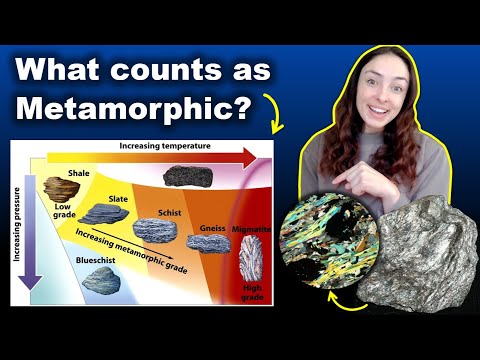
Metamorphic Petrology- Types of Metamorphism, Protoliths, Textures, & Classification | GEO GIRL
Introduction to Metamorphic Petrology
In this section, an introduction to metamorphic petrology is provided, including the definition of metamorphism and the different types of metamorphism.
What is Metamorphism?
- Metamorphism in geology refers to the recrystallization of a rock under high temperature and pressure.
- Different types of metamorphism have varying amounts of pressure and temperature acting on the rock.
- Contact metamorphism is primarily caused by heat, while regional metamorphism involves both heat and pressure.
Different Types of Metamorphism
- Regional metamorphism occurs on a regional scale, typically at plate boundaries or subduction zones.
- Contact metamorphism happens when intrusions of magma come into contact with country rock.
- Other types include burial metamorphism, dynamic metamorphism caused by shear zones, hydrothermal metamorphism from hot fluids, and impact metamorphism from meteorite impacts.
Goals of Metamorphic Petrology
This section discusses the goals of studying metamorphic petrology.
Determining Protolith
- The first goal is to determine the protolith (original rock) before it underwent metamorphosis.
- Understanding whether it was igneous or sedimentary can provide insights into its environment and type of metamorphism.
Determining Conditions
- Another goal is to determine the conditions under which the rock underwent metamorphosis.
- This includes identifying temperature and pressure conditions that influenced its transformation.
Metamorphic Rocks and Protoliths
This section discusses the composition and structural history of metamorphic rocks, as well as how to determine their protoliths.
Determining Protoliths
- Marble is a metamorphic rock that forms when limestone undergoes metamorphism. Its composition is calcitic, made of calcite grains that have become deformed and recrystallized.
- Quartzite typically has a sandstone protolith, as quartz grains are common in sandstone and dominate the recrystallization fabric during metamorphism.
- Nice is the high-grade metamorphic version of granite, containing mostly quartz, feldspar, amphiboles, peroxines, and micas. It becomes banded due to compositional variation.
- Schist is the high-grade metamorphic rock derived from shale, while slate is the low-grade metamorphic rock derived from shale. Shale serves as the protolith for both.
- Coal forms through burial metamorphism and can be classified as a low-grade metamorphic rock. Anthracite coal is an example of coal that has undergone low-grade barium anamorphism.
Textures in Metamorphic Rocks
This section explores the importance of observing textures in determining the structural history and environment of formation for metamorphic rocks.
Primary Textures
- Primary textures form during deposition of sedimentary rocks or crystallization of igneous rocks. In some cases, these primary textures can be preserved in metamorphic rocks if they underwent relatively low-grade metamorphism or if the original rock was sturdy enough to retain them.
Secondary Textures
- Secondary textures are more common in metamorphic rocks and can be classified as either static textures or tectonic textures.
- Static textures refer to minerals that grew or recrystallized without deformation or after deformation, resulting in no regular pattern.
- Tectonic textures are those that grew or recrystallized during or before deformation, leading to smushed, foliated, or pressure-oriented patterns.
The remaining sections of the transcript will be summarized in subsequent chapters.
Understanding Metamorphic Textures and Protoliths
In this section, the speaker discusses how to differentiate between different types of layering or banding in metamorphic rocks and how to identify the protolith (original rock) from which they formed.
Identifying Sedimentary Protoliths vs. Igneous Protoliths
- The presence of stratified sandstone or clayey layers indicates a sedimentary protolith.
- Sedimentary textures are often obliterated during metamorphism, especially in high-grade metamorphism.
- Low-grade metamorphism may preserve some sedimentary textures.
- If high-grade metamorphism is evident, it is more likely that the textures observed are secondary metamorphic or deformation textures rather than primary sedimentary textures.
Distinguishing Relic Igneous Textures
- Tabular feldspar, such as tabular plagioclase or K-feldspar, is a distinguishing relic igneous texture.
- Other primary igneous textures that may be preserved in metamorphic rocks include pillow basalts and vesicles.
- Pillow basalts can retain their primary texture even after alteration or hydrothermal metamorphism.
- Vesicles filled with minerals like zeolite, calcite, epitote, or pranite indicate an igneous protolith.
Preservation of Primary vs. Metamorphic Textures
- Metamorphic rocks often preserve secondary textures caused by metamorphism rather than primary textures.
- Primary textures are typically obliterated by the process of metamorphism.
Static and Tectonic Metamorphic Textures
- Static textures arise from high temperature but relatively low-pressure conditions during metamorphism.
- Grains are typically equant (equal in size) and have dihedral angles around 128 degrees.
- Euhedral crystals with well-defined crystal faces are called ideoblastic crystals.
- Coarse-grained crystals within a finer-grained matrix are called porphyroblasts.
- Tectonic textures develop a crystallographic preferred orientation due to deformation.
- Foliation, schistosity, and lineation are examples of tectonic textures.
Metamorphic Classification
- Metamorphic rocks can be classified based on their structure or composition.
- Structural classification includes terms like granofels (equal granular rock) and hornfels (finer-grained concoidally breaking rock).
- Compositional classification is discussed in the next section.
Structural and Compositional Classification of Metamorphic Rocks
This section explores the structural and compositional classification of metamorphic rocks.
Structural Classification
- Granofels refers to an equal granular rock, but it is not commonly used in metamorphic petrology.
- Hornfels is a fine-grained rock that breaks with conchoidal fracture, similar to glass or obsidian.
Compositional Classification
- Compositional classification complements structural classification in describing metamorphic rocks.
- Different types of terms can be used to describe a metamorphic rock, including both structural and compositional terms.
Conclusion
The speaker provides insights into identifying different types of layering or banding in metamorphic rocks and determining their protolith. They discuss the preservation of primary igneous textures and the prevalence of secondary metamorphic textures. The distinction between static and tectonic metamorphic textures is explained, along with the structural and compositional classifications of metamorphic rocks.
New Section
This section discusses the distinguishing features of different types of metamorphic rocks, such as slate, schist, and gneiss.
Distinguishing Features of Metamorphic Rocks
- Slate is characterized by its cleavage and platy structure.
- Schist has a silky luster and thinner plates compared to slate.
- Phyllite can be distinguished from schist by its less flaky and more hard texture.
- Gneiss is easily recognizable due to its banded appearance resembling granite.
New Section
This section focuses on distinguishing between phyllite and schist.
Distinguishing Phyllite from Schist
- True phyllite is relatively easy to recognize when held and observed closely. It is less schistose and does not flake off like schist.
New Section
This section highlights the unique characteristics of nice as a metamorphic rock.
Characteristics of Nice
- Nice is significantly harder than other metamorphic rocks.
- It does not flake or break easily.
- Nice has distinct banding patterns that make it easily recognizable.
New Section
This section introduces metamorphic rock names based on mineral assemblages rather than structures.
Metamorphic Rock Names Based on Mineral Assemblages
- Green schist: A foliated mafic metamorphic rock with actinolite as its major amphibole.
- Greenstone: A massive mafic metamorphic rock with actinolite as its major amphibole. It lacks foliation like green schist.
- Amphibolite: A mafic metamorphic rock with hornblende as its major amphibole. It has a black and white polka-dotted appearance.
- Blueschist: A mafic metamorphic rock with sodic amphibole as its major amphibole. It gets its name from the blue color of sodic minerals.
New Section
This section continues discussing metamorphic rock names based on mineral assemblages.
Metamorphic Rock Names Based on Mineral Assemblages (Continued)
- Granulite: Not covered in detail.
- Eclogite: Easily recognizable and visually appealing metamorphic rock dominated by green clinopyroxene and red garnets.
- Marble: Derived from limestone, it is composed mainly of calcite or dolomite. Quartzite is derived from sandstone and is dominated by quartz.
- Serpentine: An ultra-mafic metamorphic rock dominated by serpentine minerals.
New Section
This section concludes the discussion on different types of metamorphic rocks.
Recap of Metamorphic Rock Types
- Amphibolite, nice, schist, phyllite, slate are structural terms used to describe different textures and appearances of metamorphic rocks.
- Green schist, greenstone, amphibolite, blueschist are named based on their mineral assemblages.
- Eclogite, marble, quartzite, serpentine are also named based on their composition and protolith.
New Section
The video concludes with additional information about the source material used for the presentation.
Source Material
- The video was created using "The Essentials of Igneous and Metamorphic Petrology" by Ronald and Carol Frost.
- The book is linked in the video description along with other minor references.
- Upcoming videos in the playlist will cover more topics in metamorphic petrology.
The remaining part of the transcript does not contain relevant information for note-taking purposes.