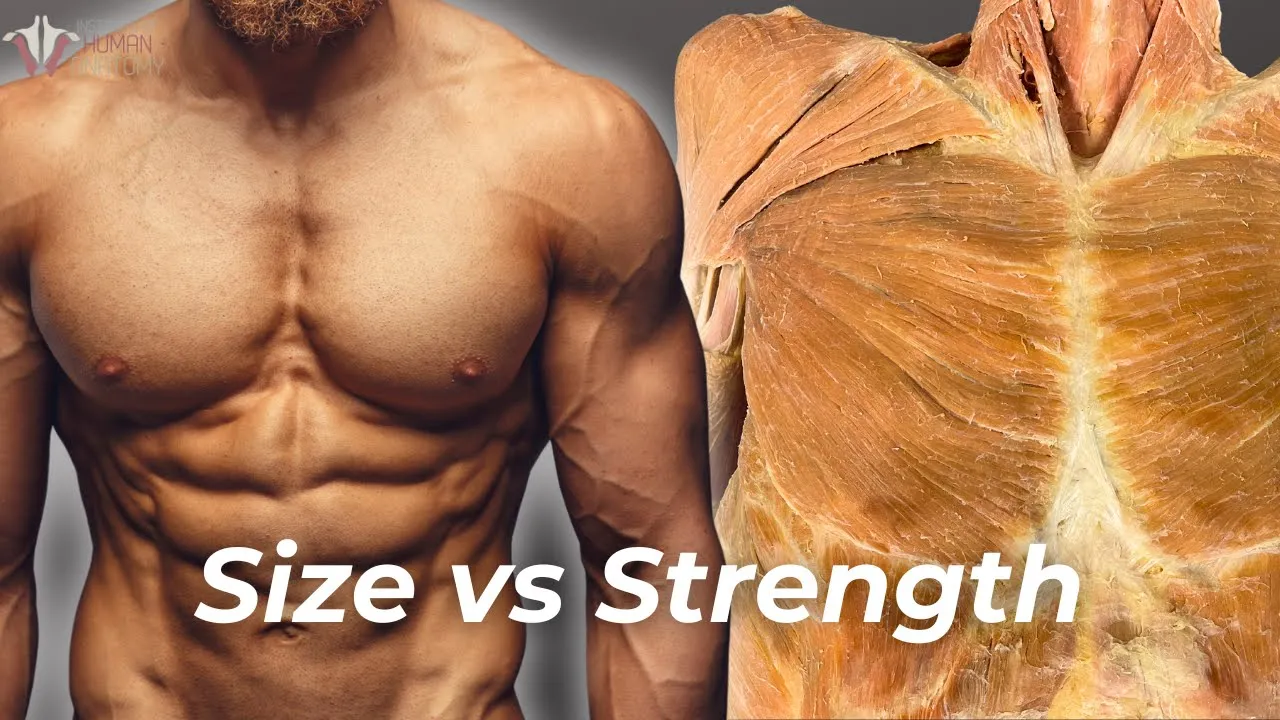
Strength vs Hypertrophy: The Science of Building Muscle
What Happens When You Increase Muscle Size?
The discussion delves into the process of increasing muscle size, exploring training principles and the physiology behind muscle growth.
Types of Muscle Tissue
- Smooth, cardiac, and skeletal muscles are the three main types of muscle tissue in the human body.
- Smooth muscle is found lining organs and operates involuntarily under autonomic nervous system control.
- The uterus contains the largest smooth muscle mass in the body, demonstrating involuntary contractions during processes like menstruation and labor.
Muscle Growth Mechanisms
- Smooth muscle can undergo hyperplasia to increase in size by multiplying cells, unlike cardiac and skeletal muscles that grow through hypertrophy.
Understanding Muscle Tissues
This section delves into the characteristics and functions of smooth muscle, cardiac muscle, and skeletal muscle tissues.
Smooth Muscle Characteristics
- Smooth muscle cells can increase in size through hyperplasia (increase in cell number) and hypertrophy (cell enlargement).
- The inability of cardiac muscle cells to divide poses challenges in clinical scenarios like heart attacks where damaged cells are replaced by scar tissue.
Cardiac Muscle Functionality
- Cardiac muscle tissue is unique to the heart, contracts involuntarily, and has its own pacemaker.
- Unlike skeletal muscles, cardiac muscles cannot be directly controlled voluntarily; they are regulated by the autonomic nervous system.
Skeletal Muscle Attributes
- Skeletal muscles attach to and move the skeleton under voluntary control through resistance training.
Skeletal Muscle Hypertrophy
The discussion delves into the process of hypertrophy in skeletal muscle cells, exploring how they grow and strengthen through various mechanisms.
Skeletal Muscle Hypertrophy Process
- Cardiac muscle cells also undergo hypertrophy by increasing in size and strength.
- Hypertrophy in skeletal muscle cells involves increased production of contractile protein units like myofibrils and sarcomeres.
- Other contributors to hypertrophy include the development of more mitochondria and organelles within the muscle cell.
- Factors such as increased fluid content within the muscle cell contribute to hypertrophy, stimulated by forceful repetitive muscular activity.
- Different training approaches for strength versus hypertrophy depend on goals, intensity levels, rep schemes, and rest periods.
Training Approaches: Strength vs. Hypertrophy
Contrasts between powerlifting routines focused on strength and bodybuilding routines aimed at hypertrophy are discussed, highlighting differences in intensity, exercises, and goals.
Powerlifting Routine
- Emphasizes higher intensity lifts with a higher percentage of one's one-rep max (1RM).
- Involves longer rest periods between sets (3-5 minutes), focusing on compound exercises over isolation movements.
Bodybuilding Routine
- Includes a mix of compound exercises but emphasizes more isolation movements for specific muscle targeting.
- Utilizes lower percentages of 1RM with higher reps (8-15), shorter rest periods (60-90 seconds), and higher overall lifting volume per session for hypertrophy stimulation.
Strength vs. Hypertrophy Adaptations
Explores how strength-based routines differ from hypertrophy-focused ones in terms of physiological adaptations and outcomes.
Physiological Adaptations
- As individuals advance in training, divergence occurs between strength-based routines emphasizing contractile protein unit development and hypertrophic routines focusing on muscle size increase.
Conclusion
Key Takeaways:
- Skeletal muscles undergo hypertrophy through various mechanisms including increased contractile protein production.
- Training approaches differ for strength (powerlifting) versus hypertrophy (bodybuilding), impacting intensity levels, exercise selection, rep schemes, and rest periods.
The Science Behind Muscle Training Methods
The discussion delves into the mechanisms behind strength-based training and hypertrophy, shedding light on how muscle cells adapt to different training methodologies.
Sarcomers and Nervous System Contribution
- Sarcomers produce force within muscle cells.
- The nervous system enhances coordination and recruits more motor units with strength-based training.
- Nervous system adaptation contributes to greater strength in powerlifters.
Hypertrophy and Sarcoplasmic Fluid Increase
- Bodybuilding routines lead to increases in contractile protein units.
- Hypertrophy involves an increase in fluid content within muscle cells.
- Sarcoplasmic hypertrophy results from a disproportionate increase in sarcoplasmic fluid compared to myofibrils.
Muscle Tissue Adaptations: Strength vs. Hypertrophy
Exploring the concept of sarcoplasmic hypertrophy and its implications for strength gains versus muscular size increases.
Understanding Sarcoplasmic Adaptation
- Sarcoplasm is the cytoplasm or inside fluid-containing area of a muscle cell.
- Increasing fluid within the sarcoplasm leads to overall muscle cell size increase.
Training Methodologies: Strength vs. Hypertrophy
Highlighting differences between bodybuilders and powerlifters regarding muscle adaptations and potential reasons behind these variations.
Discrepancies Between Bodybuilders and Powerlifters
- Differences observed in bodybuilders' and powerlifters' muscle adaptations.
- Uncertainty surrounding reasons for sarcoplasmic adaptation discrepancies.
Conclusion: Insights on Muscle Training Methods
Wrapping up key points on strength versus hypertrophy training methodologies, emphasizing the importance of understanding different types of muscle tissue.
Key Takeaways
- Distinction between strength-focused and hypertrophy-oriented training methods clarified.