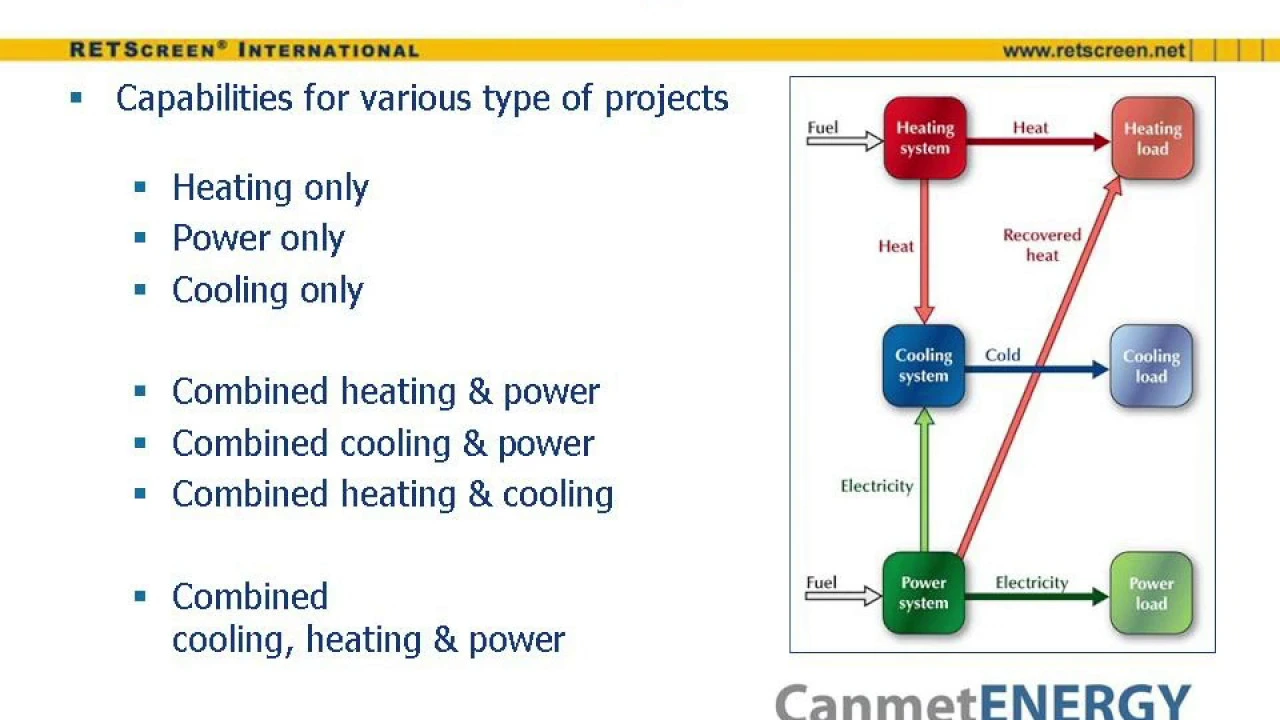
Introduction to Combined Cooling, Heating & Power
Combined Heat and Power Project Analysis
This section introduces the Combined Heat and Power (CHP) project analysis training module of the RETScreen Clean Energy Project Analysis course. It explores the use of CHP systems, their objectives, what they provide, motivations behind CHP systems, and descriptions of equipment and technologies used in CHP systems.
Objectives of CHP Systems
- The objectives include reviewing basics of CHP systems, illustrating key considerations in project analysis, and introducing the RETScreen CHP project model.
- CHP systems provide both electricity and heat, known as cogeneration systems. The electricity can be utilized on-site or fed into the grid.
Benefits of CHP Systems
- Apart from providing heat and power, CHP systems offer increased efficiency, reduced waste, and emissions.
- Distributed generation through CHP developments reduces losses in electricity transmission.
Motivation for CHP Systems
- Electricity generation is inefficient with significant energy wastage as heat. Locating power generation near heat loads improves overall efficiency to 60-90%.
- Financially, high-value electricity production drives the motivation for investing in CHP plants.
Efficiency Improvement Through Waste Heat Utilization
This section delves into the inefficiencies of traditional electricity generation methods due to wasted heat. It highlights how utilizing waste heat through combined heat and power (CHP) systems can significantly improve overall efficiency.
Wasted Heat in Electricity Generation
- Traditional thermal conversion plants globally waste around 25,000 terawatt-hours annually.
- Fossil fuels dominate global electricity generation; enhancing efficiency can yield substantial economic and environmental benefits.
Concept of Waste Heat Utilization
- Waste heat utilization illustrated: inputting 100 units of energy into a system results in only 30 units as electrical energy without waste recovery.
- With a Heat Recovery Steam Generator (HRSG), up to 55 units of useful heat can be extracted from waste streams for heating loads.
Equipment and Technologies in Combined Heat and Power Systems
This part focuses on essential equipment like gas turbines, steam turbines, or reciprocating engines used in combined heat and power (CHP) systems. It explains how these technologies harness waste heat efficiently for power generation.
Components Used in CHP Systems
- Gas turbines, steam turbines, or reciprocating engines are common components that utilize waste heat effectively.
Technology and Waste Heat Recovery in Power Plants
This section discusses the technology of reciprocating engines in power plants, waste heat recovery units, and the utilization of waste heat for various applications.
Technology of Reciprocating Engines
- Reciprocating engines are commonly used in power plants for generating electricity.
- Gasoline-fueled cars and diesel fuel trucks rely on different combustion processes for ignition.
- The expansion of the combusting mixture drives a piston to generate power.
Waste Heat Recovery Units
- Waste heat recovery units collect excess heat from power plants for delivery to heat loads.
- The design of these units depends on the type of power plant and required temperature levels.
- High temperature applications often utilize steam produced from hot exhaust gases.
Utilization of Waste Heat
- Low-grade steam can be obtained from steam turbines or by preheating water using low temperature waste heat.
- Hot water streams can transport waste heat to various applications through heat exchangers.
- CHP plants may include dedicated heating systems like boilers and furnaces for additional heat supply.
Fuel Types and Applications in Combined Heat and Power Systems
This section explores the fuel types used in combined heat and power (CHP) systems, emphasizing their environmental impact, efficiency, and diverse applications.
Fuel Types
- CHP systems operate on a range of fuels including natural gas, diesel, coal, biomass, biogas, and hydrogen.
- Fossil fuels are common but have negative environmental effects; however, CHP is considered a clean energy technology due to its high efficiency.
Biomass as Fuel
- Biomass sources like wood chips, agricultural byproducts, energy crops, and landfill gases are utilized in CHP systems.
- Bagasse from sugar cane refining is widely used in Brazil as a biomass fuel source.
Hydrogen as an Energy Carrier
- Hydrogen serves as an energy carrier produced through various methods including electrolysis or processing fossil fuels.
- It can be combusted or used efficiently in certain types of fuel cells within CHP systems.
Scale and Efficiency Considerations in CHP Systems
This section delves into the scale variations of CHP systems ranging from small-scale setups for individual buildings to large district energy systems serving entire communities.
Scale Variations
- CHP systems exist at different scales catering to single buildings up to whole communities with district energy networks.
District Energy Systems
- District heating involves transporting heated water through insulated piping networks to nearby buildings for space heating or cooling needs during summer months.
Efficiency Advantages
Detailed Overview of Combined Heat and Power (CHP) Systems
The discussion delves into the various components and considerations involved in Combined Heat and Power (CHP) systems, emphasizing the importance of understanding both initial and recurring costs for project success.
Components of CHP Systems
- Initial costs do not encompass recurring costs like fuel, operation, maintenance, equipment replacement, and repair. These recurring costs can be significant.
Factors Influencing CHP Project Success
- Success of a CHP project is influenced by several risk factors:
- Reliable long-term fuel supply is crucial for equipment designed for specific fuels.
- Careful construction management to prevent capital cost escalation.
- Positive correlation between heat/power demand and on-site heat load is necessary.
Optimization Considerations for CHP Projects
- The electricity output should align with on-site consumption; excess electricity may be sold to the grid. Proper sizing ensures sufficient heat output to meet heating base load.
- Relative cost of electricity and fuel significantly impacts financial viability.
- Spark price spread must be positive for financial attractiveness.
- , ,
Applications of CHP Systems in Various Sectors
This section explores diverse applications of Combined Heat and Power (CHP) systems across different sectors such as healthcare, education, commercial buildings, industrial complexes, communities, and agricultural facilities.
Ideal Candidates for CHP Plants
- Single buildings requiring reliable power supply are excellent candidates for CHP plants. Examples include hospitals, schools, commercial buildings, and agricultural structures.
- Cooling provision is also possible through these plants.
District Energy Systems
- Multiple buildings or clusters can be served by a central heating-cooling-power plant. Commonly used in universities, industrial complexes, communities, hospitals evolving into district energy systems.
- Illustrative examples from Sweden and the USA are provided.
Innovative Applications of Waste Materials in CHP Projects
This segment highlights innovative applications where waste materials such as landfill gas or industrial byproducts are utilized effectively in Combined Heat and Power (CHP) projects.
Utilization of Industrial Waste Materials
- Industries with constant heating/cooling demands benefit from CHP developments using waste materials as fuel sources. Example includes utilizing bagasse from sugar cane refineries as a fuel source.
- Diagram showcases how waste heat from gas turbines fulfills industrial heat loads efficiently.
- ,
Analysis Tools for Evaluating CHP Projects
Introduction to the RetScreen Combined Heat and Power (CHP) project model that aids in analyzing energy production lifecycle costs and greenhouse gas emissions globally.
RetScreen Software Features
- The software allows analysis of various power generation technologies/fuels globally with options to switch languages easily.
- Supports metric/imperial units interchangeably enhancing user flexibility during analysis processes.
Energy Calculation Overview
This section discusses the energy calculation process for Combined Heat and Power (CHP) systems using the RetScreen software.
Estimation of Load and Demand Curves
- The user can request the generator to operate at maximum power to meet excess power load or satisfy heat load.
- Initial step involves estimating load and demand curves over a year, varying based on heating, cooling, power generation involvement.
Equipment Characteristics Definition
- Defines equipment characteristics including fuel requirements per unit of load.
- RetScreen calculates energy delivered and fuel consumption based on defined equipment characteristics.
Validation of CHP Model
This part focuses on validating the accuracy and reliability of the RetScreen CHP model through various tests and comparisons.
Model Validation Process
- Independent consultant FVB Energy Incorporated conducted tests to establish model validity.
- Comparison with other models and measured data showed good agreement in steam turbine performance calculations.
Efficiency of CHP Systems
Discusses how CHP systems efficiently utilize heat that would otherwise be wasted, reducing fuel consumption and greenhouse gas emissions.
Benefits of CHP Systems
- CHP systems reduce fuel needed to meet heat and power loads, lowering greenhouse gas emissions.