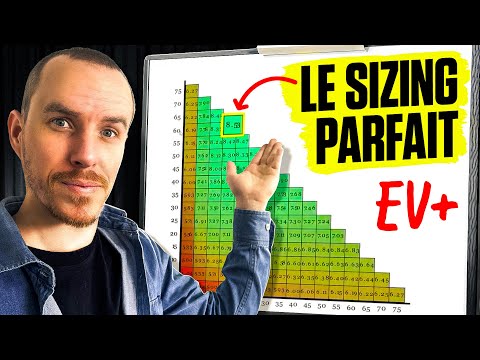
MISE GÉOMÉTRIQUE: La Théorie du Sizing que 100% des pros utilisent
Introduction to Geometric Layout
Overview of the Concept
- The speaker introduces the concept of geometric layout, acknowledging that it may be vague for many viewers.
- Arthur, a professional poker player with over 15 years of experience, aims to clarify what geometric layout means and its strategic effectiveness in poker.
Speaker Background
- Arthur has transitioned from cash games to expressos and has been living off poker for over eight years.
- He emphasizes that the concepts discussed are applicable across various formats including cash games, MTTs, and more.
Understanding Geometric Bets
Definition and Mechanics
- A geometric bet involves betting a consistent proportion of the pot on each street until reaching all-in.
- Example: In a four-blind pot with 14-blind stacks, betting 50% on each street leads to an all-in situation.
Practical Illustration
- If you start with a pot of four blinds and bet two blinds (50%), subsequent bets also at 50% will lead to an all-in scenario.
- In another example with 20 blinds and two streets left, the geometric bet would be approximately 116%, demonstrating flexibility in strategy.
Game Theory Insights
Introduction to Toy Games
- To understand why geometric betting is effective, Arthur introduces simplified poker scenarios known as toy games.
Specific Scenario Analysis
- A hypothetical situation is presented where the hero has specific hands (pairs or three-of-a-kind), illustrating equity dynamics against an opponent's range.
Equity Calculation
- The analysis shows that certain hands have different equities; for instance, strong hands have 100% equity while weaker hands have none.
Understanding GTO Strategy in Poker
Introduction to GTO Strategy
- The speaker aims to explore the Game Theory Optimal (GTO) strategy in poker, particularly when a player is at a disadvantage against an opponent.
- Key questions include what actions the Hero should take on the turn, including betting frequency and sizing when holding different types of hands.
Definitions and Concepts
- The terms "nuts" and "bluff catchers" are introduced:
- Nuts: Unbeatable hands.
- Bluff Catchers: Hands that can win only by bluffing but will lose against nuts.
Methods for Finding GTO Strategy
- Two methods for finding GTO strategies are discussed:
- Using a solver to compute optimal plays.
- Manual calculations, which are feasible in simplified scenarios with clear equity distributions.
Focus on Methodology Over Mathematics
- The speaker emphasizes practical results and methodologies over complex mathematical equations, suggesting that understanding outcomes is more beneficial than delving into intricate calculations.
First Toy Game Setup
- The first toy game involves starting from the river with fixed betting sizes (10 blinds), where the Hero has twice as many R's as nuts while the villain holds only bluff catchers.
- To find equilibrium, two unknown variables (B for Hero's bluff frequency and C for Villain's call frequency) need to be calculated manually.
Calculating Equilibrium Strategies
- It’s established that Hero must always bet with nuts; thus, focus shifts to determining how often he should bluff with R's.
- Solving yields B = 1/4 (bluffing frequency of R's) and C = 1/2 (Villain’s calling frequency).
Expected Value Analysis
- The expected value (V) is visualized through decision trees based on hand strength probabilities.
- Each branch of potential outcomes contributes to calculating V, leading to an average expected value of about 5 blinds for both players despite differing equity levels.
Equity Discrepancy Insights
- Despite having lower equity overall (33% vs. Villain), Hero manages to achieve equal expected value due to strategic play.
- This balance is attributed to Hero’s ability to know his hand strength relative to Villain’s potential holdings—referred to as being "clairvoyant."
Understanding Strategic Advantage in Poker
The Importance of Knowledge in Poker
- A player with 100% equity and a strong hand has a significant strategic advantage, as they are aware of their superior position compared to their opponent.
- Conversely, the opponent lacks information about the situation, only holding bluff catchers, which limits their ability to make informed decisions.
GTO Strategy and Indifference Principle
- The Game Theory Optimal (GTO) strategy allows players to exploit their knowledge advantage effectively.
- To play optimally, the villain must render the hero's bluffs indifferent by ensuring that the expected value (EV) of calling is zero.
Exploring Optimal Sizing
- The discussion shifts towards finding an optimal bet sizing on the river to maximize value for the hero.
- By analyzing various sizings, it was determined that an all-in bet (75 blinds) yields the highest EV for heroes.
Analyzing New Strategies
- With a new all-in strategy, recalculations show a bluffing frequency of 15/34 and a call frequency of 2/17.
- This new GTO strategy results in an impressive EV of 6.27 for heroes despite having only 33% equity against opponents.
Maximizing Value Through Sizing
- The effectiveness of this final bet lies in its ability to force opponents into difficult situations while maximizing potential gains from strong hands.
- A more expensive sizing allows for more bluffs within the range while adhering to GTO principles, ultimately enhancing overall EV.
Betting on Multiple Streets: A New Challenge
Two-Street Betting Dynamics
- Transitioning into a scenario where both turn and river betting are involved introduces complexity; here, specific sizings are fixed at 10 blinds for turn bets and 30 blinds for river bets.
Solving Two-Street Equilibrium
- Establishing equilibrium requires calculating expected values at each street sequentially; this process is intricate but essential for determining optimal strategies.
Resulting GTO Strategy Insights
- The resulting GTO strategy indicates that heroes should always bet their strongest hands on the turn while balancing with some weaker hands leading into river betting scenarios.
Understanding Optimal Betting Strategies
The Advantage of Clairvoyance in Betting
- Being clairvoyant provides a significant advantage, allowing for stronger expected values (EVs) in betting scenarios.
- This advantage enables players to maximize the number of bluffs while maintaining optimal frequencies, leading to a higher value (V) compared to opponents.
Exploring Optimal Sizing
- The discussion shifts towards finding the optimal sizing strategy over two streets, similar to previous toy games.
- While mathematical demonstrations exist, the focus is on visualizing different EV outcomes with various bet sizes rather than delving into lengthy equations.
Evaluating Different Bet Sizes
- Previous findings indicate that betting 10 on the turn and 30 on the river yields an EV of 7.5.
- A potential strategy involves small bets followed by larger all-ins; however, geometric sizing proves most effective.
Geometric Sizing Strategy
- The best strategy identified is betting 15 on the turn and 60 on the river, both representing 150% of their respective pots.
- This approach maximizes value by ensuring opponents face difficult decisions regarding their call frequency.
Maximizing Value through Strategic Betting
- The solution requires bluffing at specific rates: 78% on the turn and 38.5% on the river while maintaining opponent's indifferent responses.
- By including more raises (Rs), players can force opponents into unfavorable positions, increasing overall EV from bluffs.
Importance of Geometric Growth in Pot Size
- Utilizing geometric growth in pot size enhances optimal EV strategies when facing decent calling frequencies from opponents.
- Players should remember that polarized ranges benefit significantly from geometric bets against bluff catcher ranges.
Transitioning to Exploitative Play
- As discussions shift towards practical applications, there's a consideration for exploitative play against non-GTO opponents at lower limits.
Understanding GTO and Exploitative Play in Poker
The Importance of GTO Knowledge
- Players often dismiss the need for Game Theory Optimal (GTO) strategies, claiming they prefer exploitative play. This perspective indicates a misunderstanding of both concepts.
- To effectively exploit opponents, one must understand GTO principles since mistakes are defined relative to GTO strategies.
- Mastering poker requires knowledge of GTO to identify and exploit opponents' errors accurately.
The Complexity of Exploitative Play
- Playing exploitatively is more challenging than adhering strictly to GTO strategies.
- A Nash equilibrium occurs when players optimally exploit each other; however, this exploitation is based on situational advantages rather than mistakes in strategy.
Situational Disadvantages in Poker
- In asymmetrical situations, such as tournament bubbles with varying stack sizes, GTO can maximize exploitation of positional or stack disadvantages.
- For instance, with 60 blinds against an opponent with 15 blinds during a bubble, a solver would recommend aggressive bluffing due to the opponent's precarious position.
Utilizing GTO for Strategic Advantage
- The GTO approach exploits situational disadvantages rather than direct mistakes by opponents.
- An example includes using geometric betting strategies that leverage equity differences to gain significant value over opponents.
Learning from Errors: A Practical Example
- Studying GTO provides tools for exploiting specific situations effectively; players unaware of these may make critical errors despite believing they are playing exploitatively.
- A toy game scenario illustrates how introducing an error (alpha = 0.10), simulating a player who calls too much, can help strategize optimal bluffing frequencies (delta).
Understanding Exploitative Play in Poker
The Concept of Exploiting Opponents
- When a player pays too much, it allows for an exploitative strategy where one can bluff less and focus on value betting to increase their expected value (EV).
- By adjusting strategies based on the opponent's tendencies, a player can raise their EV from 6.7 to 7.68 without bluffing at all.
Risks of Misjudging Opponent Behavior
- If a player incorrectly assesses that their opponent is not paying enough, they may over-bluff, leading to significant losses in EV.
- Even if a player believes they are exploiting an error, they might still end up with lower EV than if they had played optimally (GTO), highlighting the importance of accurate reads.
Importance of Sizing in Strategy
- Proper bet sizing is crucial; using geometric sizing can optimize exploitation and potentially yield even higher EV than previously calculated.
- Understanding GTO strategies enhances one's ability to exploit opponents effectively by providing tools and insights into optimal play.
Studying GTO Strategies
- While studying GTO is beneficial, especially for understanding various strategies, it may not be practical for players at micro limits due to potential misinterpretations.
- Engaging with a coach or strategic videos can help players learn GTO concepts without falling into common traps associated with self-study.
Applying Geometric Alignment in Non-Ideal Situations
Realities of Poker Situations
- In practice, poker situations rarely fit pure theoretical models; hands often have varying equity percentages rather than clear-cut values.
- Players must adapt geometric alignment strategies to real-world scenarios where hand equities fluctuate based on board texture and opponent actions.
Visualizing Equity Concepts
- Understanding how to visualize equity through graphs is essential; these graphs plot range percentages against equity percentages for better decision-making.
- Each combo within a player's range should be placed according to its equity on this graph, aiding in strategic planning during gameplay.
Example Application of Equity Visualization
Understanding Geometric Betting Strategies
Overview of Polarized vs. Bluff Catcher Ranges
- The final graph illustrates a typical situation comparing polarized ranges to bluff catcher ranges, emphasizing the goal of identifying similar scenarios in practical applications.
- Transitioning from theoretical games to real-life situations introduces complexities that challenge straightforward application of strategies.
Real-Life Examples and Their Implications
- An example is presented where the player has 23 blinds, and after a button raise, they encounter a board of 10-3-2 with the opponent checking their entire range.
- A tool is introduced that calculates geometric sizing based on pot size and effective stack; here it suggests a sizing of 59% or 2.7 on the flop.
Analysis of Betting Strategies
- The solver's strategy deviates from geometric sizing, opting for smaller bets (1 or 1.5 times the pot), indicating a lack of polarized hands in play.
- With both players holding various hand strengths, a high-frequency small-bet strategy emerges as effective due to the presence of strong hands across both ranges.
Opponent's Response to Betting
- When betting one blind, opponents must respond by raising their best hands while folding weaker ones, leading to potential bluffing opportunities.
- If an 8 appears on the turn, geometric sizing would suggest betting around 5.4; however, solvers may choose different sizes based on hand strength distribution.
Evaluating River Strategies
- On the river with minimal changes (e.g., drawing a 7), strategies remain consistent despite not being perfect due to mixed hand types present in both ranges.
- The solver’s choice for geometric sizing reflects an approach nearing polarization against bluff catchers but acknowledges complexities beyond simple categorizations.
Exploring Additional Scenarios
Second Example: Adjustments in Strategy
- A new scenario begins similarly with initial raises leading into a board showing 9-6-4 where checks are prevalent among players.
- The GTO strategy involves betting some bluffs alongside strong hands while checking middle-strength hands that possess showdown value.
Impact of Turn Cards on Strategy Dynamics
Geometric Sizing in Poker Betting
Understanding Geometric Sizing
- The geometric sizing for betting is discussed, with specific sizes of 5 blinds on the turn and 16 blinds on the river. The solver primarily uses a sizing of six blinds, indicating a close but not exact adherence to geometric principles.
Analyzing Ranges and Situations
- A scenario is presented where certain cards (like a jack) could lead to an all-in situation. The ranges involved resemble those found in geometric sizing situations, highlighting polarized hands from one player and bluff catchers from another.
Complexity of Turn Situations
- The discussion notes that the turn situation is more complex than previous examples. It emphasizes that while some strategies may appear close to geometric sizing, they do not encompass the entire strategy effectively.
Visual Representation of Ranges
- A diagrammatic approach is introduced to simplify understanding of hand ranges in a given poker scenario (96 45). This visual aid categorizes hands into various groups based on their equity.
Categorization of Hands
- Five categories are established for hand classification:
- Category A: Strong hands like top pairs with over 90% equity.
- Category B: Small pairs (e.g., 6x, 4x).
- Category C: Weak hands with moderate equity (20%-50%).
- Category D: Very weak hands with less than 20% equity.
Solver Strategies for Betting
Distribution of Betting Strategies
- The solver employs several strategies including:
- Overbet strategy.
- Sizing close to geometric.
- Small bet strategy.
Playing Different Hand Categories
- Discussion focuses on how different combos are played within these strategies. For instance, overbets might be used with both strong and moderately strong hands rather than just polarized ones.
Use of Overbets by Solver
- Contrary to expectations, the solver utilizes overbets not only with top pairs but also includes category C hands that possess some equity—indicating strategic depth beyond simple polarization.
Checking Range Dynamics
Composition of Checking Range
- In addition to aggressive betting strategies, there exists a checking range that includes:
- Some strong two pair or straight combinations.
- Category B hands which still hold value against potential bluffs from opponents.
Defensive Strategy Insights
Understanding Polarization in Betting Strategies
The Complexity of Ranges
- The example discussed illustrates a more complex scenario than previously seen, reflecting real-life situations where ranges are not simply polarized.
- In one branch of the decision tree, the solver chooses to polarize its range during an overbet, indicating strategic depth beyond basic polarization.
Strategic Choices and Sizing
- The solver employs different betting sizes: a small bet, a check, and a large geometric sizing bet that leads to polarization of the range.
- The presence of category C hands with some equity suggests that larger bets may be beneficial as they can potentially turn into strong hands.
Reasons for Larger Bets
- Top pairs needing protection might also benefit from larger bets to avoid giving opponents favorable odds on their draws or weak hands.
- Observations indicate that raisers often use slightly higher geometric sizing on turns compared to rivers when dealing with complex ranges.
Key Takeaways on Geometric Betting Strategy
- A significant takeaway is that geometric betting strategies yield excellent expected value (EV), especially when facing polarized versus capped ranges.
- It's important to note that while initial ranges may not be perfectly polarized, players can still achieve polarization through strategic sizing choices.
Mastery and Practical Application
- Mastering optimal frequencies and combo choices is challenging; understanding geometric alignment takes time and practice.
- Even if players do not execute perfect strategies, studying these concepts can lead to improved EV in various scenarios.
Calculating Geometric Sizing
- A formula for calculating geometric sizing is provided; creating an Excel sheet can help visualize effective stack sizes across streets.
Geometric Sizing in Poker
Understanding Geometric Sizing
- The concept of geometric sizing is introduced, highlighting that with specific pot sizes (e.g., three times the pot), players can quickly determine optimal bet sizes. For instance, a pot size of four times leads to a 100% bet size.
- The speaker notes that geometric sizing is often more applicable in certain scenarios, particularly when considering check raises on the flop. In these cases, the solver may suggest a geometric raise size due to polarization between strong and weak hands.
Application of Geometric Sizing
- It is emphasized that while check raises can utilize geometric sizing effectively, it is less common for continuation bets (C-bets) on the flop to follow this pattern. This rarity stems from how ranges develop during play.
- The discussion concludes by explaining how actions taken on the flop can influence hand ranges, leading them to become bluff catchers. This shift makes it more likely for turn ranges to align with geometric sizing principles.
Conclusion