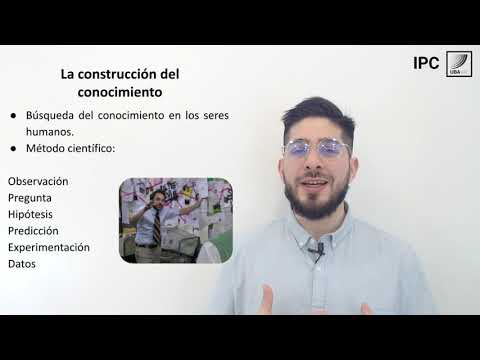
23. IPC (C): Teorías y leyes científicas. El resultado de la construcción del conocimiento
Understanding Knowledge Construction in Science
Introduction to Knowledge Construction
- Agustín Méndez welcomes participants to the session, focusing on knowledge construction within scientific contexts.
- The discussion emphasizes the progression from evidence to the development of laws and theories, highlighting the importance of corroborating hypotheses.
The Scientific Method
- The scientific method is introduced as a rigorous approach for understanding reality through observation and experimentation.
- An example illustrates how humans observe phenomena (e.g., gravity), leading to questions about object characteristics and their influence on behavior.
Formulating Hypotheses
- A specific inquiry into why objects fall when released leads to hypothesis formation regarding gravitational force and variables like mass and distance.
- Predictions based on these hypotheses guide experimental design, aiming to gather data that supports or refutes initial assumptions.
From Hypothesis to Law
- Successful experiments yielding supportive data can lead to the establishment of scientific laws, which describe consistent phenomena but are not absolute truths.
- Laws require extensive prior research and evidence; they evolve over time as new findings emerge.
Theories vs. Laws
- The distinction between theories and laws is clarified: theories encompass broader interpretations supported by multiple hypotheses and verified laws.
- New predictions can challenge existing laws, demonstrating that scientific understanding is subject to change with new evidence.
Importance of Evidence in Theory Development
- Theories are built upon substantial evidence from previous experiments; they represent comprehensive models explaining various observations (e.g., Mendelian genetics).
- Not all scientific concepts become established laws; many remain theories until sufficient evidence solidifies their status.
Misconceptions About Scientific Theories
- Common misconceptions equate "theory" with mere speculation; however, in science, a theory signifies a well-supported framework backed by extensive research.
- For instance, the theory of evolution is grounded in significant empirical support rather than being dismissed as just a theory.
Conclusion on Scientific Understanding
- While theories can be tested and potentially disproven over time, they provide valuable insights into observable phenomena based on accumulated evidence.
Modifications in Scientific Concepts Over Time
Overview of Scientific Evolution
- The discussion highlights that scientific concepts, theories, and laws are subject to change over time, reflecting the dynamic nature of science.
- Historical examples illustrate how scientific understanding has evolved, emphasizing the importance of adaptability in scientific inquiry.
Turn any video into a summary like this
YouTube links, meetings, lectures — with transcripts, search, and chat.