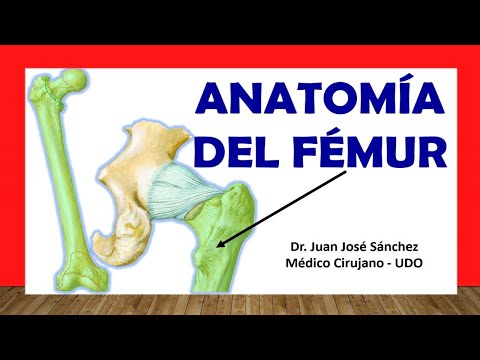
🥇 Anatomía del FÉMUR. Fácil, Rápida y Sencilla
Introduction to the Anatomy of the Femur
In this video, Juan José Sánchez from the University of Oriente in Venezuela provides an overview of the anatomy of the femur, which is the longest and heaviest bone in the human body. He introduces the different regions of the lower limb and emphasizes the importance of studying the femur in medicine.
The Four Divisions of the Lower Limb
- The lower limb is anatomically divided into four parts:
- Pelvic girdle (coxal bones)
- Thigh region (femur)
- Leg region (tibia and fibula)
- Foot region (metatarsals, tarsals, and phalanges)
Focus on the Femur
- The femur is a long bone that plays a crucial role in weight-bearing and transferring weight from the coxal bones to other leg bones.
- It articulates with both the coxal bone at its proximal end and with the tibia and patella at its distal end.
- The femur consists of three main parts:
- Head: A spherical structure that forms part of the hip joint.
- Neck: Connects the head to the shaft (diaphysis) of the femur.
- Trochanters: Prominent bony projections located between the neck and shaft.
Detailed Structure of Proximal Epiphysis
- The proximal epiphysis includes three major portions:
- Head: Approximately two-thirds of a sphere that articulates with the acetabulum of the coxal bone, forming a highly mobile hip joint.
- Neck: A narrow section connecting the head to diaphysis. It is covered by a capsule in most areas but exposed anteriorly.
- Trochanters: Prominent bony elevations located between the neck and shaft.
Understanding the Head and Neck
- The head of the femur is a semispherical structure that fits into the acetabulum of the coxal bone, forming the hip joint.
- The neck is a narrow region connecting the head to the shaft. It is covered by a capsule, which envelops most of it but leaves part of it exposed anteriorly.
Importance of Trochanters
- The trochanters are two prominent bony projections found between the neck and shaft of the femur.
- They serve as important attachment sites for muscles and ligaments.
Conclusion
This section provides an introduction to the anatomy of the femur, highlighting its role in weight-bearing and its articulations with other bones. It also explains key structures such as the head, neck, and trochanters.
Anatomy of the Femur
In this section, the speaker discusses the anatomy of the femur, focusing on the trochanter major and trochanter minor.
Trochanter Major and Trochanter Minor
- The line connecting the trochanter major and trochanter minor is called the intertrochanteric line.
- The intertrochanteric line starts at the trochanter major and has an elevation called the cervical tubercle.
- The intertrochanteric line connects the femoral diaphysis with the neck of the femoral head.
Faces and Borders of Trochanter Major
This section covers the faces and borders of the trochanter major.
Faces and Borders
- The trochanter major has two faces: a medial or internal face that looks towards the neck, and an anterior face that extends forward.
- The borders of the trochanter major are as follows:
- Anterior border (where ligaments attach to the joint capsule)
- Superior border (upper tip)
- Posterior border (towards back)
Capsule Articular Coverage
Here, we learn about how much of the neck is covered by the joint capsule from different perspectives.
Joint Capsule Coverage
- From an anterior view, it can be observed that the joint capsule covers all of the neck through to its connection with intertrochanteric line.
- From a posterior view, only two-thirds of the neck are covered by the joint capsule. The outer third remains uncovered.
Diaphysis Structure
This section focuses on the structure of the femoral diaphysis.
Diaphysis Structure
- The femoral diaphysis has three faces: medial, lateral, and anterior.
- In some regions, there is a fourth face called the posterior face.
- The borders of the diaphysis are:
- External or lateral border
- Internal or medial border
- Posterior border (which bifurcates into superior and inferior branches)
Faces of Diaphysis
Here, we learn about the different faces of the femoral diaphysis.
Faces of Diaphysis
- In most parts of the diaphysis, there are three faces: medial, lateral, and anterior.
- However, in certain regions towards the ends of the diaphysis, there is also a posterior face.
- The central region only has three faces: medial, lateral, and anterior.
Linea Aspera Formation
This section explains how the linea aspera is formed on the posterior side of the femur.
Formation of Linea Aspera
- The linea aspera is formed by two lips that unite in the middle to create a ridge on the posterior side of the femur.
- The internal lip forms part of the linea aspera and is also known as the internal spiral line. It continues from intertrochanteric line towards trochanter minor.
- The external lip forms part of the linea aspera and is a continuation of another line called gluteal tuberosity. It extends from trochanter major to form part of linea aspera.
Crests Supracondylaris Formation
This section discusses the formation of the supracondylar crests on the femur.
Formation of Supracondylar Crests
- The two lips of the linea aspera eventually separate and form two distinct ridges.
- The internal lip forms the medial supracondylar crest, while the external lip forms the lateral supracondylar crest.
- These ridges are also known as condyles, and they give rise to the names of these crests.
Conclusion
In this final section, we conclude with a summary of the different anatomical features discussed.
Summary
- The femur has two trochanters: trochanter major and trochanter minor.
- The intertrochanteric line connects these trochanters and has an elevation called cervical tubercle.
- The trochanter major has faces (medial and anterior) and borders (anterior, superior, posterior).
- The joint capsule covers all of the neck from an anterior view but only two-thirds from a posterior view.
- The femoral diaphysis has three main faces (medial, lateral, anterior) and sometimes a posterior face in certain regions.
- Linea aspera is formed by two lips on the posterior side of the femur. It includes an internal spiral line and gluteal tuberosity.
- Supracondylar crests are formed when these lips separate. They are named medial supracondylar crest and lateral supracondylar crest.
Zona Poplítea del Fémur
In this section, the speaker discusses the popliteal region of the femur and its anatomical features.
Zona Poplítea
- The area between both lips of the linea aspera is known as the zona poplítea or popliteal region of the femur.
- This triangular zone contains the trochanters, with the trochanter major and trochanter minor located at the posterior region.
- The anterior part of this region is called linea intertrocantérea, while at the back it is referred to as cresta intertrocantérea anterior.
- The cresta intertrocantérea presents a square tubercle at this level.
Diaphysis and Epiphysis of Femur
This section focuses on the diaphysis and epiphysis of the femur, highlighting their anatomical structures.
Diaphysis and Epiphysis
- The diaphysis of the femur appears straight in this view but is actually convex forward when placed on a horizontal surface.
- The head of the femur faces forward in anteversion compared to the rest of its structure.
- In the lower epiphysis, there are two prominent condyles - medial condyle (with supracondylar crest) and lateral condyle (with supracondylar crest).
- The patella (kneecap) articulates with the surface above these condyles, while only the posterior part of these condyles articulates with tibia during flexion.
Intertrochanteric Line and Crest
This section discusses the intertrochanteric line and crest of the femur.
Intertrochanteric Line and Crest
- The fosa located between both condyles is called the intercondylar fossa.
- Above this fossa, there is a crest that connects both condyles, known as the intercondylar crest.
- It's important not to confuse the intercondylar fossa with the intercondylar crest.
Angles of Femur
This section covers three important angles related to the femur - angle of rotation, angle of torsion, and angle of inclination.
Angles of Femur
- The angle of rotation is obtained by drawing a horizontal line touching the femoral head and a line along the diaphyseal axis. It measures approximately 10 degrees and allows for internal and external rotation movements.
- The angle of torsion is determined by drawing a line through the neck's longitudinal axis and a frontal line touching both trochanters. Normally measuring between 8 to 15 degrees, it indicates anteversion or twisting of the femur.
- The angle of inclination is obtained by drawing a line along both the diaphysis and neck's longitudinal axes. Typically measuring 125 degrees, deviations from this angle indicate varus (decreased) or valgus (increased) alignment.
Conclusion
In this final section, the speaker concludes their discussion on femoral anatomy.
Conclusion
- The video provides an overview of various anatomical features and angles related to the femur.
- Viewers are encouraged to subscribe to the channel for more videos on related topics.
Timestamps have been provided for each section based on available information in order to create a structured and informative markdown file.
Turn any video into a summary like this
YouTube links, meetings, lectures. With transcripts, search, and chat.