La historia de la tabla Periodica!
History of the Periodic Table
An exploration of the development and evolution of the periodic table, highlighting key discoveries and contributions from various scientists throughout history.
Early Discoveries
- The periodic table's journey began in 1669 when Henning Brand, an enthusiastic alchemist, discovered phosphorus, unknowingly identifying a chemical element. He named it "cold fire," a curious title for a substance derived from urine.
- As new elements were discovered over time, the need to organize them effectively became apparent. This led to various proposals for classification systems.
Development of Classification Systems
- John Dalton introduced a system of symbols to represent elements. Later, Jöns Jacob Berzelius improved upon Dalton's ideas by making them more comprehensible.
- In 1817, Johann Wolfgang Döbereiner observed specific atomic weights among strontium, calcium, and barium. He proposed the Law of Triads, suggesting that groups of three elements had properties where the central element was an average of the other two.
Advancements in Periodic Classification
- By 1862, Alexandre Bain proposed a periodic classification in an elliptical form called "teluric snail," arranging elements based on increasing atomic weights while grouping similar properties together.
- In 1864, John Newlands published his version of the periodic table and introduced the Law of Octaves. This law stated that every eighth element exhibited similar properties when arranged sequentially like musical notes on a staff.
Mendeleev's Breakthrough
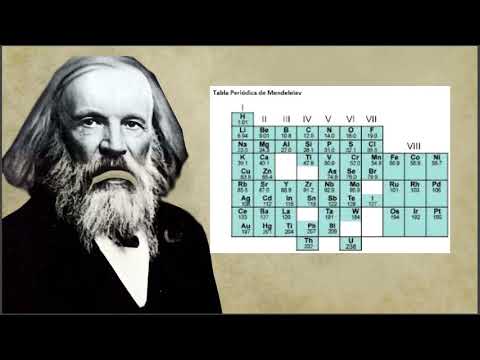
- Dmitri Mendeleev made significant advancements in 1869 by organizing 63 known elements according to their increasing atomic weights into series and groups. His table allowed for predictions about undiscovered elements based on gaps within it.
- Despite its success, Mendeleev’s table required further refinement. The work done by William Ramsay between 1895 and 1898 helped identify noble gases and integrate them into the existing framework.
Final Refinements
- In 1913, Henry Moseley demonstrated that X-ray emissions from atoms could be ordered numerically rather than relying solely on atomic weight as Mendeleev had done. This led to a more accurate arrangement of elements based on atomic number.