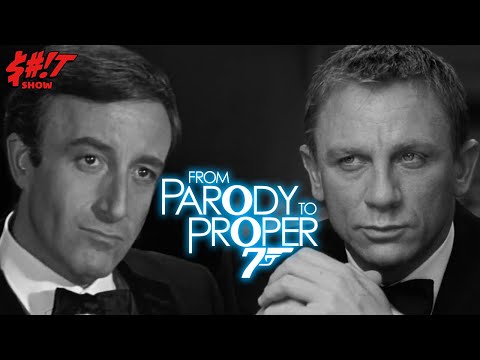
The Making of Casino Royale(s) was a Sh*t Show
Introduction to James Bond Franchise
This section provides an introduction to the James Bond franchise and its history.
The James Bond Franchise
- The James Bond franchise is a series of films that spans six decades and 25 movies.
- It includes trendsetting fashion, badass cars, sex symbols, jetpacks, trips to volcano lairs and space cities, and bad puns.
- The franchise was built on a novel titled Casino Royale by Ian Fleming in 1953.
Adapting Casino Royale
This section discusses the challenges faced in adapting the first James Bond novel for screen.
Challenges in Adapting Casino Royale
- CBS paid Fleming $1000 to adapt Casino Royale for their anthology series Climax! in 1954.
- The one-hour episode starred Peter Lorre as Le Chiffre and Barry Nelson as Jimmy Bond.
- In 1961, President John F. Kennedy revealed From Russia with Love as one of his favorite books of the previous year which led to increased sales of Fleming's novels.
- Canadian producer Harry Saltzman bought the rights of every current and future Bond novel that Fleming wrote (aside from Casino Royale).
- Saltzman partnered with fellow producer Albert Broccoli to form Eon Productions with the sole purpose of making James Bond films.
Plot Summary of Casino Royale
This section provides a brief summary of the plot of Casino Royale.
Plot Summary
- In Casino Royale, Bond is tasked with beating villain Le Chiffre in a card game to reveal a wider conspiracy that includes his love interest.
- CBS adaptation was mildly faithful while hitting mostly same beats.
Thunderball Legal Troubles
This section discusses the legal troubles surrounding the adaptation of Thunderball.
Legal Troubles with Thunderball
- Fleming's navy buddy, Kevin McClory, saw potential in James Bond character and together they started work on a movie script.
- Nothing materialized, so Fleming adapted it into his ninth Bond novel, Thunderball, giving McClory zero credit.
- McClory rightfully sued and won.
Dr. No Production
This section discusses the production of Dr. No.
Production of Dr. No
- Most studios didn’t want to fund the film because it wasn’t ‘American’ enough, but United Artists bet that with a flat one million dollars they could make it happen.
- Saltzman and Broccoli wanted Cary Grant or David Niven to play Bond but cast an unknown Scottish actor Sean Connery due to budget constraints.
- Dr. No released in 1962 and debuted to mixed reactions from critics but was a resounding success with audiences making nearly $60 million worldwide (off that measly one million).
Trademarks Established by Dr. No
This section discusses the trademarks established by Dr. No.
Trademarks Established by Dr. No
- Followed book fairly closely and established many trademarks of James Bond series that continue today; card playing, evil lairs, cars, chases, puns...
- Introduced gun barrel sequence and iconic theme music
The Making of Casino Royale
This section covers the backstory of the making of Casino Royale, including how it came to be made and the challenges faced during production.
Feldman's Preposterous Producing Fee
- Eon Productions initially wanted to work with Charles K. Feldman on producing Casino Royale.
- However, Feldman demanded a preposterous producing fee that Eon could not agree to.
- As a result, Eon ended up negotiating with Kevin McClory to produce Thunderball instead.
A Spoof/Satire of James Bond
- After failing to make a serious adaptation of Casino Royale, Feldman decided to make a spoof/satire of James Bond instead.
- He hired four directors to shoot simultaneously, including John Huston.
- With no official script, they ran with one idea: MI6 would start calling all their secret agents James Bond.
Full House of Talent
- The film featured an ensemble cast including Peter Sellers as a decoy Bond, Orson Welles as Le Chiffre, Woody Allen as nephew Jimmy Bond, David Niven as the original Bond (one of Eon’s choices), and Ursula Andress as Vesper Lynd.
- Production was an embarrassment of riches with lavish sets and a Burt Bacharach score.
Spiraling Out Of Control
- Peter Sellers and Orson Welles were notoriously difficult people to work with and were jealous of each other's success on set.
- Sellers hired Dr. Strangelove co-writer Terry Southern to rewrite only his lines in order to upstage Welles and Woody Allen.
- Everyday turned into passive-aggressive dickishness until Sellers forced Feldman to have them shoot their scenes separately.
Cobbling Together A Narrative
- Eventually Feldman fired Sellers before finishing his scenes due to his erratic behavior on set.
- Woody Allen was given free reign to write his own dialog and the ending was thrown together last minute just to get it all over with.
- Co-director Val Guest had to cobble together a narrative from the mishmash of everything filmed up until that point.
Casino Royale and the Early Bond Films
This section covers the release of Casino Royale in 1967, which was not well-received due to its drawn-out scenes and unrelated nonsense. The section also touches on the ups and downs of the Bond franchise through the next four decades.
Release of Casino Royale
- Casino Royale was released in April 1967 and was a small hit.
- The film is not as funny as it thinks it is, with drawn-out scenes of unrelated nonsense, sex jokes, and excuses for famous people doing walk-on cameos.
- The film wastes all that talent, including Peter O'Toole who has a brief cameo.
Ups and Downs of Bond Franchise
- Eon Productions continued to produce Bond films after Casino Royale but had mixed reviews.
- George Lazenby served her Majesty once to mixed reviews before Sean Connery returned for one more film.
- Roger Moore then played Bond in seven films, reaching peak camp.
- Timothy Dalton suited up for two Eon films before MGM Studios fell into legal madness, causing his contract to expire.
Never Say Never Again and Beyond
This section discusses Never Say Never Again (1983), a non-Eon production that stars an older Sean Connery. It also covers how MGM Studios' legal issues caused Timothy Dalton's contract to expire.
Never Say Never Again
- Kevin McClory produced this virtual remake of Thunderball because he still had the rights to the novel.
- Eon sued McClory to keep it from being made or released but were unsuccessful.
- The film isn't fondly remembered or considered part of the James Bond canon.
Legal Issues and Timothy Dalton
- MGM Studios bought United Artists in 1981, causing legal issues that led to Timothy Dalton's contract expiring.
- The seventeenth Bond film was announced in 1993 after the legal issues were solved.
GoldenEye and Beyond
This section covers how Albert Broccoli passed the torch to his stepson Michael G. Wilson and daughter Barbara Broccoli, who showed that with the right hand (and Pierce Brosnan), James Bond could be timeless. It also touches on how Eon Productions had to reconceive Bond after Die Another Day.
Passing of the Torch
- Albert Broccoli made Michael G. Wilson and Barbara Broccoli the heads of Eon Productions.
- Critics questioned if Bond was relevant after the Cold War ended.
- GoldenEye (1995), directed by Martin Campbell and starring Pierce Brosnan, revitalized Bond for a new generation.
Reconceptualizing Bond
- The three sequels that followed GoldenEye became increasingly more expensive, attempting to up the ante against CG-filled blockbusters.
- Die Another Day (2002) was often pointed to as the pinnacle of Bond absurdity with its invisible car, ice palace, race switching, and surfing a tsunami to outrun a space laser.
- Eon realized they wrote themselves into a corner and had to reconceive Bond from a fantasy style of filmmaking.
Kevin McClory and the Remake of Thunderball
In this section, we learn about Kevin McClory's attempt to remake Thunderball with Sony Pictures and how it was eventually resolved.
Double Down on Another Remake
- Kevin McClory wanted to double down on another remake of Thunderball, this time with Sony Pictures.
- Vesper questions Bond if he is seriously considering going back there.
- Bond responds that he wouldn't dream of it.
MGM Sues and Pays Sony
- MGM sued and won against Sony who owned Columbia for the film rights to Casino Royale.
- At long last, Casino Royale was with Eon Productions.
- Ironically, Sony would purchase MGM outright in 2004, bringing everything under one roof anyway.
Albert Broccoli's Death
- Unfortunately Albert Broccoli died in 1996, never pulling that trump card.
- His daughter saw it as a great time as any to start fresh with James Bond.
Quentin Tarantino's Offer to Make Casino Royale
In this section, we learn about Quentin Tarantino's offer to make Casino Royale and how Eon Productions responded.
An Unlikely Candidate Emerges
- In early 2004, an extremely unlikely candidate emerged asking to make Casino Royale; Quentin Tarantino.
- He started a public campaign trying to get Eon Productions to hire him as the next director.
- He was a massive fan of Brosnan’s Bond and wanted to make a faithful adaptation.
A Faithful Adaptation?
- Tarantino offered a pitch for a period piece set in the 1950s, filmed in black and white, yet still starring Pierce Brosnan.
- Eon couldn't get on board with the idea.
- Tarantino then offered to buy the rights.
Eon Productions' Response
- Eon had been trying to make this film since the 60s and had just gotten the rights to do so; they were not about to throw in the cards after all this time.
- To this day, Tarantino is bitter about being passed up, claiming he was the only reason Casino Royale was made.
The Making of Casino Royale
In this section, we learn about how Casino Royale came to be made.
Brosnan's Contract Ends
- In October of 2004, Brosnan’s contract wasn’t renewed.
- Q asks Bond if he sees that "the writing's on the wall?"
- In February of 2005, Casino Royale was announced as the 21st Bond film.
Inspired by Batman Begins
- Inspired by Batman Begins which was currently in production at that time, Eon took on the idea of reimagining a franchise film starting from scratch and ditching continuity; aka: a reboot.
- If you ever wondered where that craze started look no further than these two films.
Writing an Actual Character Arc for James Bond
- Paul Haggis joined returning screenwriters Purvis and Wade to adapt the book.
- They loved the chance to write the first Bond film with an actual character arc something that James Bond had never experienced in his twenty previous films.
Bringing Back Martin Campbell
- Eon also brought back Martin Campbell to direct because of how well he revamped Bond in GoldenEye.
- The one carryover would be Judi Dench, because...
Barbara Broccoli's Eye on Daniel Craig
- Barbara Broccoli had her eyes on him since 1998’s Elizabeth, as he exuded not just cool confidence but the malice of a trained killer (which would be a stark contrast to his predecessors).
- Craig already feared the loss of anonymity and the curse of typecasting.
Fans' Reaction to Daniel Craig
- The reaction to him earning the role was brutal.
- In what would sadly become the norm, Craig was dragged through the mud by fans who couldn’t possibly accept a blue-eyed, blonde-haired Bond.
Casino Royale: The Road to Reinvention
This section discusses the making of the 2006 James Bond film, Casino Royale, and how it reinvented the franchise.
Daniel Craig's Commitment
- Daniel Craig related to a disconnected, emotionally charged version of 007.
- He used bad press to fuel his performance.
- Craig argued with Martin Campbell's choices to ensure the film was true to that character.
Filming Challenges
- Troubles getting an Aston Martin to flip.
- Difficulty filming an hours-long poker game due to continuity issues and accuracy requirements.
Success of Casino Royale
- Hailed as one of the best Bond films ever made upon release.
- Smart, intense and faithful to the novel, it reinvented James Bond for the 21st century.
- The much-feared Daniel Craig performance showed depths never before seen in 007.
Franchise Record and Legacy
- Raised a franchise record of $606 million worldwide.
- Elevated the series to prestige filmmaking for the first time in its history.
- Modernized and popular again, Craig’s reign alone has amassed over $3 billion.
Future of James Bond
- A new James Bond will always return (in whatever form), as Eon has done five times before.
- After Amazon purchased MGM in 2021, 007 will have to face their first real-world Bond villain; a maniacal, balding billionaire hell-bent on world domination (and beyond).