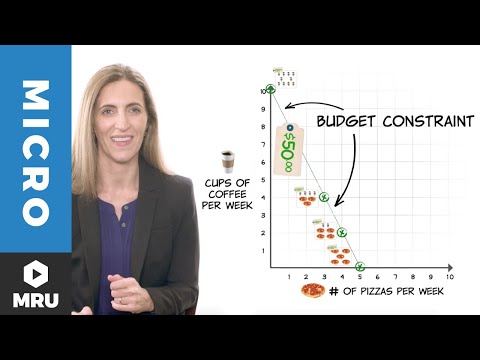
Budget Constraints
Understanding Decision-Making in Economics
The Elements of Decision-Making
- To comprehend how choices are made, it's essential to recognize that not all decision-making elements are within our control. External factors significantly influence prices.
- Prices of goods and services, such as coffee, depend on various variables including culture, demographics, supply and demand, and external costs like rent.
Budget Constraints and Choices
- When given a budget (e.g., $50 for coffee at $5 each and pizza at $10 each), multiple combinations can be plotted on a graph to visualize spending options.
- The budget constraint line illustrates all possible combinations of coffee and pizza purchases within the budget. Options above this line are unaffordable.
Opportunity Cost
- The slope of the budget constraint indicates opportunity cost; for instance, if pizzas cost twice as much as coffee, choosing one pizza means giving up two cups of coffee.
- Changes in income do not affect relative prices; thus, even with an increased budget (e.g., $70), the tradeoff between goods remains constant unless market prices change.
Impact of Price Changes
- If the price of coffee drops from $5 to $2.50 while pizza remains at $10, the relative price shifts dramatically—pizzas become four times more expensive than coffee.
- This shift alters purchasing power significantly; consumers can now buy more cups of coffee without changing their ability to purchase pizzas.
Preferences in Economic Decisions
Turn any video into a summary like this
YouTube links, meetings, lectures — with transcripts, search, and chat.