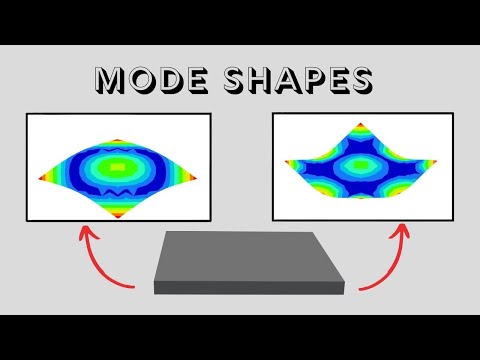
Mode shapes explained and demonstrated
What Are Mode Shapes?
Introduction to Mode Shapes
- The video aims to define and explain mode shapes, derive natural frequencies and mode shapes for a single degree of freedom system, and perform numerical computations for a simple square plate.
Definition of Mode Shape
- A mode shape is described as the instantaneous shape of a structure at a specific natural frequency, representing the relative displacement of all parts during vibration.
Understanding Stationary Waves
- Mode shapes can be likened to stationary or standing waves in one, two, or three dimensions. For example, when plucking a string fixed at both ends, it vibrates at its natural frequency.
Nodes and Antinodes
- In vibrating strings, nodes are points with zero displacement due to destructive interference (e.g., fixed ends), while antinodes are points of maximum displacement resulting from constructive interference.
Nodal Points in Different Dimensions
- Nodes can be conceptualized differently based on dimensionality:
- 1D structures have zero-dimensional nodes,
- 2D structures have one-dimensional nodal lines,
- 3D structures exhibit surfaces as nodal regions.
Natural Frequency Explained
What is Natural Frequency?
- Natural frequency refers to the frequency at which an object vibrates after being given initial excitation; it is crucial for understanding how structures respond dynamically.
Multiple Degrees of Freedom
- Complex structures possess multiple degrees of freedom leading to various natural frequencies and corresponding mode shapes. Each natural frequency has an associated unique mode shape.
Normal Modes and Their Independence
Definition of Normal Modes
- The deformed shape of a structure at a specific natural frequency is termed its normal mode. Each normal mode operates independently from others despite potentially sharing frequencies.
Combination of Modes During Vibration
- When vibrating freely or under forced conditions, the instantaneous shape results from combining all normal modes rather than isolating individual modes during analysis.
Significance of Natural Frequencies and Eigenvalues
Characterization by Natural Frequencies
- Natural frequencies and their corresponding mode shapes characterize the dynamic behavior of structures under loading conditions; only prominent frequencies significantly impact structural response are typically considered.
Role of Eigenvalues and Eigenvectors
Eigenvalues and Eigenvectors in Structural Dynamics
Understanding Eigenvalues and Eigenvectors
- Eigenvalues are crucial for determining the natural frequencies of a system, while eigenvectors define the mode shapes.
- The discussion focuses on a simple single degree of freedom system involving a mass m connected to a spring with stiffness k .
Free Vibration Analysis
- The system is set to exhibit free vibration without external forces or damping, leading to the equation of motion: mx'' + kx = 0 .
- This second-order ordinary differential equation has solutions of the form x = v e^-iomega t , where further calculations lead to an important term.
Deriving Eigenvalue and Eigenvector
- The relationship derived is kphi = mphiomega^2 , substituting omega^2 = lambda , where k is the stiffness matrix, m is the mass matrix, and phi represents the eigenvector.
- Rearranging gives us (k - lambda m)phi = 0. A trivial solution ( phi = 0) is not desired as it indicates no movement.
Non-Trivial Solutions
- To find non-trivial solutions, we equate the determinant of (k - lambda m) = 0. This leads to finding positive real values for eigenvalues ( lambda > 0).
- Once eigenvalues are determined, natural frequencies can be calculated as they are related by taking the square root of eigenvalues.
Matrix Properties and Boundary Conditions
- An n-by-n matrix will yield n eigenvalues and n eigenvectors. Natural frequencies depend on structural properties which may change if boundary conditions are altered.
- Future discussions will explore how changes in structural properties affect both natural frequencies and mode shapes.
Numerical Simulation for Square Plate
Setup for Simulation
- A numerical simulation aims to find natural frequencies and mode shapes for a square plate measuring 100 mm x 100 mm x 2 mm using steel material properties.
Degrees of Freedom Calculation
- The plate is unconstrained allowing movement in all six degrees of freedom: three translations (x, y, z axes), and three rotations around these axes.
- With 121 nodes each having six degrees of freedom, this results in a total degree count leading to a large matrix size (726x726).
Results from Simulation
- After running simulations using block Lanczos method for eigenvalue extraction, results show that first six modes correspond to rigid body motions with near-zero natural frequencies.
Observations on Mode Shapes
Natural Frequencies and Mode Shapes in Structures
Overview of Mode Shapes and Frequencies
- The first mode is identified at 656 Hz, followed by the second mode shape at 944 Hz and the third mode at 1179 Hz.
- The fourth mode occurs at 1656 Hz, with a fifth mode also at 1656 Hz; however, they exhibit different mode shapes despite having the same frequency.
- The sixth mode is noted at 6129 Hz, emphasizing the concept of nodal lines and surfaces within a three-dimensional structure, where certain regions (dark blue areas) show zero displacement.
Nodal Surfaces and Dynamic Behavior
- The seventh mode appears at 2911 Hz, reiterating that both the sixth and seventh modes share the same natural frequency but differ in their respective mode shapes.