CAP 50 3/5: Hipermetropía, miopía y astigmatismo l Fisiología de Guyton
Visión y Errores de Refracción
In this section, the speaker introduces the concept of refractive errors in vision, covering myopia, hyperopia, and astigmatism. They start by discussing emmetropia as normal vision before delving into refractive errors.
Emmetropia - Normal Vision
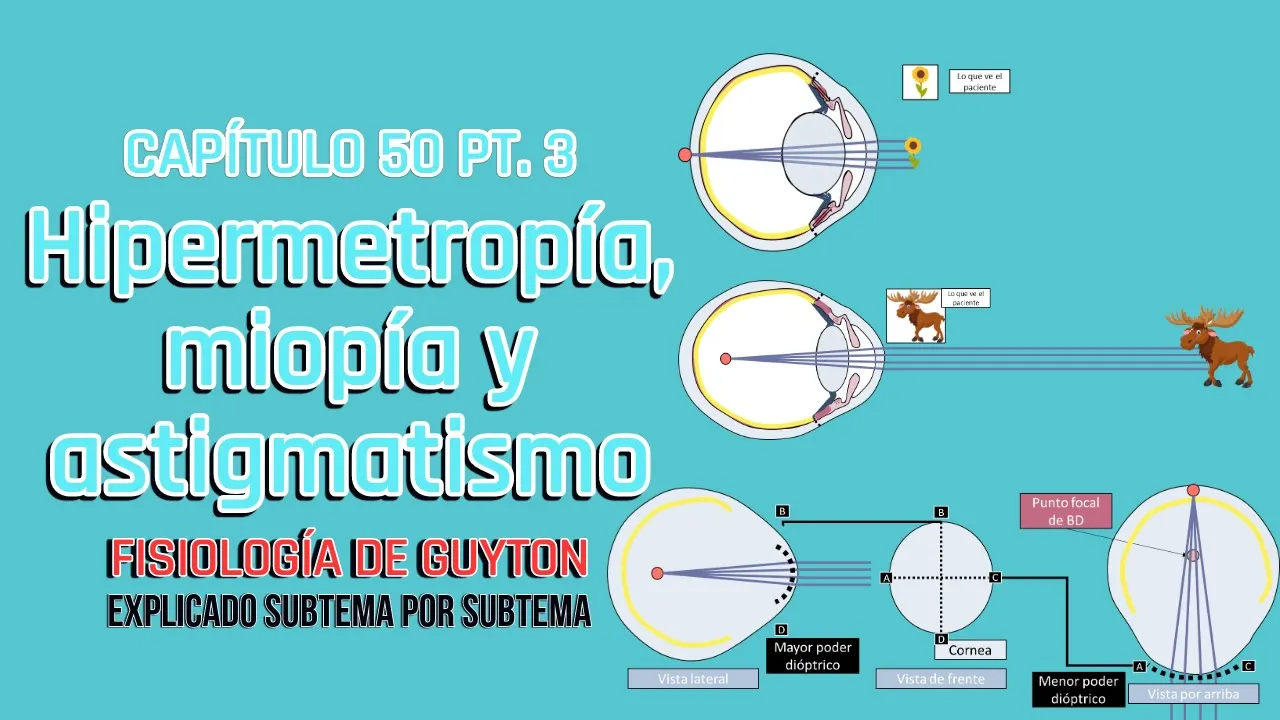
- Normal vision is defined as when parallel light rays from a distant object focus sharply on the retina with relaxed eye muscles.
- In emmetropia, the ciliary muscles are relaxed, allowing clear focus on distant objects like an elk.
- When focusing on near objects, ciliary muscles contract to adjust the lens shape for proper focal point alignment.
Hyperopia - Farsightedness
- Hyperopia occurs when the eyeball is too short or has weak lens power, leading to difficulty seeing nearby objects clearly.
- The eye's accommodation system compensates for hyperopia by adjusting the lens shape to bring distant objects into focus.
- With hyperopia, the focal point falls behind the retina due to the short eyeball length.
Myopia - Nearsightedness
- Myopia results from an elongated eyeball or excessive lens power that causes difficulty in seeing distant objects clearly.
Understanding Vision Disorders
In this section, the discussion revolves around the accommodation system in the eye and how it affects vision disorders like myopia and hypermetropia.
Accommodation System and Myopia (Short-Sightedness)
- When the accommodation system is activated, causing the lens to change shape, it shifts the focal point forward, which is counterproductive for correcting myopia.
- Myopic individuals can see objects closer clearly due to their point of focus being in front of the retina, known as the far point.
- The concept of "seeing in portrait mode" for myopic individuals is illustrated by explaining how distant objects are blurry while closer ones are clear.
Hypermetropia (Long-Sightedness) Correction
- Hypermetropia occurs when the focal point falls behind the retina due to a short eyeball or weak lens power.
- Correcting hypermetropia involves using a convex lens to move the focal point forward onto the retina, enabling clear vision.
Correcting Myopia and Astigmatism
This section delves into correcting myopia through lenses that shift focus forward and explains astigmatism caused by corneal curvature issues.
Correcting Myopia
- Myopia correction involves using concave lenses to diverge light rays before they reach the eye, moving the focal point back onto the retina for distant vision.
- Determining lens power for myopia correction involves trial and error with different diopter lenses based on patient feedback.
Understanding Astigmatism
- Astigmatism results from irregular corneal curvature rather than issues with ocular structures or lenses.
Understanding Astigmatism
In this section, the speaker explains the concept of astigmatism and how it affects vision by altering the curvature of the cornea in different planes.
Explaining Astigmatism
- Astigmatism involves a modification in one of the planes of the cornea, leading to a significant curvature change. This alteration causes the focal point to fall in front of the retina, resulting in blurred vision.
- The misalignment of focal points due to corneal curvature changes affects both vertical and horizontal planes, preventing clear focus on the retina. This dual-plane issue contributes to overall blurriness in vision for individuals with astigmatism.
- In astigmatism, neither near nor distant objects appear sharp due to unfocused light rays hitting the retina. The degree of curvature determines the refractive power, impacting convergence strength for sharper focus.
Correcting Astigmatism
- Treatment for astigmatism involves using cylindrical and spherical lenses. A cylindrical lens deflects light in one plane only, while a spherical lens refracts light across all planes.
- Correction of astigmatism requires both spherical and cylindrical lenses. A convex spherical lens adjusts focal points towards the retina by enhancing convergence. Subsequently, a cylindrical lens is used to correct any remaining plane discrepancies.
Diagnosing and Treating Astigmatism
This section delves into how eye specialists diagnose and treat astigmatism effectively through precise optical corrections using specific types of lenses.
Optical Correction Process
- To address each affected plane accurately, optometrists utilize both spherical and cylindrical lenses. The convex nature of a spherical lens aids convergence adjustment towards achieving focused vision on the retina.
- Optometrists assess correction effectiveness by observing visual clarity improvements post-lens application. Patients experience enhanced sharpness in specific planes after applying appropriate lenses tailored to rectify individualized corneal irregularities.
- Diagnostic confirmation occurs when patients perceive increased clarity in certain visual planes following corrective lens placement. This improvement indicates successful correction alignment with perpendicular reference planes within the eye structure.
- Utilizing concave or convex cylindrical lenses allows optometrists to fine-tune corrections based on whether light refraction needs divergence or convergence adjustments for optimal visual acuity enhancement.
New Section
In this section, the discussion revolves around cylindrical concave lenses and their impact on light rays.
Understanding Cylindrical Concave Lenses
- Cylindrical concave lenses are discussed, emphasizing their shape and orientation.
- "This is a lateral view of the cylindrical lens."
- The interaction between cylindrical concave lenses and spherical lenses is explored.
- Light rays first interact with the cylindrical concave lens before entering the spherical lens.
- Corrective measures involving these lenses are highlighted, focusing on focal points and retinal correction.
- Rays converge at the focal point on the retina for correction.
- Adjustments to correct specific planes are demonstrated through lens positioning.
- Proper placement of cylindrical concave lenses corrects specific planes effectively.
- The role of cylindrical concave lenses in correcting vision by adjusting side parts is explained.
- These lenses aid in correcting various aspects to improve overall vision quality.
New Section
This segment delves into contact lenses as alternatives for refractive errors and discusses their advantages over traditional glasses.
Insights on Contact Lenses
- Contact lenses serve as corrective tools for refractive errors, offering benefits beyond conventional eyeglasses.
- Contact lenses help correct refractive anomalies effectively.
- The impact of contact lens placement on corneal refraction is detailed, particularly in conditions like keratoconus.
- Contact lenses alter corneal refraction, aiding in correcting abnormal corneal anatomy such as keratoconus.
- Advantages of contact lenses over glasses are outlined, including enhanced visual field and minimal dimensional distortion effects.
- Contact lenses provide a wider field of clear vision compared to glasses and have minimal impact on object dimensions.
New Section
The discussion shifts towards cataracts, detailing their impact on vision and treatment options available.
Understanding Cataracts
- Cataracts are defined as opaque areas within the crystalline lens that hinder light passage, leading to visual impairment.
- Cataracts manifest as cloudy regions within the eye's lens affecting light transmission and causing diminished vision capabilities.
- Treatment methods for cataracts involve surgical removal of the affected crystalline lens followed by artificial lens implantation to restore vision functionality.