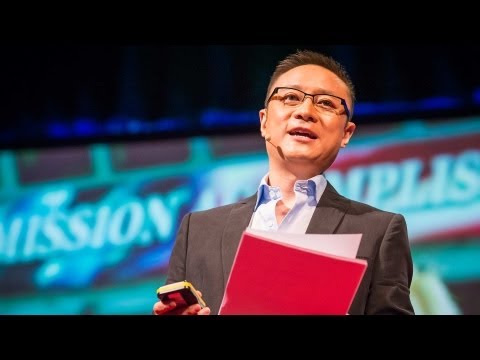
Eric X. Li: A tale of two political systems
The Evolution of Political Narratives
Introduction to Personal Background
- Eric Li introduces himself, sharing his birthplace as Shanghai during the Cultural Revolution, highlighting the tumultuous environment surrounding his birth.
- He recounts a narrative taught in his youth about humanity's linear progression through various societal stages, culminating in communism.
The Meta-Narrative of Progression
- The belief that all societies will eventually unify under communism was instilled in him and many others, reflecting a widespread acceptance of Marxist theory.
- This narrative became deeply ingrained, with one-third of the world's population living under this ideology until significant global changes occurred.
Disillusionment and New Narratives
- As he matured, another grand narrative emerged: societies must transition from traditional to modern structures centered around individualism and democracy.
- This new story posits that rational individuals desire voting rights, leading to good governance and prosperity through electoral democracy.
Global Spread of Democratic Ideals
- Prominent political figures promoted democracy as a universal solution for governance issues worldwide; however, China remained skeptical of this narrative.
- Despite Western narratives suggesting that democracies lead to success while non-democracies fail, China experienced rapid economic growth without adopting democratic practices.
China's Economic Transformation
- Li reflects on China's transformation from poverty to becoming the second-largest economy globally within 30 years, lifting millions out of poverty without elections.
- He questions why this contradicts established political theories which claim one-party systems are inflexible and incapable of adaptation.
Reevaluating Political Assumptions
- Li challenges three dominant assumptions about one-party systems: rigidity, closure, and illegitimacy. He argues these are incorrect regarding China's system.
- Over 64 years, the Chinese Communist Party has demonstrated adaptability through significant policy shifts rather than stagnation or failure.
Institutional Reforms and Self-Correction
- Historical examples illustrate how the Party has self-corrected by enacting new rules like term limits for leaders to prevent power accumulation.
Political Reform and Governance in China
The Necessity of Political Reforms
- Changes in governance are impossible without fundamental political reforms; the Party is suggested to be an expert in this area.
Meritocracy within the One-Party System
- Despite common beliefs, the Chinese Communist Party (CCP) is described as one of the most meritocratic institutions globally, with a significant portion of leaders coming from ordinary backgrounds.
- In the Politburo, only five out of 25 members come from privileged backgrounds, indicating a high level of upward mobility compared to other countries.
The Organization Department's Role
- The Party's Organization Department functions like a sophisticated human resources engine, managing career paths across civil service, state-owned enterprises, and social organizations.
- Officials start at entry-level positions and can ascend through four ranks based on performance reviews that include peer evaluations and public opinion surveys.
Competitive Nature of Advancement
- The competitive nature is highlighted by statistics: in 2012 there were 900,000 candidates for lower levels but only 40,000 for higher ranks. This indicates a rigorous selection process over decades.
- Xi Jinping’s rise exemplifies this system; he took 30 years to reach his position despite being a "princeling," managing vast populations and economies along the way.
Legitimacy Beyond Elections
- Competency is presented as a source of legitimacy for the CCP rather than electoral processes. Historical context shows significant improvements since 1949 under Party rule.
- Public satisfaction rates are high: 85% feel positive about China's direction; these figures challenge Western assumptions about political legitimacy tied solely to elections.
Challenges Facing China
Corruption and Political Systems: A Comparative Analysis
The Impact of Political Systems on Corruption
- The speaker challenges the notion that corruption is solely a result of one-party systems, suggesting that this perspective oversimplifies the issue.
- Transparency International's rankings show China improving in corruption perception, while India, as a democracy, is declining. This raises questions about the effectiveness of electoral democracies in combating corruption.
- Predictions are made regarding China's economic growth and political stability over the next decade, including an anticipated rise in its Transparency International ranking.
Meta-Narratives and Their Consequences
- The speaker critiques meta-narratives that claim universal applicability for political systems, arguing they have failed both historically and currently.
- Emphasizes that China's political model does not aim to replace electoral democracy but illustrates the existence of alternative governance models.
- Calls for an end to dogmatic beliefs about governance, advocating for recognition of diverse political systems rather than a singular path to development.
Civil Society within Different Political Frameworks
- Bruno Giussani raises concerns about unelected authorities defining national interests without oversight in China’s system.
- The speaker introduces "responsive authoritarianism" as a concept reflecting how Chinese governance seeks public opinion through surveys conducted by government agencies.
Turn any video into a summary like this
YouTube links, meetings, lectures. With transcripts, search, and chat.