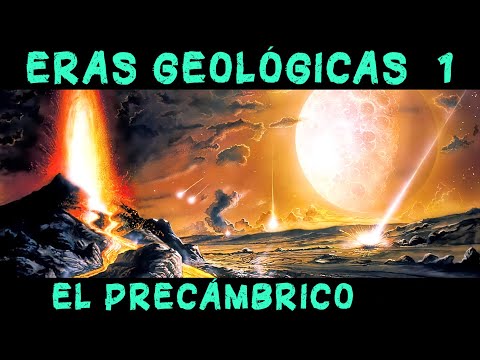
ERAS GEOLÓGICAS 1: El Precámbrico - El origen y la formación de la Tierra (Documental Historia)
New Section
This section provides an overview of the Earth's formation and the impact of a proto-planet called Theia.
Earth's Formation and Theia Collision
- The story takes place between 4.500 million years and 544 million years ago.
- Bilbao will be formed in 4.500 million years.
- The lava ocean is a result of geologic changes during Earth's formation, growth, and maturation.
- At this stage, Earth is an incandescent mass at over 1000°C.
- Theia, a proto-planet, collided with Earth, leading to significant changes.
- According to the Giant Impact hypothesis, Theia's impact threw part of Earth's mass into space, forming the Moon.
- The name "Theia" comes from the Greek goddess who was the mother of Selene, the Moon goddess.
- The collision brought water and other elements to Earth through meteorites.
New Section
This section explores the formation of terrestrial crust and introduces the Precambrian supereon.
Terrestrial Crust Formation and Precambrian Supereon
- Water from meteorites cooled down the lava surface, leading to the formation of terrestrial crust.
- s A supereon is a division in the geologic time scale, and the Precambrian supereon is the first and longest stage in Earth's history.
- The Precambrian supereon represents 88% of Earth's history, lasting for 4,000 million years.
- The Earth went through significant changes during this period, resulting in the current state with trees, woodlands, and animals.
- The Precambrian supereon is subdivided into three eons: Hadean, Archean, and Proterozoic.
- Limited knowledge exists about this time due to the transformation of rocks caused by orogenic cycles.
New Section
This section discusses volcanic activities and the formation of useful components like lithosphere, hydrosphere, and atmosphere.
Volcanic Activities and Useful Components
- Volcanoes erupted during this period, creating mountains, islands, and granite proto-lands.
- s Green seas emerged due to iron excess while red skies were a result of carbon dioxide (CO2) abundance.
- s The Earth had extreme conditions with temperatures reaching 100ºC in the shade and high pressure.
- s This period led to the formation of useful components such as lithosphere (outer crust), hydrosphere (oceans), and atmosphere (layer of gases).
- s Cyanobacteria played a crucial role by producing oxygen through photosynthesis.
New Section
This section explores the impact of oxygen production, the formation of ozone layer, and the changes in weather.
Oxygen Production, Ozone Layer, and Weather Changes
- Cyanobacteria's oxygen production led to a significant increase in oxygen worldwide.
- s 1,800 million years ago, oxygen transformed into ozone when exposed to solar radiation.
- s Tectonic movements joined all continents into one supercontinent called Rodinia.
- s The Cryogenic period within the Proterozoic eon experienced extreme glacial times with a thick layer of ice covering the entire planet.
- s Volcanic activities caused significant changes, including the release of oxygen into the atmosphere.
New Section
This section discusses Earth's stabilization and its readiness to support life.
Earth's Stabilization and Readiness for Life
- In the last years of the Proterozoic eon, Earth's crust and atmosphere stabilized.
- s With fewer earthquakes and tectonic movements, cleaner air, Earth became prepared to support life.
- s Life began with microscopic organisms like bacteria that gradually evolved into more complex organisms.
- s Fossils from this time are scarce due to their soft nature not leaving marks on rocks.
New Section
This section highlights the challenges in finding fossils from Precambrian times.
Challenges in Finding Precambrian Fossils
- Precambrian fossils are rare due to the lack of preservation caused by soft and weak organisms.
- s Fossils, such as dinosaur bones, decompose over time and are replaced by minerals like calcium.
The transcript is in English, so the notes are also provided in English.
New Section
This section discusses the division of the eon into three eras: Paleozoic, Mesozoic, and Cenozoic. It mentions the presence of fish, amphibians, reptiles in the Paleozoic era, dinosaurs ruling the Mesozoic era, and mammals inheriting the planet in the Cenozoic era. The purpose of this channel is to summarize the history of the world from beginning to end.
Division of Eon into Three Eras
- The eon is divided into three eras:
- Paleozoic era:
- Presence of fish, amphibians, and reptiles.
- Mesozoic era: (timestamp not provided)
- Dominated by dinosaurs.
- Cenozoic era: (timestamp not provided)
- Mammals inherit the planet.
Timestamps for Mesozoic and Cenozoic eras are not provided in the transcript.
Purpose of Channel
- The purpose of this channel is to summarize the history of the world from beginning to end.