UD1 Introducción a los sistemas microinformáticos 2
Historical Evolution of Computer Systems
Origins in Mathematics
- The discussion begins with the historical evolution of computer systems, tracing their origins back to mathematics. Early calculations were performed manually due to their complexity, necessitating automation.
Early Mechanical Devices
- The abacus is highlighted as one of the earliest mechanical devices used for calculations over two thousand years ago, followed by more sophisticated machines developed by mathematicians like Pascal and Babbage that could solve complex equations.
Transition to Electronic Systems
- The narrative shifts to the current era dominated by electronics, particularly post-World War II advancements. This period saw a significant development in electronic components which replaced earlier technologies.
Role of Electronics in Computing
- Electronics are described as foundational for modern computing systems, enabling machines to handle electrical signals for processing and storing information through circuits that can perform sequential or simultaneous calculations.
Introduction of Vacuum Tubes
- The vacuum tube is identified as an initial electronic component crucial for switching electric currents. It allowed early computers (1943-1955) to process data through programmed instructions using these tubes.
Advancements in Components
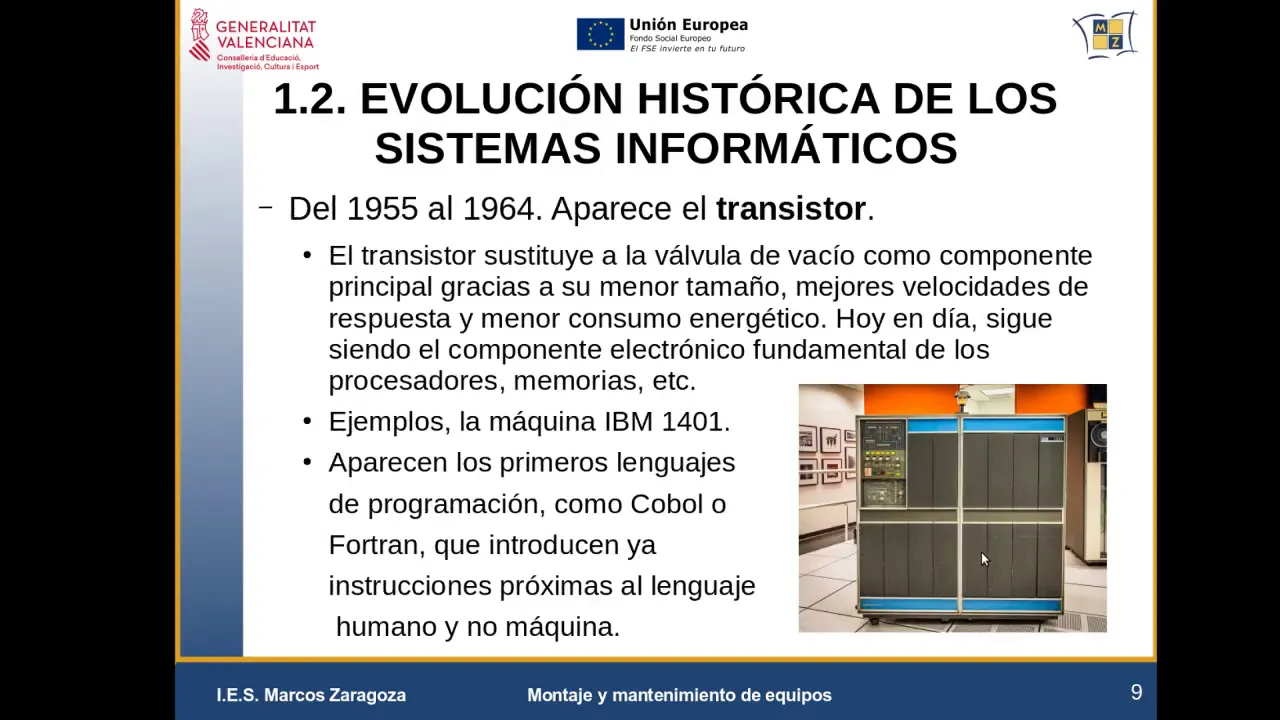
Emergence of Transistors
- Transistors emerged as a significant advancement over vacuum tubes due to their smaller size, faster response times, and lower energy consumption, leading to more compact and efficient machines.
Impact on Machine Size and Functionality
- With transistors allowing for greater integration within computers, programming languages evolved from machine code (binary language) to higher-level languages like Fortran that are more user-friendly.
Microelectronics and Integrated Circuits
Development of Integrated Circuits
- The introduction of integrated circuits marked a pivotal moment in microelectronics. These circuits enabled multiple transistors to be embedded on silicon wafers, significantly reducing size while enhancing functionality.
Silicon's Role as a Semiconductor
- Silicon is emphasized for its semiconductor properties that allow it to conduct electricity under certain conditions. This characteristic is fundamental for creating effective electronic components.
Evolution Towards Microprocessors
Integration into Microprocessors
- By the 1970s, microprocessors began integrating all processor components into single plastic encapsulated chips. This innovation streamlined design and manufacturing processes while enhancing computational power.
Microprocessor Evolution and Market Dominance
Historical Development of Microprocessors
- The evolution of microprocessors began with silicon wafers, leading to the integration of multiple functions within a single chip. Early models like the Intel 4004 laid the groundwork for future developments.
- Motorola's introduction of the 68000 microprocessor was significant, powering early Macintosh computers and contributing to Apple's reliance on Intel technology in modern processors.
Current Market Landscape
- Today, Intel and AMD are the two dominant manufacturers in the microprocessor market, catering to both personal computing and server needs. Intel primarily leads in server markets while AMD is favored for home computing.
Technological Advancements
- Modern processors have evolved to incorporate diverse technologies, allowing for complex circuitry designs. This includes advancements such as 8-bit, 16-bit, and 64-bit architectures.
- Integrated memory within chips has become common, enhancing performance through features like virtualization, overclocking capabilities (Turbo Boost), and QuickPath Interconnect.
Future Challenges and Innovations