ICT Forex Scout Sniper Basic Field Guide - Vol. 8
Introduction
The speaker introduces the final episode of the Scout Sniper Trading series, which is called "Escape-and-Evasion." He explains that this episode will provide a summary and an overview of what viewers should have learned from each individual installment.
Importance of Studying Each Component
The speaker emphasizes the importance of studying each component of the Scout Sniper Trading series individually to understand them intimately. He explains that once all components are understood collectively, it becomes easy for someone to conceptualize it into a trading plan or a process of engaging the market.
- The Time of Day Theory: Viewers should study each individual component, such as the time-of-day theory, which helps traders understand what happens between 2 o'clock and 5:00 a.m. New York time barricades in the London session.
- London Close: Viewers should also study what happens during the London close between 1500 and 1600 GMT.
- New York Open: Understanding what happens during the New York open (12 to 14 hundred GMT) on a daily basis builds an intimate understanding of price action over time.
Feedback and Goals
The speaker discusses his motivations for creating these videos and encourages viewers to provide feedback.
- No Monetization: The speaker does not monetize his videos or sell any information whatsoever. He shares his knowledge out of passion.
- Goal: His goal is to help traders become exceptional by consistently delivering results they aim for. He seeks feedback from new developing traders or folks that have been trading for a long period of time who come on to ICT concepts.
Overview of the ICT Sniper Series Skill Set
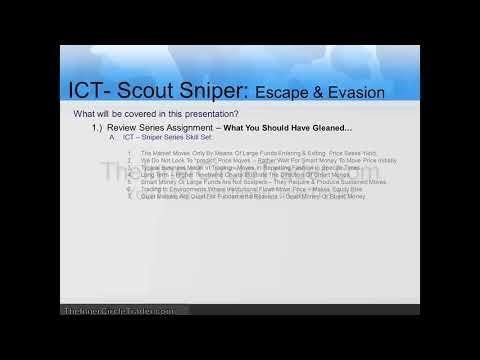
The speaker reviews the Scout Sniper Trading series and discusses the skill set that viewers should have learned.
- Market Movement: Viewers should understand that the market moves only by means of large funds entering and exiting price seeks yield. Where yields are and where yields are moving towards is a catalyst for where future price action will ensue.
- Fundamental Driving Force: Price in itself isn't just simply moving around aimlessly. There is a fundamental driving force behind price action, which we cannot always discern.
- Technical Analysis: Technical analysis is not enough to be successful in trading. It must be combined with an understanding of fundamentals.
- Risk Management: Proper risk management is essential to success in trading.
Understanding Currency Exchange
In this section, the speaker explains how to follow smart money and institutional level trading in currency exchange.
Following Smart Money
- The speaker advises waiting for smart money to move price initially instead of predicting price moves.
- The initial move away from a particular price level indicates fundamental flows being driven by institutional level trading.
- Retail trading cannot move the market, so traders should ride along with large funds and institutional banks.
Generic Business Model
- There is a generic price action theory that unfolds on a daily basis between London to New York and London close.
- Specific moves repeat in specific times of day and specific days of the week, which is attributed to Larry Williams' teachings.
Smart Money Trading
- Long term higher timeframe charts illustrate the direction of smart money.
- Smart money requires sustained moves, so traders need to wait for specific price action before taking action on their retail account.
The Importance of Price Movement
In this section, the speaker emphasizes the importance of price movement in trading and explains why quiet markets are not ideal for traders.
Why Traders Need Price Movement
- Traders need price movement to make profits.
- Quiet markets are usually caused by fundamental reasons such as dead money or street money.
- Professional traders look for specific things in the market before putting on a trade.
- New traders tend to overtrade quiet markets because they have no plan and need to be doing something.
Volatility is Key
- Volatility is a tell-tale sign that someone with more money than you is moving the market.
- Price moves typically in an overall weekly direction, and traders should aim to trade in that direction.
- Cherry setups with high probability low-risk opportunities result from higher time frame analysis and time and price theory.
Optimal Trade Entering
- Entering trades opposite to your intended trade direction is optimal.
- This forces you to trade against the dealer spread much more quickly, which brings you closer to your stop versus waiting for confirmation.
The Dangers of Quiet Markets
In this section, the speaker explains why quiet markets can be dangerous for new traders.
Why Quiet Markets are Dangerous
- Traders need price movement to make profits.
- Quiet markets are usually caused by fundamental reasons such as dead money or street money.
- Professional traders look for specific things in the market before putting on a trade.
- New traders tend to overtrade quiet markets because they have no plan and need to be doing something.
- Even if you implement small stops, they can still get tripped if you're wrong.
The Importance of Volatility
- Volatility is a tell-tale sign that someone with more money than you is moving the market.
- Price moves typically in an overall weekly direction, and traders should aim to trade in that direction.
Optimal Trade Entering
- Entering trades opposite to your intended trade direction is optimal.
- This forces you to trade against the dealer spread much more quickly, which brings you closer to your stop versus waiting for confirmation.
Understanding Smart Money Trading
In this section, the speaker discusses how smart money operates and how retail traders can learn to think differently.
Smart Money Trading
- Smart money buys when prices go down and sells when prices are going up.
- Market makers generally price markets higher to sell into the rally.
- Market makers will generally price markets lower to buy into that drop.
Trading Mindset
- Retail traders should not chase price but understand where it may be trying to get to.
- Stock setups and price patterns should be used to facilitate or execute a trade entry.
- The premise used for trading repeats over and over again, so there is no need to force oneself into a trade or chase it.
Stop Losses and Clean Levels
- Significant price moves are typically seen immediately after stops are rated.
- Short-term highs that have made rallies up to a specific price level but neither one made of any significant sweep above the previous high indicate that levels are clean.
- Double bottom lows can lead to turtle soup scenarios where stops are placed beneath them.
Using Fibonacci in Trade Execution
In this section, the speaker discusses how Fibonacci can be used in trade execution.
Fibonacci Basics
- Fibonacci can be used in trade execution for stop placement and target setting.
- Look for a pullback between the 69% and 79% retracement levels.
- Use swing projections and market structure to define highs and lows for extensions in Fibonacci for price objectives.
Ideal Day Trade Sessions
In this section, the speaker discusses ideal day trade sessions and their unique traits.
London Open
- The London open has specific characteristics that are directly related to the higher low of the daily range.
New York Open
- The New York open typically has a specific characteristic that is in relationship to what takes place during the London open.
- Trading during these time windows or ICT kill zones provides the highest probability to trade when specific market turning points take place.
Understanding High Probability Low-Risk Trades
In this section, the speaker discusses how to identify high probability low-risk trades.
Key Points:
- Look for volatility injections during London and New York open and at the London close. Minor movements occur in Asia.
- Identify key support levels on higher timeframes to understand resistance levels.
- Blend all concepts to define a high probability low-risk trade.
- Trade with controlled risk management and equity management always. Work within a demo account setting until you're confident with your ability to stick to rules and discipline-oriented trading.
- Define yourself as a trader before placing any penny at risk in the market place. Keep your risk exposure very low.
Importance of Risk Management
In this section, the speaker emphasizes the importance of risk management in trading.
Key Points:
- Sound principle-oriented trading concepts are not enough if you over-leverage or over-trade; you will blow your account.
- Assume responsibility and understanding necessary for you as a trader emotionally psychologically before placing any penny at risk in the market place.
- Define yourself as a trader before placing any penny at risk in the market place. Keep your risk exposure very low.
Daily Chart Time Frame Checklist
In this section, the speaker explains what analysis and process is used to study daily charts.
Key Points:
- Look for where yields are because markets seek yield. Where yields are supplied thereto is where price will draw to.
- Understand that 10-year German and USD bond yields are useful. You can also look at European UK rather 10-year bond yield as well.
- Seasonal tendencies are valuable because they help predict when significant price moves are most likely to occur. Utilize seasonal tendencies as a roadmap and have some other technical characteristics behind the idea.
Understanding Market Structure and Order Flow
In this section, the speaker discusses how to analyze market structure and order flow to determine bullish or bearish markets. He emphasizes the importance of looking at weekly and monthly charts periodically.
Analyzing Daily Charts
- Determine current market structure: bullish or bearish.
- Look for market structure shifts and key price swings.
- Determine the type of price swing (long-term or short-term).
- Analyze large funds' actions and order flow to determine price direction.
Using Moving Averages for Directional Bias
- Overlay 9 exponential moving average (EMA) and 18 EMA on daily chart.
- When 9 EMA is greater than 18 EMA, focus on taking long trades.
- When 9 EMA is less than 18 EMA, focus on taking short trades.
Identifying Key Swing Lows/Highs and Reaction Levels
- Highlight high-low open/close prices for each swing low/high as they are sensitive levels where price patterns may form in the future.
- Identify major reaction levels where institutional sponsorship is present. These are areas where price strongly moves away from a particular level.
- Highlight potential order blocks where price will possibly react in similar fashion.
Understanding the ICT 4-hour chart time frame checklist
In this section, the speaker explains how to use the ICT 4-hour chart time frame checklist to analyze and understand market trends and order flows.
Using the ICT 4-hour chart time frame checklist
- All levels and order blocks are carried over to lower timeframes.
- The daily analysis is kept in focus, even when analyzing a 4-hour chart.
- Look for key support levels to stock setups on when daily analysis is in a buy mode, and key resistance levels when it's in a sell mode.
- Look for liquidity candidates as they provide clear highs and lows that can be used as stop-loss orders.
- Coupling order flow with market structure helps identify buying support or selling resistance.
Understanding the ICT 60-minute chart time frame checklist
In this section, the speaker explains how to use the ICT 60-minute chart time frame checklist to analyze short-term views on large funds and/or order flows.
Using the ICT 60-minute chart time frame checklist
- Daily analysis is still kept in focus while analyzing a 60-minute chart.
- Order blocks on both daily and four-hour charts produce high probability setups.
Weekly Perspective on a 60 Minute Basis
In this section, the speaker discusses how to view the weekly perspective on a 60-minute basis and how it can provide a good vantage point for swings.
Viewing Weekly Price Action
- Viewing the weekly perspective on a 60-minute basis will provide a good vantage point for swings.
- Looking at two to three weeks worth of data on a one-hour chart is ideal for understanding where prices are swinging and retracing back into that way you can find what range you're trading within.
- Look for logical levels where retail traders and funds would possibly have their stops resting near again looking for possible liquidity pools before the next significant price advancement or decline use market structure concepts and fibs to stock possible confluences where setups will form.
Risk Management
- Utilizing your fibs on this particular price chart will give you a very dynamic risk-to-reward ratio. Your risk will be very low many times ideally you want to be hunting one two three risk the reward.
- Don't remain hoping to make it as much as three times what you're risking.
Day of the Week Theory
- The day of the week theory is a rough idea where the weekly high or low is likely to form so by implementing that idea with studying the 60-minute chart with a two to three-week vantage point in terms of how much data you have on your chart that will give you an excellent basis to work within.
- If we are bullish and hunting a weekly long set up typically Monday to Wednesday typically, the weekly low is established if we are bearish and hunting a weekly short set up Monday to Wednesday typically the weekly high is established.
Execution View on Large Funds and/or Order Flows
In this section, the speaker discusses how to execute trades based on large funds and/or order flows.
Lower Timeframe Analysis
- The ICT 15 over 50 I'm sorry 15 or 5 minute chart time frame checklist.
- The daily for hour and 60-minute perspective is maintained even while studying price action on the lower timeframe.
- Look for the daily highs to form in sell models between 7:00 GMT and 10:00 GMT.
Asian Range Parameter
- Note the Asian range high and low each day.
- What happens after 5 GMT which is essentially 12:00 midnight New York time my time that's where I classify the new day now one could argue again like I mention in the video course that the new day starts in Wellington, but for now, if you want to look at the market, I consider midnight the new day.
Trading Strategies Based on Time and Price Theory
In this section, the speaker discusses how to use time and price theory to identify high probability low-risk trade scenarios. The speaker explains how to combine time and price theory to hunt inside time windows and within large order blocks found on the 60-minute for our and daily time frames.
Identifying Optimal Trade Entry Points
- Combining time and price theory helps in identifying optimal trade entry points.
- Opposite daily high or low is formed inside the 15 GMT 216 GMT hours London close.
- When time and price Theory overlap trading patterns will form, which could be in the form of an optimal trade entry harmonic pay trading patterns, or even simple diversions.
- Use fibs and swing projections to determine possible price objectives to form risk-to-reward ratios.
- Use fibs to fine-tune entry points inside order blocks with London and New York ICT kill zones.
Using New York Open Session
- If the London setup is missed or you were incorrect and stopped out, you can use 12:00 GMT the 14 GMT do New York open session.
- Avoid New York open setups if daily swings are maturing into key support resistance.
Risk Management
- All trades should be limited to one percent risk of total account balance ideally while learning 0.25 in other words one-quarter of 1% to 1/2 of 1% risk should be the beginning traders parameter.
- Most professionals do not trade with a two percent loss exposure limit.
- If a loss has taken reduced risk and leverage in half until the loss is recouped.
- Focus on 16-minute reaction levels for ideal risk-to-reward ratios, many times 1 2 3 or better.
- You want at least three times what you hope to absorb as a not hope too but if you're willing to take a loss.
Trading Tips
- Do not rush the patterns wait for the setups and the time of day for the highest possible odds.
- You only need to be about 70% of the time to be wildly profitable.
Introduction
In this section, the speaker emphasizes the importance of patience and focus in trading. He also highlights that his concepts are unique and may be overwhelming to some traders.
Importance of Patience and Focus
- Daily and four-hour charts should be used for analysis.
- Stay patient and focused, results will manifest.
- Results may surprise you.
Unique Concepts
- Speaker's price action analysis concepts are unique.
- Some traders find them overwhelming.
Riding a Bike Analogy
In this section, the speaker uses an analogy of riding a bike to explain that there are stages of development in trading. He also emphasizes the importance of having a general understanding before risking money.
Stages of Development
- There are stages of development in trading.
- Before training wheels, one must learn to mount and stay on the bike.
- Advanced level riding requires more skills.
Importance of Understanding
- Having a general understanding is important before risking money.
- Lack of understanding can be dangerous.
Summary of Trading Approach
In this section, the speaker provides a summary of his trading approach. He explains how to use daily, four-hour, and one-hour charts for analysis. He also discusses risk management strategies.
Trading Approach Summary
- Use daily chart for direction; use four-hour chart for agreement with direction; use one-hour chart for optimal trade entry pattern.
- Use Fibonacci retracements and extensions for trade entry pattern.
- Use previous high as first objective to exit with profit; use Fibonacci extensions to take additional profits.
- Buy on Monday, Tuesday or Wednesday when it's bullish; sell when it reverses during London or New York sessions.
Risk Management Strategies
- Risk only 1%, 1/4%, or 1/2% based on understanding.
- Grow money steadily, not exponentially quick.
- Exponential growth can come later when more experienced.
The Importance of Exercises and Understanding Each Component
In this section, the speaker emphasizes the importance of exercises and understanding each component in order to formulate a successful trading plan.
The Speaker's Point
- The speaker believes that even if he were to put his information on the front page of USA Today, it would go largely ignored because it would go right over everyone's head.
- He stresses the importance of going back through the videos, taking pieces of information that arrived at this summary, and formulating them into a successful trading plan.
- By understanding each component and completing exercises, one can have an ICT million-dollar trading plan.
Turn any video into a summary like this
YouTube links, meetings, lectures. With transcripts, search, and chat.