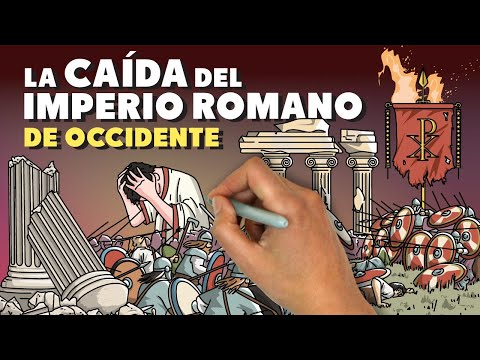
La caída del Imperio romano
Desperate Times in Rome
The transcript delves into the dire situation in Rome in 472 AD, characterized by civil war, starvation, and the decline of a once magnificent empire.
The Fall of Rome
- In 472 AD, Rome is depicted as a city in ruins, with emaciated citizens fighting against barbarian mercenaries amidst bloody civil strife.
- The Roman forces have dwindled to a mere few thousand soldiers compared to the substantial armies of 300,000 soldiers and 23,000 sailors around the year 400.
- Despite its former grandeur, Rome is on the brink of collapse. Historians grapple with over 200 theories to explain the fall of such a powerful empire.
Survival Strategies: East vs. West
Contrasting the fate of Western and Eastern Roman Empires prompts an exploration into what led to their divergent paths.
Eastern Resilience
- While the Western Roman Empire fell, its Eastern counterpart not only survived but thrived for centuries afterward.
- Understanding why the East survived necessitates examining the state of the empire before its downfall in the preceding century.
Prosperity and Growth
A closer look at the flourishing period preceding Rome's decline sheds light on economic prosperity and demographic expansion within the empire.
Flourishing Empire
- By 357 AD, Rome boasted significant population numbers and surpassed other cities like Alexandria and Constantinople in splendor.
- The late first century witnessed substantial growth in agricultural expanses across regions previously considered marginal within the empire.
Economic Boom Across Regions
Various regions within the Roman Empire experienced economic prosperity during this era despite localized declines.
Economic Diversity
- Britain flourished remarkably during this period, becoming densely populated and economically prosperous until centuries later.
Portuarias Barcazas y Molinos en Roma
The transcript discusses the logistical challenges of supplying Rome with food and resources, highlighting the role of officials in distributing provisions during difficult times.
Port Supply Challenges
- Rome faced challenges in transporting food via river Tiber, grinding wheat in mills, baking bread, and distributing food to beneficiaries.
- Despite difficulties like poor harvests or disruptions, the emperor ensured Rome's food supply by importing wheat, oil, and salted meat from regions like Macedonia, Egypt, and Gaul.
- The theory attributing Rome's downfall to socialism through free food distribution and circus expenses is refuted. Only a small percentage of citizens received free food.
Military Strength and Discipline
- Roman soldiers' discipline and continuous training made them formidable warriors rather than their ethnicity or attire.
- The Roman army post-Augustus continued to achieve victories due to effective leadership and recruitment from various provinces.
Composition of Roman Army
- Augustus had a significant number of non-Roman troops in his army compared to later emperors like Theodosius I or Valentinian III.
- The armies of Theodosius I and Valentinian III included federates who were not part of traditional Roman units but had their own leaders.
Role of Christianity in the Roman Empire
This section explores the expansion of Christianity within the Roman Empire and its impact on society during the 4th to 6th centuries.
Spread of Christianity
- By the end of the 1st century, Christianity became the dominant religion within the empire despite internal conflicts that often had political repercussions.
- While Christianity faced internal disputes and grew intolerant towards pagans and Jews, it served as a unifying force under imperial authority until late antiquity.
Influence on Society
- Contrary to claims that Christianity weakened Romans morally or militarily, historical evidence shows increased warfare success during this period compared to earlier centuries.
Economic Disparities in Late Antiquity
This segment delves into economic disparities leading to power struggles among elite Romans and contributing factors that influenced events in the 5th century.
Wealth Concentration
Agriculture and Wealth Disparities in the Roman Empire
The transcript discusses the economic disparities between the aristocracy and the general population in the Roman Empire, focusing on how agriculture and livestock were primary income sources.
Economic Disparities in East vs. West
- In the Western Roman Empire, a small aristocratic group held significant wealth compared to the rest of the population.
- The East had a more balanced distribution of wealth with a larger middle class, including local nobility, free peasants, artisans, and traders.
Attempts to Address Wealth Concentration
- Emperor Majorian's laws aimed to prevent further concentration of wealth among the aristocracy but faced opposition due to their influence in high administration.
Economic Resources and Imperial Power
- The Eastern Emperor had more extensive imperial possessions contributing to greater resources for governance compared to the Western Emperor.
Impact of Elite Greed on Roman Decline
This section delves into how elite greed and power struggles within Rome's ruling class contributed significantly to the empire's downfall.
Elite Selfishness Amidst Crisis
- The relentless pursuit of power by Roman elites exacerbated internal conflicts while external threats from barbarian invasions loomed large.
Misplaced Priorities
- Leaders prioritized political rivalries over defending against invaders like Vandals and Alans in Africa, leading to missed opportunities for survival.
Economic Strain and Military Weakness
- Despite military victories like at Catalaunian Fields in 451, financial constraints hindered troop recruitment, weakening Rome's defense capabilities.
Rome's Desolation and Final Struggles
This segment explores Rome's deteriorating state as it faced repeated sackings by various barbarian groups, highlighting its final moments of struggle.
Devastation of Rome
Oriente vs. Occidente: The Fall of the Roman Empire
The transcript discusses the decline and fall of the Western Roman Empire compared to the survival of the Eastern Roman Empire, highlighting key factors such as territorial losses, internal power struggles, and military control.
Oriente's Survival Strategies
- The Eastern Roman Empire managed to survive for another 1000 years by maintaining better military control through a more equitable distribution of power among five generals.
- In contrast to the West where power was concentrated in one individual, in the East, the emperor retained control over military forces by balancing support from multiple generals.
Internal Power Struggles in Occidente
- In Occidente, power struggles shifted from determining emperors to selecting supreme military commanders, leading to continuous instability and weakening of imperial authority.
- The assassination of Aecio by Valentinian III symbolized how internal conflicts among emperors, senators, and generals contributed significantly to the downfall of the Western Roman Empire.
Spain's Historical Narratives: Fact or Fiction?
This segment delves into Spain's historical narratives, distinguishing between its dark chapters filled with atrocities and a more exaggerated negative portrayal known as "leyenda negra."
Unveiling Spain's History
- Acknowledging Spain's history includes dark episodes like inquisitions, massacres in America, and colonial exploitation without denying these realities.