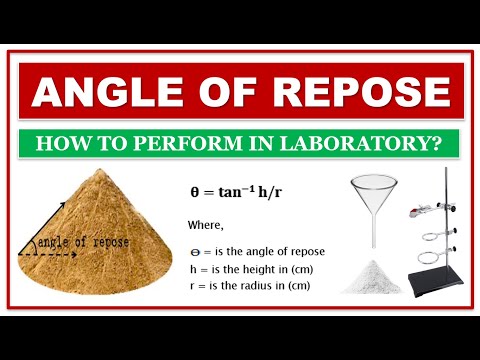
ANGLE OF REPOSE | HOW TO PERFORM IN LABORATORY? DETAIL CALCULATION | IMPORTANCE OF FLOW PROPERTY
Welcome to the Educational Channel
Introduction to Angle of Repose
- The video introduces the concept of the angle of repose, focusing on its significance in understanding powder properties and their behavior in laboratory settings.
- The angle is defined as theta, which relates to the height of a pile formed by powders measured in centimeters.
Understanding Powder Properties
- The diameter and radius are discussed, emphasizing that the angle created between the surface of oil and horizontal planes is crucial for understanding powder behavior.
- The term "angle of repose" is introduced, describing it as the maximum angle between a pile and a horizontal plane when powders are studied.
Importance in Laboratory Settings
- Emphasizes that calculating annual reports (data related to powder studies) is essential during experiments involving different types of powders.
- Mentions resources available through a mobile application for further learning about these concepts, including video lectures and study materials.
Practical Applications
- Discusses how various conditions affect the angle of repose when designing pharmaceutical products like tablets.
- Highlights that different materials yield varying angles under distinct conditions, impacting tablet formulation processes.
Tablet Design Considerations
- Stresses that proper powder studies are critical when formulating tablets; understanding flow properties can influence manufacturing efficiency.
- Explains that during granulation or direct compression techniques, good flow properties ensure uniformity in tablet production.
Machine Efficiency and Powder Flow
- Describes advanced machinery used for tablet production capable of high-speed operations; emphasizes the need for optimal powder characteristics.
- Discusses challenges at punching stations where uniform flow must be maintained to ensure consistent tablet quality.
Overcoming Challenges with Powder Properties
- Details how uniform flow characteristics help prevent issues during tablet formation, ensuring consistent content distribution within each tablet.
- Concludes with an emphasis on maintaining excellent powder properties to avoid problems during manufacturing processes.
Understanding the Angle of Repose in Powder Mechanics
Introduction to Powder Preparation
- The process involves preparing a powder on a surface, focusing on the angle created between the surface and the pile of powder, known as the angle of repose.
- It is essential to understand both the definition and basic concepts related to this angle when performing experiments involving powders.
Experiment Setup
- To conduct an experiment, one can set up an assembly that allows for passing powder through a funnel onto any surface, forming a pile.
- Measurements taken include height and diameter; radius can be calculated as half of the diameter.
Materials Required
- Necessary materials include funnels or plastic panels to hold the powder while ensuring a proper setup with a flat surface underneath.
- A butter paper is recommended for setting up beneath the funnel to collect powder effectively.
Procedure for Measuring Height
- Once set up properly, fill the funnel with powder gradually until it forms a complete pile.
- After completion, measure the height of this pile accurately using appropriate tools.
Observations and Calculations
- The top view reveals how well-defined circles form from falling powder; these circles help determine diameter and radius visually.
- The procedure should be repeated multiple times (three times suggested), allowing for averaging results to minimize errors in measurements.
Averaging Results
- Each trial may yield slightly different radii; thus, calculating an average helps achieve more reliable data.
How to Calculate Values Using a Scientific Calculator
Understanding Basic Calculations
- The value of 5.85 is introduced, with a focus on considering the final output for potatoes.
- Height is defined as 2 cm and radius as 5.8 cm; the formula for theta is presented, indicating calculations involving tennis rackets.
- Emphasis on using a scientific calculator to derive values, suggesting that users can find this tool in laptops or mobile devices.
Utilizing Trigonometric Functions
- Instructions are given on how to access trigonometric functions on the calculator, specifically focusing on calculating inverse tangent (tan⁻¹).
- The calculation yields a result of 19.29 for tan⁻¹(0.35), which is noted as part of the experiment's final results.
Experiment Results and Analysis
- The practical result recorded is slightly different at 19.83; thus, the angle derived from the experiment stands at approximately 19.3 degrees.
- Discussion about excellent material properties leading to report values between 20 and 30, indicating high quality.
Material Properties and Variations
- As properties decrease from excellent to poor, it highlights how variations affect tablet production when creating materials.
- Importance of maintaining consistent powder properties during tablet formation to avoid weight discrepancies in tablets produced.
Final Considerations in Tablet Production
- Evaluation processes must consider powder properties; good quality ensures minimal variation during production.
- Recommendations include using magnesium stearate as a lubricant to reduce friction among powders for better flow characteristics.
Conclusion and Future Learning
- A proper lecture will be designed around these concepts, emphasizing understanding annual reports and calculations related to height and radius.
- Caution against common student mistakes regarding measurements; accuracy in setup is crucial for successful experiments.