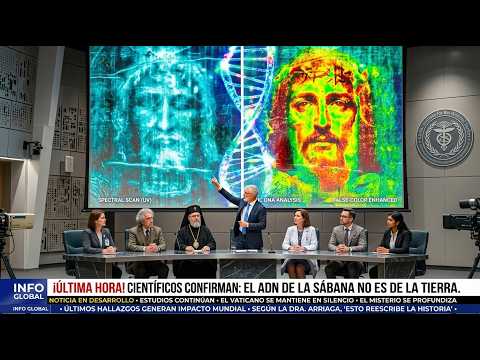
¡El ADN de la Sábana Santa desconcierta a 3 laboratorios… y NO es humano!
The Enigma of the Turin Shroud
Introduction to the Mystery
- The Turin Shroud has sparked decades of research and debate, remaining an enigma for science today.
- Recent genetic analysis from three laboratories revealed that the DNA extracted does not match any known contemporary population, with some genetic signals being ancient lineages that disappeared thousands of years ago.
Unusual Findings in Genetic Analysis
- The DNA structure showed unusual degradation patterns, appearing as if something exploded within each cell simultaneously.
- This investigation began in 1978 when a team of 40 scientists aimed to prove the shroud was a medieval forgery by searching for paint or modern devotional elements.
Initial Investigations and Discoveries
- After extensive inspection, no evidence of painting was found; instead, molecular evidence suggested something more disturbing about the blood on the shroud.
- Barry Schwarz, a technical photographer involved in documenting the findings, initially expected to uncover proof of a fraud but was met with unexpected results.
The Role of Advanced Imaging Technology
- Under intense fluorescent light, faint outlines of a body covered in wounds were visible on the linen.
- Despite thorough examination under various lighting conditions, no traces of pigment or paint were discovered on the fabric.
Breakthrough with VP8 Image Analyzer
- The introduction of the VP8 image analyzer transformed understanding by producing a three-dimensional relief image from flat photographs.
- This technology indicated that every brightness level corresponded to precise distances between the cloth and an underlying body shape.
Implications of Blood Analysis
- Microscopic examination revealed that images existed only on the outermost layer of each fiber; deeper layers remained untouched by any pigment or dye.
- A hypothesis emerged suggesting an intense burst of radiant energy could have caused this superficial imprint without burning the fabric itself.
Forensic Examination and Skepticism
- Over two decades, skeptics pointed out bright red stains resembling fresh blood as potential signs of forgery due to their appearance over time.
- Alan Adler's biochemical analysis challenged these claims by revealing abnormal concentrations indicative of genuine human blood under extreme physical torture conditions.
The Mysterious Blood Stains: A Forensic Investigation
The Nature of the Blood and Its Implications
- When the liver collapses, it releases bilirubin into the bloodstream, which binds to hemoglobin, creating a permanent reddish stain that signifies violent death.
- Molecular profiling reveals human components such as hemoglobin and albumin, alongside over a hundred marks consistent with Roman flagellation, indicating severe physical trauma.
- Evidence of puncture wounds from both wrists and an open chest wound suggests the use of a Roman soldier's spear, pointing to historical violence.
- The blood initially penetrated the fabric before an image formed around it; areas stained with blood lack any corresponding image detail.
- This phenomenon raises questions about what energy source could create a three-dimensional photographic effect without direct contact.
Genetic Analysis and Historical Context
- Advanced sequencing technology aimed to extract genetic material from fibers but expected contamination instead revealed markers from South Asia, North Africa, and ancient Near East populations.
- Contrary to expectations for European origins in medieval forgeries, genetic signatures align more closely with ancient Near Eastern demographics.
- DNA degradation patterns observed were not typical; they indicated catastrophic biological trauma rather than natural aging processes.
- Results replicated across three independent laboratories led to skepticism within the scientific community due to their unexpected nature.
- Despite rigorous testing and recalibrations confirming findings, no alternative explanations or refutations have emerged from scientists.
Ongoing Mysteries and Unanswered Questions
- As technology improves in precision and imaging quality, complexities surrounding this artifact increase rather than diminish.
- The inability to replicate or fully understand the fabric's properties suggests it was designed for revelation only when appropriate tools are available.
- Barry Schwarz’s journey shifted from debunking myths to uncovering evidence that hints at something transcendent beyond mere forgery.
- The presence of bilirubin indicates prolonged torture; combined with ancient DNA evidence points towards significant historical events yet unexplained by modern science.