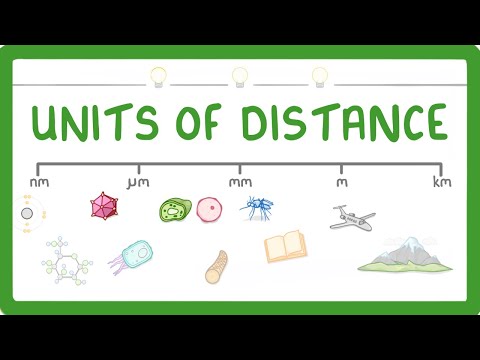
GCSE Biology - How to convert between nm, um, mm, m and km #4
Understanding Units of Length and Their Conversions
Introduction to Units of Length
- The video introduces various units of length, focusing on conversions between them, including nanometers, micrometers, millimeters, meters, and kilometers.
- Each unit is explained as being 1,000 times larger or smaller than the adjacent unit (e.g., a kilometer is 1,000 times bigger than a meter).
Converting Between Units
- To convert from a smaller to a larger unit (e.g., mm to m), divide by 1,000 for each place moved up the scale. For example:
- Converting 6 mm to meters involves dividing by 1,000 resulting in 0.006 m.
- Conversely, converting from a larger to a smaller unit requires multiplying by 1,000 for each place moved down the scale (e.g., converting mm to micrometers).
Practical Conversion Examples
- Example conversion:
- From 6 mm to micrometers: 6 times 1000 = 6000 µm.
- When converting non-adjacent units (e.g., nanometers to millimeters), it’s easier to convert through intermediate units.
Size Comparisons of Common Objects
- Provides context on sizes:
- Atoms range from about 0.1 to 0.5 nanometers.
- Medium-sized molecules like glucose are approximately 1 nanometer across.
- Bacteria are around 1 micrometer, while most animal and plant cells range from 10 to 100 micrometers.
Visualizing Scale with Microscopes
- The human eye can see objects down to about 100 micrometers, equivalent to the width of human hair.
- With light microscopes, visibility extends down to about 500 nanometers, while electron microscopes can visualize down to approximately 0.1 nanometers.
Understanding Centimeters in Context
- Centimeters sit between millimeters and meters; there are:
- 10 mm in 1 cm,
- 100 cm in 1 m.
- Example conversion from centimeters:
- Convert 30text cm:
- First multiply by 10: 300 text mm,
Turn any video into a summary like this
YouTube links, meetings, lectures. With transcripts, search, and chat.