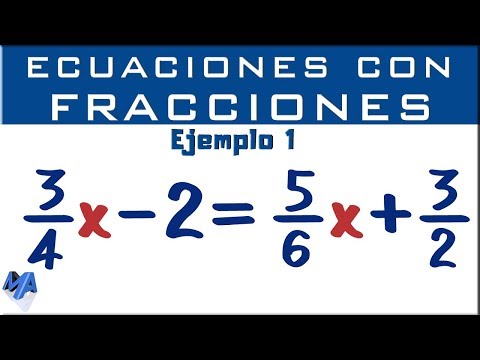
Cómo solucionar ecuaciones de primer grado con fracciones | Ejemplo 1
How to Solve First-Degree Equations with Fractional Numbers
Introduction to the Course
- The course focuses on solving first-degree equations, specifically those involving fractional numbers.
- The instructor emphasizes that there are various methods for solving these equations but will present what they consider the simplest method: converting fractions into whole numbers.
Finding the Least Common Multiple (LCM)
- To convert fractions into whole numbers, the first step is to find the least common multiple of the denominators involved.
- An example is provided where denominators 4, 6, 20, and 15 are factored down to their prime components to determine their LCM.
Multiplying by the LCM
- Once the LCM is identified (in this case, 4), all terms in the equation are multiplied by this number.
- This multiplication aims to eliminate denominators from the equation entirely.
Simplifying Fractions
- The instructor explains how simplification works when multiplying fractions; for instance, reducing a fraction like 6 times 5/2 .
- If numerators and denominators share common factors, they can be canceled out during simplification.
Transforming Equations
- After simplification, only whole numbers remain in place of fractions. For example, 3x + 10 = -11.
- The next steps involve rearranging terms so that all variables are on one side and constants on another.
Solving for x
- The process continues with moving terms across the equals sign while changing their signs accordingly.
- A detailed explanation follows about combining like terms and performing arithmetic operations correctly.
Second Example: Handling Mixed Fractions and Whole Numbers
Identifying Denominators Again
- In this second example, both fractions and whole numbers appear in an equation requiring similar treatment as before.
Finding LCM for New Denominators
- The instructor finds the least common multiple again among new denominators (2 and 6), emphasizing that every term must be multiplied by this LCM.
Solving Equations Step-by-Step
Multiplying Terms by a Common Factor
- The process begins with multiplying all terms of the equation by 6 to eliminate fractions, ensuring uniformity across the equation.
- Emphasis is placed on simplifying correctly; only numbers in the numerator and denominator can be simplified together. For instance, one cannot simplify two numerators directly.
- Further simplification involves reducing 6 and 2 by their greatest common divisor, resulting in simpler coefficients for subsequent calculations.
Rearranging and Combining Like Terms
- After simplification, the equation transforms into a more manageable form: 9x + 12x = 21 - 5. This step highlights how to combine like terms effectively.
- The rearrangement of terms is crucial; moving constants across the equals sign changes their signs. This principle is fundamental in solving linear equations.
Finalizing the Solution
- The final steps involve combining all x terms to isolate x on one side of the equation. Here, 21x = 26, leading to x = 26/26.
- A practice exercise is introduced for viewers to apply what they've learned about finding a common multiple and simplifying equations.
Practice Problem Breakdown
- The example problem illustrates finding the least common multiple (LCM) of numbers involved (4 and 8), which aids in simplifying fractions within an equation.
Turn any video into a summary like this
YouTube links, meetings, lectures — with transcripts, search, and chat.