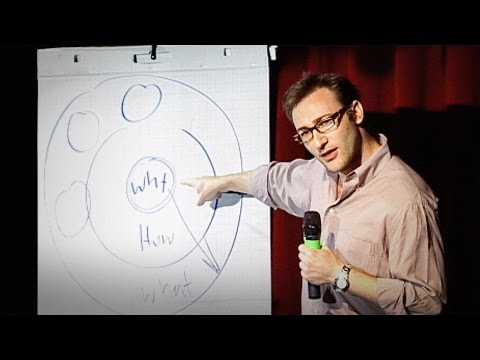
How Great Leaders Inspire Action | Simon Sinek | TED
How Do We Explain Exceptional Success?
The Mystery of Innovation and Leadership
- The speaker poses questions about why certain individuals or organizations achieve extraordinary success despite similar resources as their competitors, using Apple as a primary example.
- He highlights Martin Luther King Jr. and the Wright brothers as examples of leaders who succeeded against odds, suggesting there is a deeper reason behind their achievements.
- A significant discovery was made regarding a common pattern among inspiring leaders and organizations: they think, act, and communicate differently than others.
Understanding the Golden Circle
- The concept of the "Golden Circle" is introduced, consisting of three levels: Why, How, and What. Most people know what they do; some know how they do it; very few understand why they do it.
- The "why" refers to an organization's purpose or belief rather than profit. This understanding shapes how organizations communicate and operate.
Inside-Out Communication
- Inspired leaders communicate from the inside out (starting with "Why"), contrasting with most who communicate from the outside in (starting with "What").
- An example is provided comparing typical marketing messages to Apple's approach. Apple emphasizes its core beliefs before discussing its products.
People Buy Why You Do It
- The speaker asserts that consumers are more inclined to buy based on an organization’s beliefs rather than just its products or services.
- Despite being a computer company, Apple successfully sells various products because customers resonate with its underlying philosophy.
Biological Basis for Decision-Making
- The discussion shifts to biology, explaining that human decision-making correlates with brain structure—rational thought resides in the neocortex ("What") while feelings like trust reside in the limbic brain ("Why").
Understanding Decision-Making and Belief Systems
The Role of Emotion in Decision-Making
- People often express decisions based on feelings rather than facts, indicating that the limbic brain governs decision-making, not language.
- The limbic brain influences behavior without conscious understanding, leading to actions driven by emotional responses.
Selling Ideas vs. Products
- Successful selling is about connecting with those who share your beliefs rather than merely meeting needs; loyalty stems from shared values.
- Hiring should focus on belief alignment over mere capability; employees who resonate with a company's mission will invest more effort.
Case Study: Wright Brothers vs. Samuel Langley
- Samuel Langley had resources and connections but failed because his motivation was wealth and fame, unlike the Wright brothers' purpose-driven approach.
- The Wright brothers lacked funding and formal education but were fueled by a vision to change the world through flight.
Motivation and Success
- The Wright brothers' team worked passionately due to their shared belief in their cause, contrasting with Langley's paycheck-driven workforce.
- Langley's failure to adapt after the Wright brothers' success highlights that motivation rooted in personal gain can lead to quitting when faced with challenges.
Attracting Like-Minded Individuals
- Understanding the law of diffusion of innovation is crucial for achieving market acceptance; early adopters are key to tipping points in popularity.
- Businesses often misinterpret customer conversion rates; true engagement comes from identifying those who inherently "get it" before transactions occur.
Crossing the Chasm
- Innovators and early adopters make intuitive decisions based on beliefs rather than just product availability; they drive initial market interest.
Understanding the Law of Diffusion of Innovation
The Importance of "Why" in Business
- People are motivated by beliefs about the world and how they want to be perceived; they prioritize "why" over "what."
- A commercial example illustrates this: TiVo, despite being a high-quality product with great funding, failed commercially.
- TiVo's marketing focused on features rather than connecting with consumer beliefs, leading to skepticism and lack of demand.
- If TiVo had framed their product around personal empowerment and control, it might have resonated better with potential customers.
Successful Example: Dr. Martin Luther King Jr.
- In contrast to TiVo, Dr. King's success stemmed from his ability to communicate beliefs rather than just demands for change.
- His message attracted 250,000 people not for him personally but because they identified with his vision for America.
- Dr. King emphasized belief in higher moral laws versus man-made laws, which inspired collective action beyond racial lines.
Transforme qualquer vídeo em um resumo como este
Vídeos do YouTube, reuniões, aulas. Com transcrição, busca e chat.