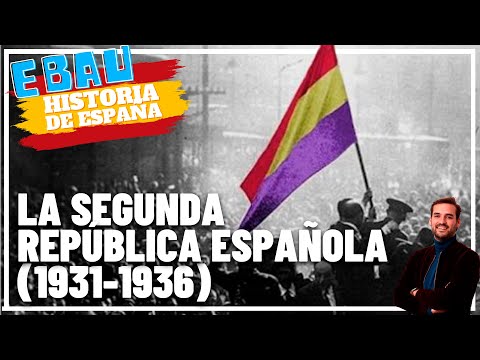
LA SEGUNDA REPÚBLICA ESPAÑOLA (1931-1936) | Historia de España 🇪🇸
Spanish Second Republic: Historical Context
The discussion delves into the historical significance of the Second Spanish Republic, highlighting its impact on contemporary Spanish society and politics.
The Legacy of the Second Republic
- The Second Spanish Republic remains a prominent topic in contemporary discourse, with frequent mentions in media and political arenas.
- Commemorating the 90th anniversary of the Proclamation of the Second Republic sparks debates and reflections among political leaders.
- Despite differing perspectives, the legacy of the Second Republic endures due to its attempts at modernization and democratic values.
Significance and Controversies
- The Second Republic symbolizes both aspirations for progress and divisions within Spanish society.
- Political shifts following Berenger's resignation led to the establishment of a provisional government under Alcalá Zamora.
Establishment of the Second Republic
This segment explores the events leading to the proclamation and early governance of the Second Spanish Republic.
Proclamation and Initial Challenges
- Following Alfonso XIII's departure, leaders signed the San Sebastián Pact, proclaiming the Second Republic on April 14, 1931.
- The provisional government aimed to hold constituent elections while facing social tensions, including conflicts with religious institutions.
Constitutional Developments
- The Constituent Cortes worked towards drafting a progressive constitution emphasizing popular sovereignty and civil liberties.
- Key features included universal suffrage, rights such as divorce and education, regional autonomy provisions, and secular state principles.
Reforms Under Azáña's Government
This section focuses on Manuel Azáña's reformist agenda during his tenure as President of Spain.
Military Reforms
Spanish Republic Reforms Overview
This section discusses the reforms implemented by the Spanish Republic government, focusing on military, education, agrarian reform, and religious matters.
Military and Education Reforms
- The military personnel had to show loyalty to the republican regime. The Military Justice Council was abolished to place the army under government control. Military education was linked to universities, and the Zaragoza Military Academy was closed.
- The duration of compulsory military service was adjusted based on recruit training needs. Significant agrarian reform projects were presented and one approved in September 1932.
Agrarian Reform Complexity
- Thirteen categories of land expropriation with compensation were established. Noble-owned lands were expropriated without compensation. The complexity of these reforms led to frustration among peasants, pushing some towards radicalization or rebellion.
Religious and Educational Changes
- Efforts were made to reduce Catholic Church influence in Spanish society. Teaching by religious orders in schools was prohibited, cemeteries came under municipal control, and church funding decreased over two years.
- Religious institutions were required to register in 1933 with limited property ownership rights. Church involvement in education decreased; religious studies became optional while school construction and teacher hiring programs were initiated for a friendly co-ed environment.
Labor Reforms and Autonomy Movements
This section delves into educational improvements as a key goal of the new republican regime along with labor reforms favoring workers' positions and unions. It also touches upon autonomy movements like those in Catalonia and Basque Country.
Educational Enhancements
- Education improvement was a prime objective of the republican regime. Labor Minister Largo Caballero advocated various labor reforms supporting workers' rights within a republic self-proclaimed as "a workers' republic" constitutionally.
Autonomy Movements
- Repression during Primo de Rivera's dictatorship exacerbated nationalist issues addressed by the republic. Catalonia saw significant nationalist movements uniting right-wing and left-wing factions.
- In 1931, Esquerra Republicana de Cataluña proposed an autonomy statute approved by the Spanish Congress in 1932 granting certain powers to Catalonia including official use of Catalan language and establishing the Catalan Parliament.
- Basque nationalism primarily aligned with PNU evolved into conservative Christian democracy during the Second Republic without receiving any statutes initially. Autonomy struggles became a major conflict source later on.
Opposition Groups and Challenges
This part highlights opposition faced by Azana's government from various groups such as traditional right-wing associations, radical leftists like CNT exceeding one million members advocating violence against Azana's reforms, Communist Party following Stalinist ideals for proletarian dictatorship establishment, church affiliates, monarchists, conservatives opposing progressive changes.
Diverse Opposition Forces
- Traditional right-wing opposition included associations like patronages & Radical Republican Union (RUX). Radical leftist CNT surpassed one million members advocating violent resistance against Azana's insufficient reforms.
- Communist Party despite being minor then supported global communist ideologies fighting for proletarian dictatorship establishment alongside other opponents like church affiliates or conservative sectors fearing Azana's progressive policies.
- Fear among these groups triggered opposition from Republican Army leading General San Jurjo's failed coup attempt due to poor organization causing his arrest but not toppling Azana’s government.
Downfall of Azana’s Government
Events at early 1933 instigated by CNP & FI anarchist syndicates aiming for libertarian communism due to perceived inadequacies in Azana’s agrarian reforms led to uprisings notably Casa Viejas incident resulting in severe casualties discrediting Azana’s governance contributing to his downfall ushering Bienio Radical-Cedista conservative period between 1933 - 1935.
Uprising Consequences
Spanish Elections and Political Landscape
The section discusses the political landscape in Spain during the elections, highlighting key parties and their influence.
Right-Wing Parties in the 1933 Elections
- The right-wing organized into two main parties for the elections:
- CEDA (Confederación Española de Derechas Autónomas) led by Gil Robles and supported by the Church.
- Renovación Española led by José Calvo Sotelo.
- Other notable parties included:
- Falange led by José Antonio Primo de Rivera.
- Partido Agrario Español.
Women's Suffrage and Election Impact
This part delves into women's suffrage, its approval, and impact on the 1933 elections.
Women's Suffrage in 1931
- Women voted for the first time in the November 1933 elections after suffrage was approved in 1931.
- Some left-wing sectors opposed female suffrage, citing women's unpreparedness due to Catholic Church influence.
Government Formation and Policies
Focuses on government formation post-elections and key policies implemented.
Government Formation and Policies
- Despite CEDA winning, President Alcalá Zamora appointed Alejandro Lerroux of Radical Republican Party as Prime Minister.
- A coalition between moderate Republicans and CEDA was formed.
- Implemented measures included halting agrarian reform, military reform, appointing anti-republican military figures like Franco, amnesty for coup participants, reconciliation with the Church, and confronting regional nationalisms.
Radicalization of Left-Wing Movements
Discusses how right-wing actions led to left-wing radicalization.
Left-Wing Response
- Right-wing government actions fueled left-wing radicalization.
- PSOE, UGT, CNT, and Communist Party united in a General Revolutionary Strike against the government in October 1934.
Asturias Revolution and Government Response
Details Asturias revolution aftermath and government response.
Asturias Revolution
- The strike resulted in a revolution primarily led by UGT and CNT in Asturias.
- Met with force by sending Legion under General Franco resulting in casualties & detentions including prominent leaders like Luis Companys & Largo Caballero.
Political Turmoil Leading to New Elections
Explores corruption scandals leading to new elections.
Corruption Scandals
- Corruption cases within Radical Republican Party pressured President Lerroux to include more CEDA ministers.
New Section
This section discusses the events leading up to the outbreak of the Spanish Civil War in 1936.
Events Leading to the Spanish Civil War
- The assassination of Lieutenant Castillo by right-wing extremists on July 12, 1936, led to the death of Calvosotelo by state security forces.
- The government's failure to take action following these events worsened tensions in the streets.
- On July 16 and 17, the Moroccan army initiated a coup against the Republic's government, culminating in the start of the Spanish Civil War on July 18 due to the failed coup attempt.
New Section
In this section, there is a preview of topics to be covered in future videos along with a call for engagement from viewers.
Preview and Viewer Engagement
- The speaker hints at discussing these events more extensively in upcoming videos.
- Viewers are encouraged to share their thoughts in the comments section and show support through likes and subscriptions.
- A mention is made about exploring Spain's history for educational purposes related to EVAU exams.
Turn any video into a summary like this
YouTube links, meetings, lectures. With transcripts, search, and chat.