Das politische System der Schweiz | einfach und verständlich erklärt
Political System of Switzerland
This section introduces the political system of Switzerland, explaining the different types of democracy and the unique elements of Swiss governance.
Types of Democracy
- Direct democracy involves citizens deciding on issues and laws without a parliament.
- In contrast, representative democracy sees citizens electing representatives who make decisions on their behalf.
Swiss Political System
- Switzerland operates as a semi-direct democracy, combining elements of both direct and representative democracies.
- Swiss citizens over 18 years old elect the Parliament consisting of the National Council and Council of States.
Legislative Process
- The Parliament proposes laws and constitutional amendments that require approval through referendums.
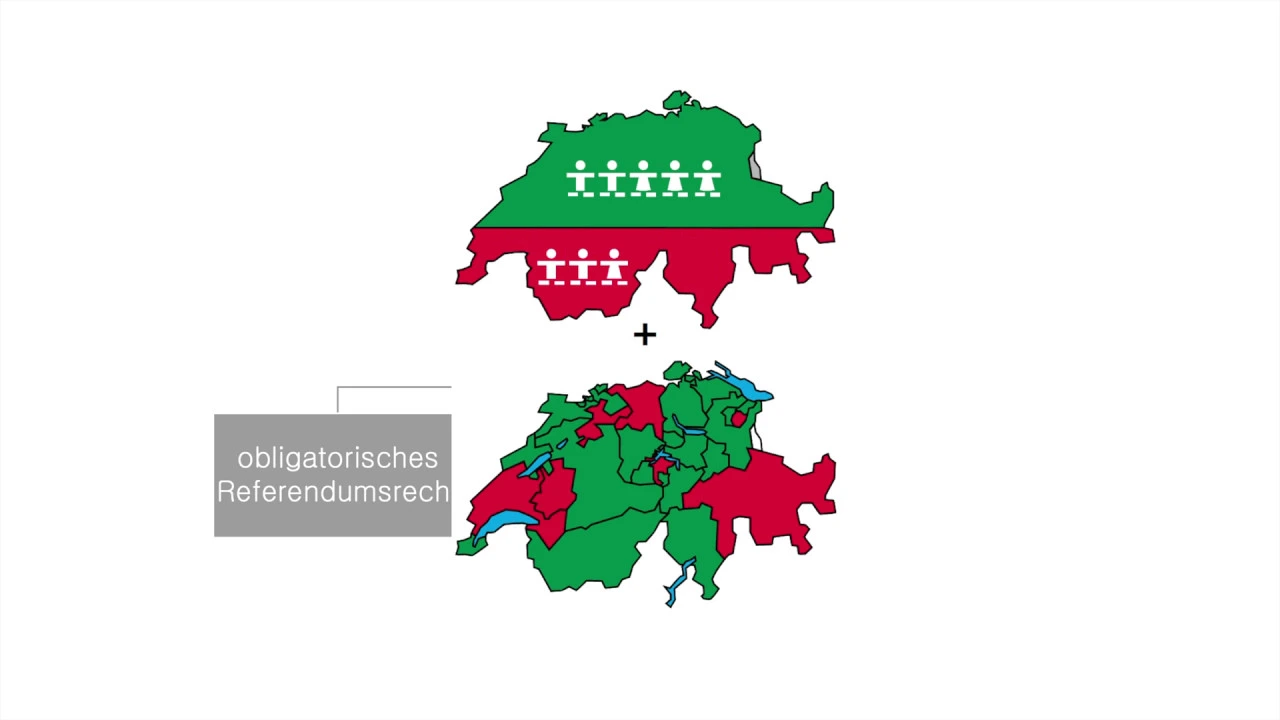
- Constitutional changes need majority support from both the population and cantons to pass.
Separation of Powers in Switzerland
This section delves into the division of powers in Switzerland among the legislative, executive, and judicial branches.
Three Branches of Power
- The legislative branch (Parliament) creates laws and constitutional changes, with the National Council representing people directly.
- The executive branch (Federal Council) consists of seven members elected by Parliament to govern collectively.
Federal Council Structure
- The Federal Council aims for party representation fairness with each member serving a four-year term.
- The Federal Chancellor advises but is not part of the Federal Council.
Judicial System and Federalism in Switzerland
This section explores the role of the judiciary, federalism, and how power is distributed among Swiss cantons.
Judicial System
- The Federal Supreme Court acts as the highest court overseeing rule adherence. Judges serve six-year terms.
- It ensures uniformity in law interpretation across regions.
Federalism in Switzerland
- Swiss federalism allocates responsibilities to cantonal governments unless tasks fall under federal jurisdiction like postal services or currency regulation.
Verordnungen und Gesetze in der Schweiz
This section discusses the hierarchy of laws in Switzerland, detailing the process of enacting new laws and the significance of different legal instruments.
Verordnungen und ihre Hierarchie
- Regulations subordinate to federal law are issued by the government, and no referendum can be taken against them. In case of conflicting provisions, priority is given to the constitution first, then the law, and lastly the regulation.
Bundesgesetz und Kantonsrecht
- Federal provisions always supersede those of a canton, with the exception being peremptory international law which stands above the constitution. Examples include anti-torture and anti-slavery laws.
Prozess der Gesetzeseinführung
- New laws can be introduced through various means: parliament, people's initiative, or the Federal Council. The final decision on a new legislative proposal lies with the Federal Assembly (parliament).
Gesetzgebungsverfahren
- The two chambers of parliament (National Council and Council of States) deliberate on a proposed law until an agreement is reached. Subsequently, the law is prepared by the Federal Council and an expert commission before feedback from parties and interested parties is sought.
Referendum und Inkrafttreten von Gesetzen