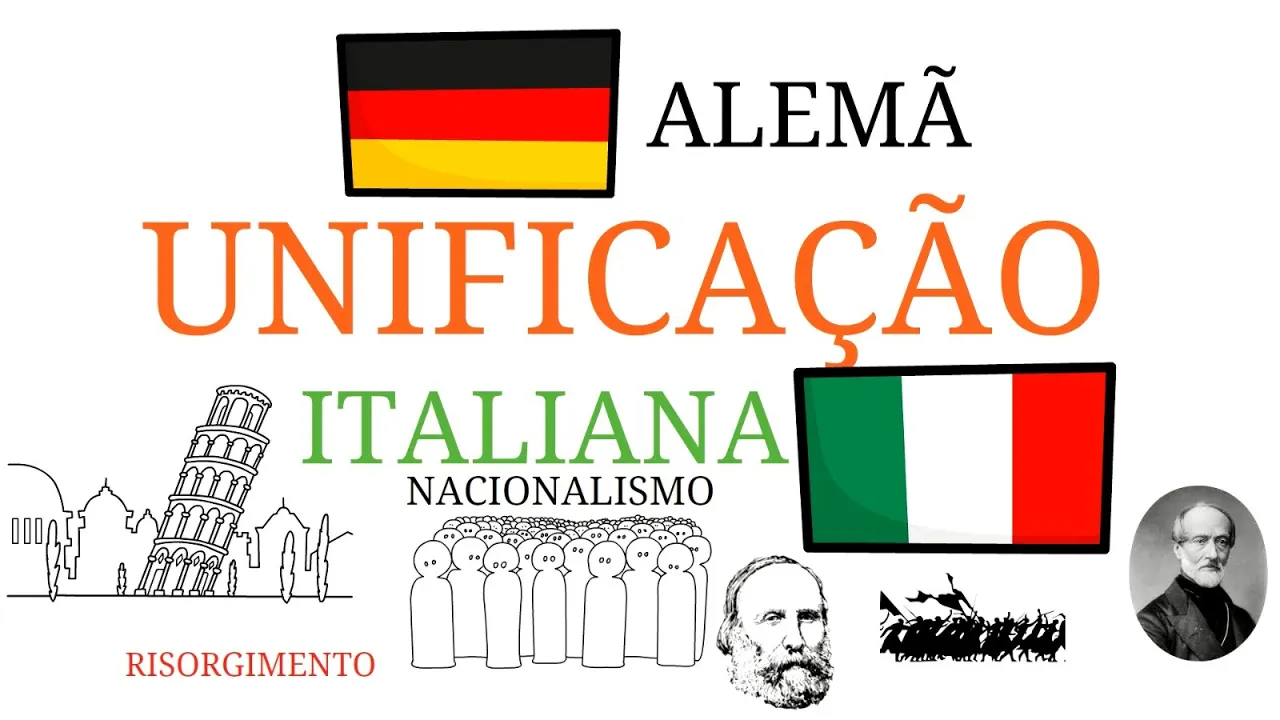
Rumo à Unidade: A Unificação Alemã e Italiana
Italian and German Unification in the 19th Century
This section discusses the main characteristics of Italian and German unification processes in the 19th century, highlighting key figures and events that led to these historical transformations.
Italian Unification
- Giuseppe Mazzini played a crucial role in advocating for Italian unification through his leadership in the Young Italy secret society, promoting Italian nationalism.
- The resurgence movement aimed at expelling foreign powers from Italy, with leaders like Giuseppe Garibaldi contributing significantly to the fight for independence.
- Count Cavour, an Italian statesman, played a pivotal role diplomatically uniting various Italian states under the Kingdom of Piedmont-Sardinia, which was industrially advanced.
War Against Austria and Unification
- Industrialized regions like Piedmont in Italy and Prussia in Germany led the unification movements due to their economic strength.
- The war against Austria, supported by Napoleon III of France, was a significant step towards Italian unification. By 1870, Rome was incorporated into the unified Kingdom of Italy.
German Unification Process
This part delves into the process of German unification leading to the formation of the German Empire in 1871 under Otto von Bismarck's leadership.
Role of Otto von Bismarck
- Otto von Bismarck orchestrated pragmatic diplomatic strategies and military alliances to achieve German unification as Prime Minister of Prussia.
- Through wars with Denmark and Austria (Austro-Prussian War), Bismarck weakened Austrian influence and consolidated northern German states under Prussian leadership.
Franco-Prussian War and Final Unification