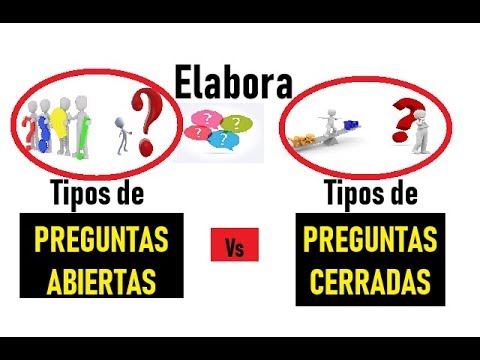
CUÁLES SON LOS TIPOS DE PREGUNTAS ABIERTAS Y CERRADAS | MUESTRO EJEMPLOS
Understanding Closed and Open Questions in Surveys
Introduction to Question Types
- The tutorial introduces the concept of open and closed questions, explaining their significance in surveys and quantitative studies.
Characteristics of Closed Questions
- Closed questions are easy to code, allowing for standardized responses that can be easily graphed and analyzed.
- Respondents have less time to think as options are provided, which simplifies the answering process but may limit response diversity.
- Greater precision is achieved with closed questions, reducing ambiguity and confusion in responses.
- A pilot test can help refine questions by identifying any ambiguities before wider distribution.
Types of Closed Questions
Multiple Choice Questions
- Multiple choice questions require respondents to select one option from a list, often used in exams or surveys.
Dichotomous Questions
- Dichotomous questions prompt a simple yes/no answer; however, they should be used sparingly to avoid oversimplifying complex opinions.
Structured or Closed-ended Questions
- Similar to multiple choice but allow selection of more than one option; useful for gathering broader preferences.
Semantic Differential Scale
- This type assesses opinions on a scale between two opposing adjectives (e.g., interesting vs. boring), providing nuanced insights into perceptions.
Projective Questions
- These involve images instead of text, catering to individuals who may struggle with reading or comprehension, such as children or those with literacy challenges.
Overview of Open Questions
- Open questions are common in qualitative research aimed at interpreting rather than measuring reality; they seek deeper insights into public opinion.
Understanding Open-Ended Questions in Interviews
Importance of Open-Ended Questions
- Open-ended questions provide broader information, allowing for deeper insights. The reliability of the responses will depend on various factors that will be discussed later.
- While open-ended questions can yield extensive information, they may also lead to irrelevant answers if the respondent lacks knowledge about the topic.
Role of the Interviewer
- The effectiveness of open-ended questions relies heavily on the interviewer's skill in guiding the conversation back to relevant topics when necessary.
Types of Open-Ended Questions
Literal Questions
- Literal questions are designed to elicit precise and concise responses, often used for personal inquiries such as name, profession, or age.
Unstructured Opinion Questions
- Unstructured opinion questions delve into subjects of interest and require respondents to express their preferences or thoughts on specific topics.