Эстетика романтизма (лекция 12/12), Александр Пустовит. Эпоха романтизма в искусстве
Aesthetic of Romanticism
Introduction to Romanticism
- The discussion begins with the aesthetic of Romanticism, contrasting it with Classicism and Baroque aesthetics.
- Romantic irony is introduced as a concept related to Baroque wit, highlighting its historical lineage from Antiquity through Renaissance and Enlightenment to Romanticism.
Key Characteristics of Romantic Aesthetics
- Unlike Classicist genre hierarchies, Romantic artists view humanity in its entirety, embracing both tragic and comic elements.
- Byron is identified as one of the first great romantic poets; his work "Don Juan" serves as a significant example within this context.
Analysis of "Don Juan"
Overview of "Don Juan"
- Byron's "Don Juan" is described as an unfinished epic poem that begins with the protagonist's youth and love for Julia.
- The narrative introduces conflict when Julia’s jealous husband forces her into a convent, leading Don Juan to leave Spain heartbroken.
Themes in "Don Juan"
- The poem captures themes of loss and longing through Don Juan's farewell to Spain and his beloved Julia.
- Don Juan expresses deep emotional turmoil reminiscent of Hamlet’s love vows, showcasing the intertwining of tragedy and comedy in romantic literature.
Physicality and Emotion in Love
Exploration of Love's Pain
- The text discusses how physical ailments like seasickness symbolize emotional distress caused by love.
- It highlights the absurdity found in romantic suffering, blending elevated emotions with mundane realities.
Comparison with Pushkin
Pushkin's Approach
- Alexander Pushkin similarly merges humor with tragedy in his works, exemplified by “The Queen of Spades.”
- The story follows Hermann, who seeks wealth through an old lady who knows winning cards but pretends to be in love for ulterior motives.
Climax and Irony
- Hermann’s desperation leads him to threaten the old woman for secrets about the cards; however, she reveals it was all a joke before dying from fright.
The Story of Silvio and the Count
Introduction to Characters
- The main character, Silvio, is depicted as a young, handsome, and very wealthy count. He is described as fortunate by fate but not malicious; rather, he possesses an overly dazzling charm that complicates his romantic pursuits.
Conflict Arises
- Jealousy emerges between Silvio and the count due to a love interest. A duel is proposed where the count shoots first but misses intentionally, showing his indifference towards death.
Duel Dynamics
- After several years, the count marries a beautiful woman he loves deeply. Silvio arrives at the estate to challenge him to a duel under the pretense of "discharging his pistol," showcasing his exceptional shooting skills.
Tension in the Duel
- As they prepare for their duel, Silvio suggests drawing lots to determine who shoots first. The count agrees despite being somewhat out of sorts mentally.
Misunderstandings and Humor
- The young countess interrupts them, questioning if they are joking about their duel. The count tries to downplay it as humor while recounting past playful incidents with Silvio.
Literary References and Themes
Mozart's Influence
- Discussion shifts to Mozart's play "Mozart and Salieri," highlighting how misunderstandings can lead to significant consequences in relationships.
Don Giovanni's Tragic Irony
- Reference made to another literary work involving Don Giovanni where tragic outcomes stem from reckless behavior and jesting invitations leading to fatal encounters.
Pushkin’s Perspective on Duels
- Transition into Pushkin’s "Eugene Onegin," focusing on how trivial matters can escalate into deadly duels—specifically detailing how Onegin's actions lead directly to Lensky's death over a misunderstanding during a social gathering.
Romantic Irony in Literature
Lidia Kreimgel’s Analysis
- Introduction of Lidia Kreimgel’s insights on romantic irony as an essential method bridging realism from romantic culture in 19th-century literature.
Characteristics of Romanticism
- Romanticism contrasts sharply with classicism by blurring lines between high/low art forms and mixing comedic elements with tragedy—a reflection on human complexity.
Pushkin’s Artistic Evolution
European Romanticism and Shakespeare's Influence
The Duality of Tragedy and Comedy in Literature
- European romantics learned from Shakespeare, showcasing a blend of tragic and comic elements. For instance, the juxtaposition of Ariel's funeral with Ophelia's death illustrates this duality.
- The movement from solemn to mundane, tragic to humorous reflects the variable value of themes based on context, highlighting the social significance of an ironic style.
- Nikolai Polevoy noted Pushkin as a pioneer in both poetic execution and thematic innovation, revealing new dimensions previously unexplored by classical poets.
Lyrical Contrasts in Byron’s Work
- Byron’s poetry contrasts lyrical expressions with comedic undertones; his work begins with tragedy but transitions into humor, exemplified by his opening lines about Spain.
- The exploration of sorrow through personal loss is serious yet intertwined with humor, reflecting a complex emotional landscape that resonates deeply.
Irony and Human Experience
- Pushkin’s works embody a tension between highbrow and lowbrow themes; he critiques human nature while simultaneously engaging readers through irony.
- The interplay between joy and melancholy in literature captivates audiences, demonstrating how humor can emerge from profound sadness.
Aesthetic Shifts: From Classicism to Romanticism
- Byron's approach reveals deeper human emotions beneath playful descriptions; he merges joy with sorrow effectively within his narratives.
- Pushkin mirrors this transition by skillfully navigating between lightheartedness and despair, captivating readers through these shifts.
Rejection of Classical Hierarchies
- Romantic irony challenges classical aesthetics by rejecting rigid genre hierarchies that separate tragedy from comedy; it embraces their coexistence instead.
- While classicism ties tragedy to divine themes (e.g., Christ), romanticism centers on humanity—highlighting the complexity of human experience beyond religious constraints.
Embracing Contradictions in Art
- Ginzburg emphasizes the equality of comedic and tragic elements within romantic art, suggesting that true artistic expression thrives on contradictions.
- Romantic art embodies oppositions rather than resolving them; it reflects life's inherent complexities rather than adhering strictly to logical frameworks.
Cultural Tolerance for Contradiction
- In contrast to strict scientific logic where contradictions are intolerable (as seen in arithmetic), cultural fields like religion or philosophy embrace them as part of human experience.
Philosophical Questions and Artistic Contradictions
The Nature of Free Will and Immortal Soul
- Discussion on philosophical questions regarding free will, with Choco asserting the absence of free will.
- Contrasting views presented: Democritus denies the existence of an immortal soul, while Plato affirms it.
- Epicurus supports the notion of free will, highlighting a divide in philosophical thought.
Art as a Reflection of Contradiction
- Exploration of how art, religion, and philosophy embody contradictions.
- Romantic irony is introduced as a means to express these contradictions within artistic contexts.
Example from Pushkin's Poetry
- Introduction to a short example from Pushkin’s poetry illustrating contradiction through imagery and themes.
- Analysis of a character's desire juxtaposed with rejection based on age, showcasing conflict in relationships.
Contrasts in Tragedy and Comedy
Classification of Literary Forms
- Attempt to classify Pushkin's work into tragedy and comedy based on perspectives presented in the poem.
- The poem reflects both tragic elements (from an older man's viewpoint) and comedic aspects (from the younger woman's perspective).
Unity in Artistic Expression
- Emphasis on the unity of artistic expression despite contrasting themes; Pushkin’s late works defy strict genre classifications.
Pushkin's "Domik v Kolomne" - A Deeper Dive
Structure and Style
- Explanation of the complex structure used by Pushkin—octaves consisting of eight lines with specific rhyme schemes.
- Historical context provided about octaves being utilized by great Italian poets for serious themes contrasted with Pushkin’s light-hearted approach.
Literary Techniques
- Discussion on iambic meter as prevalent in Russian poetry; comparison made between different poetic forms like iambic pentameter versus octave structures.
Pushkin's Humor and Irony
Playful Engagement with Readers
- Examination of Pushkin’s humorous take on literary conventions; he expresses boredom with traditional forms leading him to explore new styles like octaves.
Commentary on Literary Standards
Poetic Techniques and Themes
Exploring Rhyme and Structure
- The speaker discusses the importance of rhyme in poetry, suggesting that there are not many options available, yet they advocate for using verbs creatively without dismissing any potential rhymes.
- The distinction between masculine and feminine rhymes is introduced, with examples provided to illustrate how different types of syllables can affect the rhythm and flow of poetry.
- A call for freedom in poetic expression is made, emphasizing the need to maintain order while allowing creativity to flourish within structured forms like octaves.
- Historical references are made to notable figures such as Napoleon, highlighting their relevance in discussions about poetic techniques and the evolution of literary styles.
- The concept of caesura (a pause within a line of verse) is explained as crucial for maintaining rhythm; it’s likened to navigating obstacles in life.
Reflections on Poetry's Evolution
- An anecdote about a horse journey from Moscow to St. Petersburg serves as a metaphor for artistic struggles and the absurdity found in creative processes.
- The speaker compares musical performances with poetry, illustrating how both require skillful execution and an understanding of technique to captivate an audience.
- A humorous take on virtuosity is presented, where the speaker contrasts self-perception with actual talent, reflecting on societal expectations versus personal abilities.
Critique of Classical Influences
- There’s a critique of classicism in poetry; the speaker suggests that reliance on ancient forms can feel outdated or irrelevant in contemporary contexts.
- References to Pushkin highlight how modern poets may draw inspiration from classical themes but also seek to innovate beyond traditional boundaries.
Personal Narratives and Emotional Depth
- The narrative shifts towards personal memories involving a widow and her daughter, evoking nostalgia while exploring themes of loss and change over time.
- Vivid imagery is used when recalling past experiences tied to specific locations; this evokes emotional responses related to memory and longing.
Philosophical Musings on Life
- Contemplation arises regarding mortality and existence; reflections suggest that beauty can be found even amidst destruction or chaos (e.g., fire).
- A philosophical discussion emerges around human nature—how individuals cope with life's challenges through language or silence.
Artistic Expression Through Music
- The conversation transitions into music's role alongside literature; parallels are drawn between structural elements in both art forms that evoke similar emotional responses from audiences.
- An exploration into how narratives unfold similarly across different mediums highlights storytelling's universal nature despite varying formats.
The Poetic and Romantic Elements in Russian Literature
Exploration of Themes and Characters
- The narrative begins with a melancholic tone, highlighting the connection between music and poetry within a family setting, emphasizing the shared experience of singing.
- A character named Parasha is introduced, showcasing her domestic skills while also hinting at deeper familial dynamics through her interactions with an older woman, Fyokla.
- The imagery of seasons reflects the characters' emotional states; winter brings confinement while summer allows for freedom and romantic encounters.
- The contrast between the mother’s pragmatic nature and the daughter’s poetic inclinations illustrates generational differences in perception of love and life.
- References to Hoffmann's influence on Pushkin highlight the intertwining of literary traditions, particularly in exploring themes of love through animal symbolism.
Dual Narratives: Cat's Perspective vs. Human Experience
- The narrative structure alternates between a cat's perspective and that of its owner, Chrysler, creating a layered storytelling approach that enriches character development.
- This duality serves to explore themes such as love, loss, and artistic expression through contrasting viewpoints—one grounded in reality (Chrysler), the other whimsical (the cat).
- An emphasis on autobiographical elements suggests that personal experiences shape artistic output; this interplay invites readers to reflect on their own lives.
Critique of Society Through Characterization
- A critique emerges regarding societal expectations as seen through characters like the wealthy countess who embodies vanity yet struggles with inner turmoil despite her outward beauty.
- The juxtaposition between appearances and reality is further explored as characters navigate their desires against societal norms—highlighting themes of superficiality versus genuine emotion.
Reflections on Mortality and Legacy
- Death becomes a recurring motif as it impacts both domestic life and broader social interactions; this theme resonates deeply within Russian literature's exploration of existential questions.
- The mention of rituals surrounding death underscores cultural practices while also reflecting individual grief—a poignant reminder of life's fragility amidst societal obligations.
Conclusion: Interplay Between Artistry and Life
- Overall, the text weaves together various threads—romanticism, societal critique, mortality—to create a rich tapestry reflective of human experience within Russian literature.
Themes of Love and Death in Romanticism
Introduction to Key Themes
- The discussion begins with the exploration of two central themes in romantic literature: love and death, referencing classic works like "Tristan and Isolde" and "Romeo and Juliet."
- The speaker reflects on personal experiences related to these themes, hinting at a narrative involving a character named Vasya.
Domestic Life and Culinary Challenges
- A humorous depiction of domestic life is presented, focusing on the need for a cook (кухарка) in the household, emphasizing the importance of culinary skills.
- The character's interactions with the cook reveal her lack of experience, leading to comedic situations as she struggles with basic tasks.
Character Dynamics
- The relationship between characters is highlighted through their dialogues; there’s an emphasis on respect and duty within domestic roles.
- Tension arises when misunderstandings occur regarding intentions, showcasing human emotions tied to fear and suspicion.
Climax of Events
- A pivotal moment occurs when a character feels overwhelmed by fear while looking into a mirror, symbolizing deeper anxieties about identity and societal expectations.
- The narrative builds suspense as characters react dramatically to perceived threats or miscommunications.
Moral Lessons Embedded in Narrative
- The speaker introduces moral lessons derived from the story, cautioning against hiring unreliable help or pretending to be someone one is not.
- There’s an exploration of how art serves educational purposes by illustrating virtues and vices through storytelling.
Structural Analysis of Poetry
- A critical analysis reveals that the poem employs specific structural elements (octaves), which contribute to its thematic depth.
- An unexpected shift in structure during climactic moments indicates tension within the narrative form itself, reflecting chaos amidst order.
Conclusion: Literary Techniques
Structural Failures and Irony in Art
The Signal of Structural Failure
- The speaker discusses how structural failures signal the destruction of the world, emphasizing that such events are always tragic.
- The contrast between form and meaning is highlighted; while form indicates tragedy, the underlying meaning can suggest comedy, illustrating a romantic irony.
Artistic Analogy: Antoine Watteau
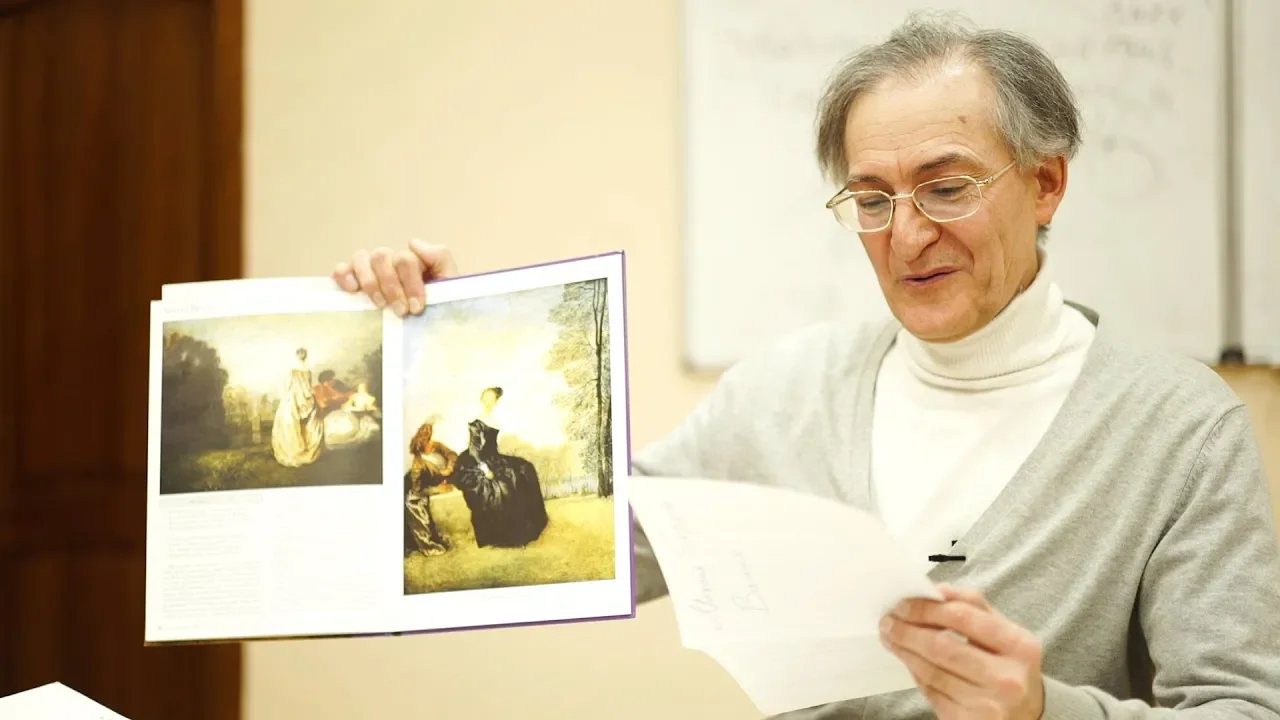
- An analogy from painting is introduced, focusing on Antoine Watteau's "gallant festivities," particularly a piece titled "The Capricious One," which depicts an idyllic autumn scene.
- Art critic Mikhail German notes that Watteau’s smaller works possess a royal immediacy that diminishes the significance of larger canvases.
Irony in Performance
- André Maurois recalls Bruno Walter conducting with an emphasis on making music sound so joyful that it evokes tears, showcasing the duality of emotions in art.
- Characters in Watteau's paintings appear frivolous yet reveal deeper complexities through their interactions, creating a tension between initial impressions and subsequent realizations.
Color Symbolism and Emotional Contrast
- The interplay of colors—black dress against light backgrounds—creates a poignant contrast that evokes feelings of sorrow amidst seemingly trivial actions.
- Black symbolizes mourning within European culture; this stark color contrast amplifies the insignificance of characters' playful antics against a backdrop of deeper emotional themes.
Irony as Central Theme
- The discussion culminates in recognizing irony as central to both Watteau's work and Pushkin's poetry, where sharp contradictions between narrative content and emotional tone create layers of meaning.