Logaritmos | Introducción conceptos básicos
What is a Logarithm?
Introduction to Logarithms
- The course begins with an introduction to logarithms, emphasizing the basic concept and its notation.
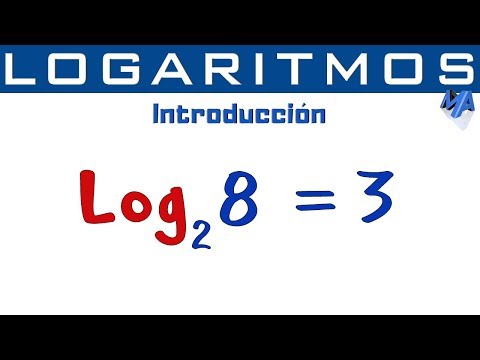
- The example presented is "logarithm base 2 of 8," which prompts the question: what exponent of 2 results in 8?
Understanding Exponents
- To solve logarithmic problems, one must recall exponentiation; specifically, finding the exponent that makes 2^x = 8.
- A breakdown of powers shows that 2^3 = 8, thus establishing that the logarithm base 2 of 8 equals 3.
Practice Exercises
- The next exercise involves finding "logarithm base 5 of 25," leading to the conclusion that 5^2 = 25, so this logarithm equals 2.
- Another example asks for "logarithm base 3 of 81," where multiplying 3 times 3 times 3 times 3 gives us 81, indicating that this logarithm equals 4.
Understanding Implicit Bases
Implicit Base in Logarithms
- When no base is specified in a logarithmic expression, it defaults to base 10. For instance, "logarithm base 10 of 100" implies finding how many times you multiply 10 to get 100.
More Examples with Base Ten
- Continuing with examples, "logarithm base 10 of 10,000" requires determining how many times to multiply by 10; the answer is four times since 10^4 = 10,000.
Practice Problems and Key Takeaways
Summary and Practice Exercises
- The instructor provides eight practice exercises for students to find solutions for various logarithmic expressions.
Important Conclusions on Logarithms
- A key takeaway is if the base and number are equal (e.g., log25^25), then the result will always be one.