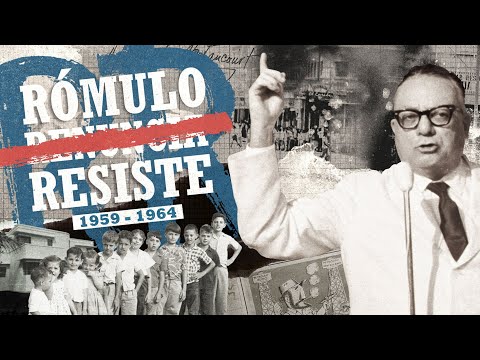
#Documental - Rómulo Resiste
Recollection and Resistance
The speaker reflects on their childhood memories and the political situation in Venezuela during the late 1950s.
Childhood Memories
- The speaker reminisces about their childhood years.
- They describe their memories as fleeting clouds that they try to recollect.
- The speaker attempts to recall how they lived those years.
Political Situation in Venezuela
- The military sets up checkpoints, causing disruptions in daily life.
- Perez Jimenez's dictatorship falls, leading to a power vacuum.
- A military junta takes over with support from various sectors of society.
- Rómulo Betancourt returns from exile and calls for unity among Venezuelans.
- Betancourt's government grants universal suffrage, including for women.
Economic Challenges
- Unemployment becomes a major issue due to the economic fallout from the dictatorship's fall.
- Vice Admiral Larrazábal implements an emergency plan to subsidize unemployment.
General Castro León Replaced
This section covers the events leading up to the replacement of General Castro León.
Uprising of Military Police Battalion
- In September 1958, there was an uprising of the Military Police battalion guarding Miraflores.
- The seat of government, Palacio Blanco, was also guarded by this battalion.
- Tiuna Films cameras captured these scenes.
- Cameraman Eduardo Hernández Guayo filmed these impressive scenes of the national democratic feat.
Casualties and Opposition to Political Parties
- The uprising resulted in 19 deaths and over 100 injuries.
- Retrograde sectors that aspired to maintain the preeminence of the military institution as a political factor were revealed in both the Castro León movement and in the September pronouncement.
- These sectors believed that only the Armed Forces had a project capable of guaranteeing modernization in Venezuela.
- Within the Armed Forces, there was a rejection of political parties, which was personified by Rómulo Betancourt.
Presidential Candidacies
This section covers discussions around presidential candidacies leading up to elections.
Candidates
- Rómulo Betancourt is viewed seriously but not well-regarded at school or by some family members.
- Rafael Caldera is spoken about with greater sympathy at home.
- Wolfgang Larrazábal is heard most on television playing cuatro with his white uniform.
Voting System
- Ballots are colored so that people who cannot read can vote by choosing their candidate's card color.
Punto Fijo Pact
This section covers discussions around Punto Fijo Pact signed after elections.
Purpose of Pact
- The Punto Fijo Pact was signed to give political stability to the next government that would emerge from the December '58 elections.
- It was a pact between political adversaries, very bitter political adversaries.
- Whoever won, the other parties and candidates would support that regime and achieve a formula for a unified government.
Signatories
- The Communist Party and leftist forces did not sign Punto Fijo as their presence in the Pact would generate noise within the Armed Forces.
- Those political forces that did not appear in this photo supported it with their signatures and votes for the Constitution of 1961.
Presidential Elections
This section covers events leading up to presidential elections.
Election Day
- Rómulo Betancourt signs autographs before fulfilling his duty to vote on December 7, 1958.
Entering the Queue
The speaker enters the queue approaching the voting booth.
Voting Day
- The speaker enters the queue approaching the voting booth.
- AD, URD, COPEI, the Communists and the independent majority are contributing to the new Venezuela with their vote.
Election Results
The speaker talks about election results and data that began to arrive in early afternoon.
Caracas Loss
- When election results and data began to arrive in early afternoon.
- The loss in Caracas was data from Caracas, of course, the beating was enormous. Many colleagues crying.
- Colleagues crying over losing.
Betancourt's Triumph
- Larrazábal sweeps Caracas and Betancourt wins in the interior.
- Betancourt’s triumph and Rafael Caldera's defeat do not leave a major mark on my memory.
Boulevard of Sabana Grande
The speaker remembers walking along Boulevard of Sabana Grande looking for new shoes.
New Shoes
- Walking along Boulevard of Sabana Grande looking for new shoes.
- A pair of Rex shoes
- Thinking of what I will ask Baby Jesus.
Secret of Baby Jesus
- For the first time, I write the letter with my own hands and give it to my parents to send it to him.
- My neighbor Pedrito calls me and what I do not forget about that Christmas is how painful it was for me, the secret of Baby Jesus. Explosive news.
Fidel Castro's Guerrillas
The speaker talks about Fidel Castro's guerrillas and their triumph in Venezuela.
Triumph of Fidel Castro
- The Governmental Council sends weapons to support Fidel Castro's guerrillas in the Sierra Maestra.
- The reaction to the triumph of Fidel Castro in Venezuela caused a celebration similar similar to that of January 23 when Pérez Jiménez fled in the Sacred Cow.
- When Fidel is speaking, I was on the left side of Fidel.
Betancourt and Jeering
- I realized Fidel Castro's bewilderment when he mentioned Betancourt.
- They applauded Fidel, in part, to condemn or criticize Betancourt.
Meeting with Betancourt
- The only one who did not want to meet with Fidel was Betancourt.
- Leaders of Acción Democrática had to go to extreme measures to convince Betancourt to meet with Fidel, to receive him.
Economic Aid Proposal
The speaker talks about Fidel Castro's economic aid proposal to Betancourt.
Meeting with Betancourt
- It is known that it was a rather acerbic meeting, tense, with a certain stiffness.
- Fidel Castro and his cause are known in our house.
- Marita, my mother is Cuban and her family, the Sculls, live in Havana.
Cha-Cha-Cha
The speaker talks about dancing cha-cha-cha with their mother.
Dancing Cha-Cha-Cha
- On some trip they have brought three dolls of Fidel, Camilo and Che.
- Marita teaches us to dance cha-cha-cha in front of the large glass doors that separate us from the garden.
Rómulo Betancourt Assumes Presidency
The speaker talks about Rómulo Betancourt assuming presidency.
Inauguration Day
- TODAY AT TEN O'CLOCK IN THE MORNING RÓMULO BETANCOURT ASSUMES THE PRESIDENCY
- The dictatorship left the country on the brink of bankruptcy.
Unemployment and National Unity
- There is widespread unemployment in the country and the number of those without work reaches an impressive proportion.
- When Rómulo Betancourt wins the elections, one of the commitments was to create a government of national unity.
Deficiencies in Venezuela's Economy
This section discusses the economic crisis that President Betancourt inherited when he took office. The economy was paralyzed, bleeding capital, and had negative expectations. There was high unemployment and marked marginalization.
Economic Crisis
- Betancourt inherited a paralyzed economy that was bleeding to death with massive capital flight.
- High unemployment rate and marked marginalization existed.
- Emergency Plan set up by Larrazábal in 1958 was dismantled by Betancourt in 1959 because it was unfeasible from an economic point of view.
- Public finances needed to be put in order as public spending far exceeded revenue.
Betancourt's Approach to Revolution
This section discusses how Betancourt approached revolution through profound reforms rather than violence. He proposed eliminating the left wing of his party, which hindered his government.
Betancourt's Approach
- Betancourt believed in making a revolution through profound reforms instead of violence.
- He proposed eliminating the left wing of his party, which hindered his government.
- Youth saw Betancourt as a representative of the past and acted very much in tune with other youthful rebellions taking place globally.
Repression and Violence
This section discusses how Betancourt repressed movements that did not allow him necessary governability. His opponents managed the street and handled violence.
Repression and Violence
- Anarchic outbreaks in the country caused by forces trying to generate a revolution different from the one Betancourt was doing.
- Betancourt's message was very clear that he would impose order, but it did not go to those social and political movements that were in the street.
- Betancourt understood that the street as a street is not the solution. However, his opponents who managed the street and handled violence reproached him for professing a vision of hijacked democracy.
- Betancourt proposed democracy expressed institutionally through parties, unions as mechanisms of intermediation for society's requirements and demands.
Influence of Cuban Revolution
This section discusses how the influence of the Cuban revolution in Latin America was strong, especially on youth from various social democratic parties. It led to an insurrectionary process in Venezuela.
Influence of Cuban Revolution
- The influence of the Cuban revolution in Latin America was strong, especially on youth from various social democratic parties.
- The image of heroic guerrillas coming down from mountains infected and encouraged an insurrectionary process in Venezuela.
Cuba's Influence
This section discusses the influence of Cuba on Venezuela and how it wanted to get its hands on Venezuelan wealth.
Cuban Revolution
- Cuba had a fundamental influence on Venezuela.
- Cuba wanted to get its hand on Venezuelan wealth to sustain its revolution and export it.
Democracy in Venezuela
This section talks about democracy in Venezuela and how Dr. Elías Toro believed that if Venezuelans had more patience with democracy, the country's destiny would have been different.
Patience with Democracy
- Dr. Elías Toro said that if Venezuelans had the patience with democracy that they had with dictatorships, the country's destiny would have been different.
Wrestling and First Communion
This section discusses wrestling as a favorite show among siblings, first communion, and a child named Ernestico who has developmental delays.
Wrestling
- The narrator watches wrestling with their brothers every Sunday night.
- They enjoy watching wrestlers who wear masks because they are considered the toughest, dirtiest, and most yelled at.
First Communion
- The narrator will soon have their first communion and will stop watching wrestling for a month as an offering for their mother's health.
Ernestico
- Ernestico is two years old but still hasn't walked. He hits himself constantly and does not speak due to developmental delays.
- Despite his difficulties, the narrator enjoys spending time with him since he is the youngest of all siblings.
New Year's Message
This section discusses the end of Venezuela's first year under the constitutional regime and President Betancourt's New Year's message.
End of First Year
- The first year that Venezuela lived under the constitutional regime ends.
New Year's Message
- President Betancourt wishes all Venezuelans, even opponents of the political order of things, a happy new year.
Assassination Attempt on President Betancourt
This section talks about an assassination attempt on President Betancourt and how he survived it.
Assassination Attempt
- There was a serious attack against Betancourt with explosives on Los Próceres Avenue when he was on his way to commemorate Army Day.
- He suffered serious injuries, including a ruptured eardrum.
- After receiving first aid at Hospital de Clinicas, he went to Miraflores with his hands full of bandages like a boxer.
Capture of Perpetrators
- Those responsible for the bombing were captured and confirmed that Rafael Leónidas Trujillo provided them with the bomb and resources to carry out the attack.
Accusation Against Santo Domingo
- Venezuela officially accuses Santo Domingo of being involved in the attack.
Symbolic Politics
This section discusses politics' symbolic content and how it can be used to help leaders affirm their leadership.
Pipe Thing
- The pipe thing was not started by Betancourt but helped him affirm his leadership as people thought he had magical powers.
- Many attributed Betancourt himself as having magical powers.
Leadership
- The pipe thing was a mechanism to help Betancourt's own leadership and affirmation as a political leader.
Rector's Parties
This section talks about the rector's parties at school, which are three days of sports competitions that begin with a strange ritual.
Ali, Rájame el Coco
- The narrator introduces "Ali, Rájame el Coco," who wears a huge mask during the rector's parties.
Ritual
- The rector's parties begin with a mysterious ritual where fifth-year students wear grotesque masks and carry straps and rubber batons.
The Uproar of Fear
In this section, the speaker describes how the carnival-like uproar is experienced with fear and how it is the most terrifying time of the year.
The Terrifying Carnival
- The uproar is lived as if it were a carnival, but with fear.
- It is the most terrifying time of the year.
Memories of "Alí, Rájame el Coco"
In this section, the speaker shares a personal memory related to "Alí, Rájame el Coco".
Personal Memory
- That is why I will never be able to forget "Alí, Rájame el Coco".
Public Works and Inaugurations
This section discusses public works and inaugurations during President Betancourt's term.
Public Works and Inaugurations
- More than 20,000 people greeted President Betancourt as he passed through several towns.
- President Betancourt reviewed some public works including an aqueduct and sewers.
- He inaugurated Pérez Bonalde High School which has capacity for 1,500 students.
- President Betancourt focused on functional public works such as irrigation systems, teacher schools, hospitals and aqueducts.
- He criticized building public works that only demonstrated greatness rather than being useful to the population.
Presidential Inaugurations
This section discusses President Betancourt's attention to detail during inaugurations.
Attention to Detail
- President Betancourt reviewed public works before inaugurating them.
- He waited for all journalists and photographers to arrive before proceeding with an inauguration.
- He was known for his political cunning and attention to detail.
President Betancourt's Caravan
This section describes President Betancourt's caravan and his personal style.
Caravan and Personal Style
- The Roll Royce car in the presidential caravan was acquired by Mister John, who gave it to President Pérez Jiménez.
- The car offered an almost panoramic view.
- President Betancourt was not fond of luxury but dressed neatly and wore a hat which was unusual at that time.
- He continued wearing a hat even in 1978 when he said he was the last man left in the country who wore one.
Naiguatá Resort
This section describes the opening of Naiguatá resort.
Opening of Naiguatá Resort
- Naiguatá resort is opened by Mr Rómulo Betancourt, President of the Republic.
- The speaker sees the presidential caravan go by while sitting with cousins at Club Playa Azul.
- The beach club becomes the speaker's weekend refuge.
- The speaker has to protect Ernestico from the vicissitudes of life, especially in the sea.
A Day at the Beach
The speaker describes a day at the beach with friends and the fear that arises when one of them goes missing.
A Dangerous Beach
- The club has wonderful facilities but is located on a dangerous ocean beach.
- Despite this, the speaker and their friends find it irresistible.
Searching for a Friend
- While playing in the waves, they leave Ernestico on shore to watch their T-shirts.
- When they come out of the water, they realize Ernestico is missing.
- They search for him even under rocks and wonder who to ask for help.
Reunited
- Suddenly, Ernestico appears and points them towards where he was hiding.
- The speaker almost gets angry but is disarmed by his mischievous smile.
Agrarian Reform in Venezuela
This section discusses President Betancourt's agrarian reform program in Venezuela during the 1960s.
Proclamation of Agrarian Reform
- On March 5th, 1960, President Betancourt proclaimed an agrarian reform law that would redistribute land from landlords to peasants.
- Those who did not work would not be able to retain possession of their land or receive loans from Banco Agrícola y Pecuario.
Comprehensive Project
- The agrarian reform was not just about land distribution but also included country roads, rural housing, and health clinics.
- Peasants from all over the region came to testify their appreciation and support for President Betancourt.
Combating Landlordism
- The Agrarian Reform Law aimed to combat landlordism while enhancing the productive apparatus and reducing support for regional guerrilla movements.
- President Betancourt mocked the guerrilla in Venezuela as one that represented rice with chicken but without the chicken, meaning it lacked support from Venezuelan peasants.
Adecos
- When talking to peasants about agrarian reform and socialism, they referred to themselves as "from the mocracy," which meant Democratic Action or "adecos."
- Despite efforts to encourage people to return to the countryside, there was a massive increase of poverty concentrated in cities due to migration.
Life at Home
This section describes a family's experience dealing with a sick mother.
Crisis at Home
- The speaker's mother gets sick again, which means she will spend weeks in her room and may go to the clinic.
- Her cries of despair cause great anguish for her family.
Taking Care of Things
- The speaker's sisters take command of daily tasks while their mother is sick.
- Eventually, things return to normal when their mother recovers.
Foreign Migration in Venezuela
This section discusses the importance of foreign migration in Venezuela during the 1940s and 1950s.
Need for Production
- During the period between wars and World War II, foreign migration was important for production.
- Immigrants, especially Europeans, needed a place to work and develop professionally.
My Family's Story
The speaker talks about her family's history in Venezuela and their identity as Venezuelans.
Family History
- The speaker's family moved to Venezuela, and they identify as Venezuelans.
- The speaker mentions her grandfather Luis, who was a journalist and diplomat with a Spanish accent.
- Luis was the first Oteyza to disembark in the port of La Guaira at the end of the Gomez era.
- Luis was forced to stay in Venezuela due to the Franco dictatorship.
- The speaker celebrates Christmas with nougats from Spain but considers Bolívar and other patriots as heroes.
Life in Caracas
- The speaker identifies as Venezuelan and from Caracas.
- The speaker's father works at ARS, which is considered the best advertising agency according to what they are told.
- ARS advertises new imported products through commercials featuring family members like Tite.
Venezuelan Oil Policy
This section discusses Venezuelan oil policy and its role in OPEC.
Venezuelan Oil Policy
- Rómulo Betancourt dedicated himself to studying the oil industry and published "Venezuela, Politics, and Oil" as a historical legacy for understanding Venezuela's formation as an oil country.
- In 1960, OPEC was created to avoid a price war, and Venezuela participated as one of its founding members.
- OPEC allowed small countries to manage an industry and impose conditions on powerful countries.
Kennedy's Visit to Venezuela
This section discusses Kennedy's visit to Venezuela and his interest in Latin America.
Kennedy's Visit
- Kennedy visited Venezuela in 1961 as part of his interest in Latin America.
- Betancourt discussed world politics, Inter-American relations, and specific issues between Venezuela and the United States with Kennedy.
- Kennedy represented an important change in the United States, which recognized the changing political events in Latin America.
Fidel Castro's Criticism of Rómulo Betancourt
This section discusses Fidel Castro's criticism of Rómulo Betancourt.
Criticism of Betancourt
- Fidel Castro criticized Rómulo Betancourt for representing reactionary policies that betrayed Venezuelan interests.
- The Kennedy clan chose Betancourt as the counterpart of Fidel Castro because they realized where political events were going in Latin America.
The University as a Political Focus Point
This section discusses the university as a political focus point during the 1958-1959 dawn of democracy.
University Politics
- The university was a political focus point during this time.
- Student centers represented each faculty, and electoral campaigns involved posters from both Christian Democrats and Marxist-inspired parties.
- There was an atmosphere of aggressiveness on the part of the extreme left against everything that did not submit to its dictates and policies.
Listening to Epic Narratives
This section discusses listening to epic narratives about politics.
Epic Narratives
- The speaker listens to epic narratives about politics from her cousin Luis, who is a law student like her brothers.
The Beginnings of Political Activism
In this section, the speaker talks about the political activism of his cousin and how it may have been influenced by his father's imprisonment during Gomez's time. He also discusses the tense atmosphere at that time and how many operations were carried out by students who resided in student residence number one.
Political Activism and Tension
- The speaker's cousin's passion for political activism at university may have come from his father, Uncle Pedro or Lieutenant Betancourt, who was imprisoned for seven years in La Rotunda during Gomez's time.
- There was a great tension at that time, with many operations being carried out by students who resided in student residence number one.
- Many of these operations were carried out during the urban armed struggle stage.
- During this period, there was a symbiosis between guerrillas and common criminals. Bank robberies were carried out to obtain revolutionary funds, but they had to ally themselves with bank robbers to take their cut.
Urban Guerrilla Operations
In this section, the speaker talks about the urban guerrilla operations that took place during that period. He explains how they obtained information about banks and robbed them to obtain funds for revolution.
Urban Guerrilla Operations
- Many of the urban guerrilla operations were small groups planting bombs or doing some spectacular acts with revolutionary goals.
- To obtain funds for revolution, they robbed banks using information provided by someone infiltrated inside the banks.
- The speaker recalls a conversation with the rector Francisco de Venanzi, who questioned why policemen were being killed to take their revolvers.
Criticism of Guerrilla Movement
In this section, the speaker criticizes the guerrilla movement and its policies. He talks about how they were like a postmodern gang and how they believed they were marching into the future when in reality, they were moving towards the past.
Criticism of Guerrilla Movement
- The speaker always thought that the guerrillas were like a postmodern gang.
- The movement was going towards the past when they believed they were marching into the future.
- There was youthful effervescence in the streets that had already turned into violence.
- Cuban leaders painted Betancourt as a murderer, tyrant, and dictator.
Conspiracies Against Betancourt Administration
In this section, the speaker talks about conspiracies against Betancourt administration. He explains how there was civil disloyalty from opposition sectors towards Betancourt.
Conspiracies Against Betancourt Administration
- The regime has been besieged since its inception by two conspiracies - one seeks to reestablish a regime similar to the one that was swept away on January 23 while another seeks to establish a branch of Cuban regime in Venezuela.
- Civil disloyalty from opposition sectors towards Betancourt began to occur from Congress.
Venezuela: A Life Between Oil and Protests
This transcript covers the period of 1962-1963 in Venezuela, which was marked by political instability, military uprisings, and economic challenges. The transcript highlights the role of President Rómulo Betancourt in stabilizing the country and promoting democracy.
Political Instability and Military Uprisings
- Civil disloyalty created a combustible element during 1962 leading to two military uprisings that were already serious with many deaths.
- In May 1962, troops loyal to the constitutional government prepared to reconquer Carúpano city occupied by a rebellious marine battalion. Loyal soldiers prepare for action.
- The first casualties occur but the battle continues with full intensity.
- The government forces have triumphed over Puerto Cabello rebels after two days of combat. More than 100 people died.
Betancourt's Response to Left-Wing Insurrection
- Military sectors identified with the right, some independent personalities of political parties, and also parties of the left participated in left-wing insurrection against Betancourt's government.
- By 1962, Cuba had manifested its interest in taking over Venezuela as part of a global political project. The military high command concluded that supporting constitutional order was necessary since left-wing guerrillas could represent elimination of Armed Forces as an institution.
- Betancourt handled left-wing insurrection problem for rest of his term while appeasing military problem.
Inauguration of Bridge Over Lake Maracaibo
- In August 1962, there was political instability due to the Portenazo and Carupanazo. Betancourt's presence at the inauguration of the Bridge over Lake Maracaibo showed his commitment to democracy and stability.
- The General Rafael Urdaneta Bridge was not a whim of megalomaniac rulers but an important public work.
Work Experience and Skating
- In 1962, more cousins left Cuba to come live in Venezuela.
- In December, skating was popular despite bloody knees.
- Betancourt visited Washington in February 1963 to discuss problems related to Venezuela's economy.
Conclusion
This transcript covers a period of political instability, military uprisings, and economic challenges in Venezuela from 1962-1963. It highlights President Rómulo Betancourt's role in stabilizing the country and promoting democracy.
Betancourt and Kennedy's Relationship
This section discusses the special relationship between Betancourt and Kennedy.
Betancourt's Reception
- Betancourt was received in a way that confirmed his special relationship with Kennedy.
- The relationship had been built since Kennedy's visit to Venezuela two years earlier.
Classroom Interruption
- Math class is interrupted by the sudden opening of the classroom door.
- The priest enters and turns to Brian, who is sitting next to the note taker.
- He asks Brian and the note taker to come with him to the Rector's office.
News of Kennedy's Assassination
- An hour later, they are brought up to speed on what happened.
- They learn that Kennedy has been assassinated.
- The news deeply affects them at school and at home.
CEL: Loyola Hiking Center
This section discusses CEL, the Loyola Hiking Center, which is a favorite subject for students.
Head of Patrol
- Gringo Brian is also the head of their patrol at CEL.
- Students enjoy going up to The Ávila on weekends, organizing themselves to camp, cook, set up tents.
Lessons Learned
- Going up with fourteen kilos in their backpack on Saturday and coming down singing on Sunday afternoon makes CEL their favorite subject at school.
Public Works Inauguration Schedule
This section discusses public works inaugurated during 1963 under Betancourt's government.
Road Network Paving Plan
- One of Betancourt's challenges as President of the Republic was to pave the country's road network.
- The democratic government maintained a line of work in taking the effect of construction and transformation of the Venezuelan geography to the most remote corners of the country.
Functional Public Works
- The message of touring the country is that they are following a plan and delivering public works of a functional rather than monumental nature.
- Examples include Antituberculous Hospital Bolívar City, Hospital General De Barcelona Anzoátegui State, and schools.
CVG: Venezuelan Corporation of Guyana
This section discusses CVG, which was created under Betancourt's regime for industrial centers' development in Venezuela.
Planned Development
- The CVG and Guayana were planned developments aimed at industrializing Venezuela.
- Betancourt symbolically inaugurated the Guri dam project by setting off the first explosion, representing the beginning of Venezuela's great electrification project.
Industrialization Policy
- Betancourt implemented an industrialization policy based on ECLAC principles.
- The State encouraged creating industries because it understood that business communities needed financing that oil income would allow.
Public Works in Caracas
This section discusses public works done by Betancourt in Caracas.
Transportation Improvement
- Betancourt retakes important public works in Caracas to improve transportation and territorial interconnection.
- He also did public works such as Parque del Este, which became Caracas' green zone.
El Cafetal Urbanization
- Mr. Rómulo Betancourt opened El Cafetal urbanization with 600 homes for middle-class people, about 300 fully finished.
Chacao
This section discusses Chacao, a European atmosphere built for immigrants.
San Marino Urbanization
- The note taker's San Marino urbanization is far from the center of Caracas, which they hardly know.
- Two blocks from their house is Chacao, their true center of the city.
Immigrants in Chacao
- Many immigrants live in Chacao due to its European atmosphere.
The World Outside My Home
In this section, the speaker talks about his childhood memories of going to a barber shop and a restaurant with his classmates. He also mentions the urban left's violent activities in 1963.
Childhood Memories
- The speaker remembers going to a barber shop on Guaicaipuro Avenue where they would get haircuts for three bolivars.
- Nearby was the Emiliano restaurant where he would go with his classmates to eat spaghetti bologna for two bolivars.
Urban Left Violence in 1963
- In 1963, there were many incidents of violence by the urban left, including explosions, fires, hijacking of aircraft and merchant ships.
- The urban left believed that attacking the infrastructure of the bourgeoisie was legitimate and sought to highlight their armed plot through spectacular activities that made world news.
- In August 1963, an urban unit of MIR kidnapped Argentine footballer Alfredo Di Stéfano to draw attention to their revolutionary struggle.
- On September 29th, 1963, five National Guardsmen were killed during a train robbery by individuals who had boarded the train.
Betancourt Imprisons Communist Party and MIR Leaders
This section discusses how Rómulo Betancourt imprisoned leaders of the Communist party and MIR after the train robbery incident.
Imprisonment of Communist Party and MIR Leaders
- After the train robbery incident in which five National Guardsmen were killed, Rómulo Betancourt arrested leaders of the Communist party and MIR, who were even congressmen.
- This was a tremendous blow to the armed Left as Venezuelan society received and assimilated what happened.
Family Life
In this section, the speaker talks about his family life and his mother's emotional instability.
Family Life
- The speaker's younger brother Ernestico had to be removed from kindergarten as he was not performing up to par.
- The speaker's older brothers take him out of the house to watch soapbox races and go-kart racing competitions.
Mother's Emotional Instability
- The first Friday of each month, the speaker accompanies his mother to communion at Campo Alegre Church.
- The speaker prays for his mother's health as her emotional instability persists, which has affected their family life.
Childhood Memories
The speaker talks about their childhood memories in Caracas, Venezuela. They mention going to the drive-in movie with family and friends, ice skating, and visiting the Mariposa dam.
- On Saturday nights, the speaker went to the drive-in movie with their brothers and their girlfriends.
- The speaker mentions that everything was new during their childhood.
- They also went up on a cable car to go ice skating and visited the Mariposa dam to see other races.
Political Instability
The speaker talks about political instability in Caracas during their childhood. Despite this instability, they believe they had a normal childhood.
- The speaker mentions violence from urban guerrillas in Caracas during their childhood.
- Despite this violence, they lived comfortably and calmly.
- They believe that despite being in a period of political instability, they had a quiet and normal childhood.
Importance of Voting
The speaker emphasizes the importance of voting for young Venezuelans over 18 years old.
- The speaker encourages young Venezuelans over 18 years old to vote.
- They mention that an electoral card is the best credential as a good Venezuelan.
- The speaker urges people to sign up today.
Electoral Process
The speaker discusses the electoral process in Venezuela during 1963. There were two different candidates from Democratic Action: Raúl Ramos Giménez (A.D. Opposition) and Raúl Leoni (A.D. Government).
- Democratic Action suffered a new division and had two different candidates: Raúl Ramos Giménez (A.D. Opposition) and Raúl Leoni (A.D. Government).
- The speaker mentions that there was a space of important ideological diversity during this time.
- The Communist Party, MIR, and FALN considered the strategy of preventing elections from time to time.
Violence During Elections
The speaker talks about violence during the 1963 elections in Venezuela.
- The left wanted the population to abstain from participating in the elections through violence.
- They devised a plan to use bullets to disrupt the electoral process.
- A fisherman discovered weapons that Cuba had landed on the beaches of Falcón State with which they were going to sabotage the electoral process.
"Votes Yes, Bullets No"
The speaker discusses how democracy won over violence during the 1963 elections in Venezuela.
- The slogan "votes yes, bullets no" led to a clear victory for votes over bullets.
- There was only an 8% abstention rate during these elections, making it one of the lowest in Venezuelan history.
- These were also the elections where Raúl Leoni became president.
The Failure of Armed Struggle
In this section, the speaker discusses how the Venezuelan people sought a democratic solution but ended up resorting to armed struggle, which ultimately led to defeat. There was violence from both sides, and many people died unnecessarily.
Armed Struggle and Defeat
- The speaker notes that they looked for a democratic solution through armed means, which was a mistake.
- This approach led to defeat, as Betancourt said that they were "rice with chicken without the chicken."
- Many people believed that the revolution was just around the corner and that the Cuban revolution's rapid success could be replicated in Venezuela.
- Violence came from both sides, with repression killing many left-wing militants who were captured.
Response to Government Violence
- The response had to be given based on the actions of those sectors trying to depose the government.
- Those sectors were willing to resort to any avenue to achieve their goal.
- The speaker notes that they put their lives on the line because they believed that armed struggle was necessary at the time.
Painful Fight Between Venezuelans
- The speaker acknowledges that it was painful because it was a fight between Venezuelans.
- It was taken absurdly far and promoted by historical drunkenness, which blinded them and hurt them personally and as a country.
Betancourt's Legacy
In this section, the speaker discusses Rómulo Betancourt's legacy as president of Venezuela. He left behind a positive balance where the people no longer doubted the possibility of democratic survival. He also left behind a growing economy and a great political achievement.
Positive Balance
- Betancourt left the country with a positive balance where people no longer doubted the possibility of democratic survival.
- He also left behind a growing economy, although not massively.
Political Achievement
- A great political achievement was that for the first time, a government elected by the people ended its constitutional period.
- The leading sectors of society represented by various groups saw that democracy could establish a win-win relationship.
Baseball Stadium and Family Life
In this section, the speaker talks about his love for baseball and how he enjoys going to games with his family. His son Ernestico is his favorite model for photos.
Love for Baseball
- The speaker's great conquest this year is the baseball stadium.
- He tries to arrive early and sit in the front row behind the dugout to see his favorite players up close.
- Thousands of spectators shout as one body when they see an exciting play.
Family Life
- The speaker notes that Ernestico cannot come to baseball games because he has tantrums and fusses.
- However, when they return home, Ernestico waits happily for them as if nothing had happened.
- Ernestico is also the speaker's favorite model for photos.
Overview
This transcript is a conversation about the political situation in Venezuela during the 1960s. The speakers discuss the role of Rómulo Betancourt, Fidel Castro, and the challenges facing democracy in Latin America.
Rómulo Betancourt's Goals
- Betancourt's goal was to give stability to the democratic process.
- He succeeded in achieving his goals while Fidel Castro did not achieve his.
- Betancourt wanted to show that democracy was not the past but that it was the future.
- The new president Leoni is also a civilian and speaks very calmly.
Ernestico Goes to AVEPANE
- Ernestico will begin to go to AVEPANE, a new specialized school where he will receive the attention he requires.
- The speaker's mother is very happy about this news as their house feels small now.
- Beyond Caracas reality awaits me.
Rómulo Betancourt After Presidency
- Rómulo Betancourt goes abroad after handing over presidency and resides in Europe.
- He returned to Venezuela in 1972 and continued to be a member of Acción Democrática.
- Although allowed by Constitution, he did not run for president again.