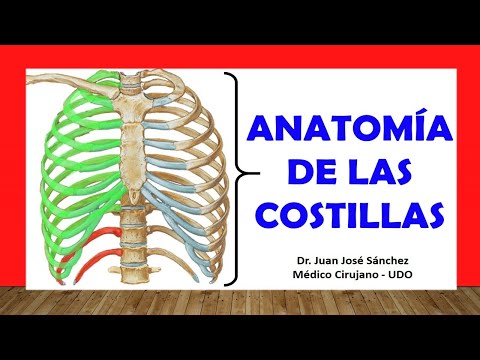
🥇 Anatomía de las COSTILLAS. Rápida, Fácil y Sencilla
Understanding the Ribs: Structure and Classification
Introduction to Ribs
- The video discusses the second part of a series on the thorax, focusing specifically on ribs and their anatomy.
- The speaker encourages viewers to subscribe for continued educational content.
Basic Anatomy of Ribs
- There are 12 pairs of ribs (24 total), classified as flat bones, crucial for protecting thoracic organs like the lungs and heart.
- Ribs have a curved shape that twists from the spinal column, creating an oblique angle that increases from the first rib to the ninth rib.
Rib Obliquity and Size Variation
- The obliquity of ribs peaks at the ninth rib before decreasing towards the twelfth rib.
- Rib size increases from the first to seventh rib, with the seventh being the longest, then decreases again towards the last rib.
Classification of Ribs
True vs. False Ribs
- Ribs are categorized into true ribs (first seven pairs articulating directly with sternum) and false ribs (remaining pairs).
- False ribs include floating false ribs (11th and 12th pairs not reaching sternum at all).
Subclassification of False Ribs
- Floating false ribs do not connect to sternum; other false ribs (8th, 9th, 10th) connect indirectly via cartilage.
Typical vs. Special Ribs
Characteristics of Typical Ribs
- Typical ribs (3rd to 9th pairs) share similar characteristics except for size and obliquity.
Special Rib Characteristics
- Special ribs include first, second, tenth, eleventh, and twelfth due to unique anatomical features.
Anatomy of a Typical Rib
Structural Components
- A typical rib consists of three parts: head (articulates with vertebrae), neck (narrow section), and body.
Articulation Details
- The head has two semi-articular facets for connecting with corresponding vertebrae; lower facet is larger for articulation with its respective vertebra.
Additional Features
Anatomy of the Rib: Key Features and Special Ribs
Structure of Typical Ribs
- The rib features an articular facet that connects with the corresponding vertebra's transverse process, exemplified by the third rib articulating with T3.
- The angle of the rib is crucial as it marks where the rib begins to twist from its origin at the spine, bending sharply outward and forward.
- On the internal face of the rib body, a groove known as the costal canal accommodates the intercostal neurovascular bundle (artery, vein, nerve).
- Each typical rib has an inferior articular facet for articulation with its corresponding vertebra and an upper facet for articulation with the vertebra above.
- The posterior view highlights how ribs extend outward and backward before curving inward towards the thoracic cavity.
Characteristics of Special Ribs
First Rib
- The first rib is unique; it is shorter, wider, and flatter than typical ribs. It has a single articular head facet making it atypical.
- A notable feature is a groove for the subclavian artery located in front of which lies an elevation called the scalene tubercle where anterior scalene muscle inserts.
- Behind this groove is another for subclavian vein; additionally, there’s no elevation for scalenus medius insertion behind subclavian artery.
- The first rib also supports structures like lower primary trunk of brachial plexus resting on its grooves alongside muscle insertions such as serratus major and subclavius.
Second Rib
- The second rib resembles typical ribs more closely due to having two articular facets on its head—one for D1 and one for D2 vertebrae.
- An important feature includes an elevation known as tuberosity for serratus major muscle insertion which distinguishes it from other typical ribs.
Understanding the Anatomy of Ribs and Vertebrae
Overview of Rib Articulation with Vertebrae
- The D1 vertebra features a complete facet for the first rib, which shapes its head. In contrast, D2 has an upper half-moon and D1 a lower half-moon, indicating their specific articulations.
- The articulation between ribs and vertebrae continues down to the second rib, where the lower articular facet connects to D2 while the smaller upper facet aligns with the notch left by D1.
- Ribs 10 through 12 are atypical due to having only one articular facet on their heads instead of two, distinguishing them from other ribs.
Characteristics of Atypical Ribs
- The eleventh (D11) and twelfth (D12) ribs have poorly developed or absent transverse processes, affecting how they articulate with surrounding structures.
- Due to underdeveloped tuberosities on these ribs, articulation is compromised; this lack of development contributes to their atypical classification.
- The costal canal's medial aspect is less pronounced in both D11 and D12 ribs, further emphasizing their unique anatomical features compared to typical ribs.
Conclusion
Turn any video into a summary like this
YouTube links, meetings, lectures. With transcripts, search, and chat.