ALAT PEMBAYARAN - UANG
Introduction to Central Banking and Payment Systems
Overview of the Lesson
- The speaker, Dewi Nur, introduces the lesson on central banking, payment systems, and means of payment in Indonesia.
- The objective is to describe the role of central banks and payment systems within the Indonesian economy.
Types of Payment Instruments
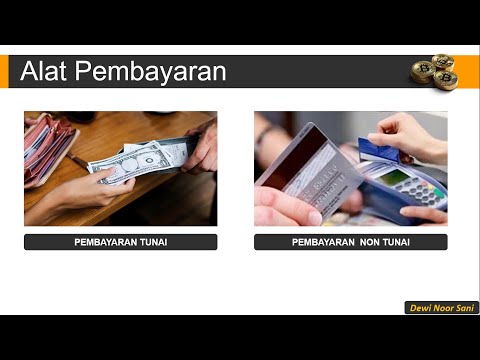
- Payment instruments are categorized into two types: cash (money) and non-cash payments.
- The discussion begins with cash payments, specifically focusing on the history of money starting from barter systems.
The Evolution of Money
Barter System
- Barter involved direct exchange of goods but faced challenges such as finding matching needs between parties.
Emergence of Commodity Money
- Commodity money emerged as a solution; it consists of items widely accepted for trade (e.g., shells, tobacco).
- However, commodity money had limitations like storage difficulties and lack of durability.
Introduction of Metal Coins
- Metal coins were introduced due to their high value and durability (e.g., gold, silver).
- Despite their advantages, metal coins also posed issues regarding transportability in large quantities.
Modern Forms of Money
Paper Money Development
- Paper money gained acceptance based on public trust in issuing institutions.
Giral Money
- Giral money emerged as a practical alternative for transactions in complex economies. It simplifies exchanges without physical currency.
Legal Definition and Characteristics of Money
Legal Framework
- According to Law No. 7/2011 on currency, valid money must meet specific criteria:
- Acceptability: Widely liked and accepted.
- Durability: Long-lasting without easy damage.
- Stability: Maintains value over time.
- Portability: Easy to carry or transfer.
- Divisibility: Can be divided without losing value.
- Uniformity: Consistent quality across units.
- Scarcity: Limited supply that prevents counterfeiting.
Functions and Types of Money
Primary Functions
- The primary function is as a medium of exchange facilitating trade by eliminating barter's limitations.
Additional Functions
- Unit of account for pricing goods/services comparison.
- Storehouse for wealth through savings accounts.
- Capital formation tool supporting business activities.
Types Based on Issuing Institutions
- Currency (Kartal): Everyday cash used for transactions (paper & coins).
- Giral Money: Bank deposits accessible via checks or electronic transfers.
Value-Based Classification
Full Bodied vs Representative Money
- Full bodied money has intrinsic value equal to its nominal value while representative money does not hold equivalent intrinsic worth.
Understanding Full Bodied Money and Its Management
Types of Money
- Full Bodied Money: This type of currency has intrinsic value equal to its nominal value, typically seen in coins where the material cost matches the face value.
- Representative Full Bodied Money (Token Money): This refers to money that has a lower intrinsic value than its nominal value, meaning the materials used are less valuable than what is printed on it.
Management of Rupiah by Bank Indonesia
- Planning Stage: The management process begins with planning and determining how much Rupiah will be printed, coordinated with government assumptions about inflation and economic growth.
- Printing Stage: Bank Indonesia oversees the printing of Rupiah, designating state-owned enterprises for this task while ensuring quality and competitive pricing.
- Distribution Stage: The distribution of Rupiah is managed by Bank Indonesia based on circulation needs; they also determine serial numbers for banknotes.
- Withdrawal Stage: Withdrawal from circulation involves replacing old notes with new ones at their nominal value as determined by Bank Indonesia.
- Destruction Stage: Unfit or unpopular notes are destroyed in coordination with the government, ensuring only valid currency remains in circulation.
Security Features of Rupiah
- Material Composition: Rupiah paper is made from cotton fiber, making it durable against wear and tear.
- Watermark & Electrotype: These features enhance security; watermarks are visible when held up to light.
- Intaglio Printing: Certain areas feel rough to touch due to this printing method which adds texture for authenticity verification.
Exploring Non-Cash Payment Methods
Types of Non-Cash Payments
- Checks and Giro Bills: A check serves as an unconditional order to pay a specified amount. In contrast, a giro bill instructs banks to transfer funds between accounts.
- Electronic Money (e-money): This form requires users to deposit money into an electronic medium before transactions can occur, emphasizing prepayment before spending.
Card-Based Payment Systems
- Debit Cards & ATMs: Debit cards allow direct payment from bank accounts while ATM cards facilitate cash withdrawals or fund transfers instantly reducing account balances accordingly.
- Credit Cards: These enable purchases on credit with a "buy now, pay later" principle where issuers cover initial costs until repayment occurs later.
Conclusion
The discussion provides insights into both cash and non-cash payment systems within Indonesia's economy. Understanding these mechanisms is crucial for navigating financial transactions effectively.