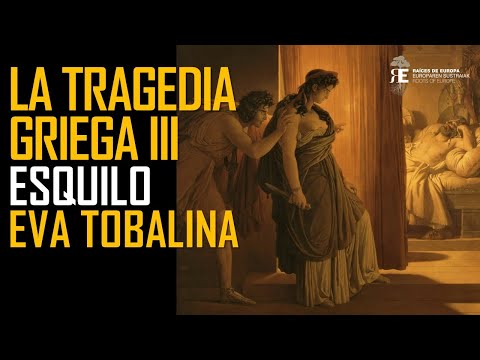
La Tragedia Griega (III). Esquilo: el primer y grandioso creador de la tragedia. Eva Tobalina
Introduction to Greek Tragedy
Overview of the Session
- The session focuses on Greek tragedy, its origins, major themes, and significant family sagas. This builds upon discussions from the previous session about Aeschylus's tragedies.
Aeschylus and His Contributions
- Aeschylus is introduced as the first major tragedian in history. He participated in annual theatrical competitions where each playwright presented three tragedies and a satyr play.
- Despite hundreds of tragedies likely composed during the 5th century BC, only 32 complete works survive today, attributed solely to Aeschylus, Sophocles, and Euripides. This highlights the loss of much ancient literature.
The Historical Context of Aeschylus
Life During Significant Wars
- Aeschylus lived through pivotal moments in Greek history, particularly the Persian Wars (490–479 BC), which greatly influenced his life and work. He fought in both battles at Marathon and Salamis.
- The Persian Wars were seen by contemporaries as defining events for Greek civilization—small city-states uniting against a vast empire symbolizing freedom versus tyranny. This context shaped Aeschylus's perspective as an artist.
Impact on His Work
- Participation in these wars profoundly affected Aeschylus’s biography and artistic expression; his experiences are reflected in his plays' themes and narratives about heroism and conflict.
Esquilo y Sofocles: La Competencia en la Tragedia Griega
La llegada de un nuevo competidor
- Esquilo, un gran artista sin competencia durante mucho tiempo, se enfrenta a un joven competidor, Sófocles, que trae innovaciones al arte de la tragedia.
- En el año 468 a.C., después de 20 años ganando concursos teatrales, Esquilo es superado por Sófocles, quien presenta una nueva forma de hacer tragedia.
Adaptación y competencia
- A medida que Sófocles gana popularidad con su frescura e innovación, Esquilo intenta adaptarse incorporando las novedades del joven autor en sus últimas obras.
- Aunque Esquilo logra ganar algunos concursos nuevamente, su frustración por ser desbancado lo lleva a retirarse a Sicilia donde finalmente muere.
El epitafio de Esquilo
- Interesantemente, Esquilo redacta su propio epitafio en Gela, destacando su participación en batallas como la de Maratón más que su éxito como autor teatral.
- Su epitafio menciona el "bosque de Maratón" y los "medos", refiriéndose a su valentía en las Guerras Médicas contra el Imperio Persa.
Ciudadanía y valores en la obra de Esquilo
- A pesar de ser un famoso autor teatral, no hace referencia a su literatura en su epitafio; prefiere ser recordado como ciudadano y patriota.
- Las obras de Esquilo reflejan preocupaciones sobre moralidad y unidad ciudadana; sus personajes son grandiosos y dominados por ideales.
Características del teatro de Esquilo
- Los héroes en las tragedias de Esquilo son valientes y enfrentan el destino con nobleza; esta grandeza no se encuentra en otros autores contemporáneos.
- Se destaca que todas las obras trágicas abordan temas políticos desde una perspectiva cívica sin caer en propaganda partidista.
- De sus aproximadamente 390 tragedias escritas, solo se conservan siete; estas muestran el estilo primitivo del teatro griego con pocos personajes presentes.
Evolución del formato teatral
- Las primeras tragedias de Esquilo presentan solo dos personajes junto al coro; este formato resulta menos dinámico comparado con las innovaciones posteriores introducidas por Sófocles.
The Evolution of Greek Tragedy
Introduction of Multiple Characters in Greek Theatre
- Sofocles innovated by introducing a third character on stage, alongside the chorus, which created a dynamic interaction that captivated Athenian audiences.
- Esquilo attempted to adapt by adding a third actor in his later tragedies but struggled to maintain relevance against Sofocles' advancements.
Characteristics of Esquilo's Tragedies
- Esquilo's works are deeply rooted in myth and legend, characterized by their poetic nature and timeless themes.
- His tragedies often explore grand moral themes within the context of human and divine interactions, contrasting with the more mundane focus of Sofocles and Euripides.
Thematic Focus on Mythology
- Most Greek tragedies revolve around mythological themes, particularly those related to royal families like the House of Atreus or Thebes.
- An exception is "Los Persas," which does not center on mythology or these royal families but instead addresses real historical events—the Persian Wars.
Overview of "Los Persas"
- "Los Persas" recounts the Battle of Salamina (480 BC), presenting it from the perspective of the defeated Persians rather than the Greeks.
- The narrative features Atosa, mother of King Jerjes, who experiences premonitions about her son’s struggles against the Greeks during this pivotal battle.
Themes and Characterization in "Los Persas"
- The tragedy unfolds as Atosa learns about Persia's defeat through a messenger and encounters the ghost of Dario I.
- Esquilo’s style emphasizes message over plot; thus, while events are minimal, they convey profound insights into respect for both victors and vanquished.
Audience Reception and Historical Context
- Presented eight years post-battle, many audience members had firsthand experience in Salamina; this connection added depth to their viewing experience.
- Despite portraying Persians as adversaries, Esquilo treats them with dignity—highlighting their nobility while acknowledging Greek superiority.
Transition to Other Works
- Following "Los Persas," one notable work is "Los Siete Contra Tebas," part of a larger tradition where playwrights presented multiple plays at festivals.
The Tragic Structure of Aeschylus' Works
Thematic Elements in Aeschylus' Tragedies
- Aeschylus incorporated comedic elements at the end of his tragedies to provide a tonal shift, contrasting with the heavy themes of familial sagas where ancestral crimes haunt subsequent generations.
- His first tragedy focuses on the actions of Laius, followed by narratives about parents and children, culminating in a satirical drama that ties back to these themes.
- The story revolves around Laius's abduction and violation of a young boy, leading to tragic consequences for Thebes due to this original sin committed by Laius.
The Cycle of Tragedy
- Laius defies divine prophecy, resulting in the birth of Oedipus who unknowingly kills his father and marries his mother Jocasta, perpetuating a curse upon Thebes.
- Oedipus discovers his horrific actions lead to a plague ravaging Thebes; in despair, he blinds himself and ultimately leaves the city.
- After Oedipus's departure, his sons Eteocles and Polynices vie for power over Thebes after expelling their blind father.
Conflict Between Brothers
- Eteocles and Polynices agree to alternate ruling but conflict arises when Eteocles refuses to relinquish power after his year is up.
- Polynices seeks support from Argos, gathering an army which leads to the siege known as "The Seven Against Thebes."
Moral Dilemmas in Greek Tragedy
- This narrative presents a classic dilemma: neither brother is entirely right or wrong; both have justifiable claims yet are embroiled in conflict.
- Aeschylus differs from other tragedians like Euripides by emphasizing that defending one's city (Thebes) is paramount over personal grievances.
Aeschylus' Perspective on Heroism
- In "The Seven Against Thebes," Eteocles emerges as the hero for defending his city against foreign invaders despite failing to honor his agreement with Polynices.
- Eteocles expresses deep concern for Thebes’s survival amidst war, reflecting Aeschylus's focus on civic duty over individual desires.
The Tragic Sacrifice of Eteocles and the Fate of Thebes
Eteocles as a Hero
- Esquilo portrays Eteocles, who defends Thebes against the Persian invasion, as an absolute hero despite being depicted as a villain by others. His commitment to protect his city is unwavering.
Acceptance of Destiny
- Eteocles willingly accepts his fate to save Thebes, even when faced with the threat from his brother Polynices and six Argive warriors at the seven gates of Thebes.
Brother Against Brother
- Eteocles prepares for battle against Polynices, emphasizing that he will fight both as a prince and as a brother. The chorus expresses their dismay at the thought of brothers fighting each other.
Consequences of Fratricide
- The chorus warns that while enemies can kill each other without shame, fratricide leaves an indelible stain on one's honor. Eteocles contemplates this but feels compelled to follow what he believes is divine will.
Divine Will and Tragedy
- Eteocles believes that the gods have destined him to confront Polynices due to their family's curse. He resolves to die defending Thebes, leading to both brothers' deaths in battle.
The Aftermath: Burial Rights and City Division
Sacrifice for Salvation
- Esquilo presents Eteocles' sacrifice as having saved Thebes from invasion, marking a significant deviation from traditional Greek mythology where prophecies must be fulfilled.
Antigone's Dilemma
- Following the battle, Antigone insists on burying her brother Polynices despite city laws prohibiting it. This creates a division within Thebes between those supporting her and those upholding the law.
Unity vs. Division in Esquilo's Work
- Scholars argue that Esquilo would not depict a divided city; thus, they believe this conflict was added later during historical turmoil rather than reflecting Esquilo’s original intent.
Transitioning Themes: From Theban Tragedies to Mycenaean Saga
Shift in Focus
- While earlier tragedies focus on themes surrounding Oedipus and family curses in Thebes, future works like "Orestiada" shift attention towards Agamemnon's saga in Mycenae involving themes of sacrifice and familial betrayal.
Agamemnon's Choices
Tragedy of Agamemnon and the Role of Clytemnestra
Variations in Mythology
- The myth of Agamemnon varies among different tragedians; Aeschylus presents a version where Iphigenia is sacrificed without divine intervention, highlighting human agency in tragic events.
Clytemnestra's Motivation
- Clytemnestra's hatred for Agamemnon stems from his murder of their daughter, Iphigenia, to secure favorable winds for war. This act transforms her into one of the most notorious villains in theater history.
Aeschylus' Portrayal of Villainy
- Aeschylus depicts Clytemnestra as a complex villain, showcasing her actions with terrifying grandeur. Her role in the Orestiad reflects deep themes of revenge and justice within familial relationships.
Structure and Innovation in Tragedy
- "Agamemnon" represents one of Aeschylus' later works, influenced by Sophocles’ innovations. The introduction of multiple characters on stage enhances dramatic interaction and complexity.
The Climax: Murder Scene
- The play’s climax occurs when Agamemnon is fatally wounded by Clytemnestra. His cries echo through the palace, signaling a pivotal moment that reveals the consequences of betrayal and vengeance.
Chorus Reaction to Crime
- The chorus embodies public sentiment, struggling to comprehend the unfolding tragedy. Their discussions reflect naturalistic dialogue typical among witnesses to such heinous acts.
Confusion Among Witnesses
- As confusion reigns among the chorus members regarding how to respond to Agamemnon's apparent murder, their varied opinions illustrate societal reactions to violence and authority.
Clytemnestra's Justification
- Upon revealing herself after committing murder, Clytemnestra justifies her actions as retribution for Agamemnon’s sacrifice of Iphigenia. She challenges societal norms regarding justice and morality.
Vivid Imagery in Murder Description
- Clytemnestra describes her act with vivid imagery—comparing Agamemnon’s bloodshed to life-giving dew on crops—highlighting her twisted sense of triumph over his death.
Themes of Retribution
- In her speech, she confronts societal hypocrisy regarding justice; while she faces condemnation for killing Agamemnon, no one protested his earlier crime against their daughter.
Final Confrontation with Chorus
The Curse of Agamemnon's Lineage
The Role of Egisto and Clitemenestra
- Egisto, the lover of Clitemenestra, enters the narrative as a key figure in the plot against Agamemnon, who is away at war. His motivations are intertwined with personal desires for power and revenge.
Introduction to Greek Tragedy
Overview of the Session
- It is revealed that Egisto has a longstanding vendetta against Agamemnon due to familial disputes dating back to their fathers, highlighting a cycle of vengeance within their lineage.
- The relationship between Egisto and Agamemnon is further complicated by their family ties; they are cousins, which adds layers to their conflict rooted in betrayal and historical grievances.
- This session focuses on Greek tragedy, its origins, major themes, and significant family sagas. The previous discussions will aid in understanding Aeschylus's tragedies today.
Atreus' Horrific Actions
Aeschylus and the Theater Competitions
- Each playwright presented three tragedies and one satyr play annually in theatrical competitions. This format was a staple of ancient Greek theater.
- A pivotal moment occurs when Atreus (Agamemnon's father) deceives his brother Tiestes into consuming his own children during a banquet, showcasing the depths of familial treachery that haunt Agamemnon’s lineage.
- Tiestes’ realization leads him to curse Atreus' line, establishing a dark legacy that continues to affect future generations, including Agamemnon.
The Cycle of Violence
- Throughout the 5th century BC, numerous tragedies were composed; however, only 32 complete works from three authors (Aeschylus, Sophocles, Euripides) have survived. The loss of countless works highlights the fragility of historical literature.
- Egisto claims he has orchestrated Agamemnon's downfall as retribution for past wrongdoings against his family. This highlights how deeply entrenched cycles of violence perpetuate through generations.
The Significance of Aeschylus
Aeschylus as a Pioneer
- Despite being justified in his actions from his perspective, Egisto’s murder of Agamemnon reflects the tragic consequences of revenge-driven motives.
Chorus Commentary on Justice
- The leader of the chorus expresses disapproval towards Egisto’s actions while foreshadowing inevitable justice that awaits him. This commentary serves as a moral compass within the narrative.
- Aeschylus is recognized as the first great tragedian who won multiple competitions and gained immense fame beyond Greece. His contributions are considered foundational to Greek poetic art.
- Tensions rise as characters engage in verbal sparring about power dynamics and morality; this dialogue emphasizes themes of hubris and accountability.
Orestes' Revenge
- He was born around 525 BC in Eleusis, near Athens, during pivotal times in Greek history marked by the Persian Wars which influenced his work significantly.
Historical Context
- Orestes returns home with plans for vengeance alongside Electra after witnessing the tyranny imposed by Clitemenestra and Egisto following Agamemnon's death.
- Aeschylus fought in both Persian Wars: at Marathon (490 BC) and Salamis (480/479 BC). These experiences shaped his worldview and artistic expression within his plays.
- In a climactic confrontation, Orestes kills both Egisto and Clitemenestra, liberating Mycenae from their oppressive rule—a significant act reflecting themes of justice versus revenge.
Conclusion: Restoration or Further Chaos?
- The epic nature of these wars against Persia defined not just his era but also had lasting implications for Western civilization as a whole. His participation deeply impacted his biography and theatrical output.
Aeschylus's Legacy
Recognition and Influence
Esquilo y Sofocles: La Competencia en la Tragedia Griega
La llegada de un nuevo competidor
Tragedy of Orestes and the Role of the Areopagus
- Esquilo, un gran artista y pionero en la tragedia, se enfrenta a la competencia de un joven talento, Sófocles, quien introduce innovaciones que sorprenden al público.
The Consequences of Orestes' Actions
- Orestes kills his mother, Clytemnestra, and her lover, Aegisthus, fulfilling a divine command to avenge his father's death. However, this act is seen as a tremendous crime due to the nature of matricide.
- Following the murders, Orestes is tormented by the Furies (Erinyes), who relentlessly pursue him with accusations and insults for committing such a heinous act against his mother.
- Driven to madness by their torment, Orestes seeks guidance from Apollo at Delphi on how to escape his dire situation after following divine orders.
The Unusual Trial in Athens
- The Oracle instructs Orestes to go to Athens and submit himself to trial before the Areopagus, marking a significant shift as most tragedies are set outside contemporary Greek society.
- The Areopagus was reformed during Pericles' time; it allowed ordinary citizens to serve as jurors rather than just aristocrats. This change reflects democratic principles emerging in Athens.
- En el año 468 a.C., después de 20 años de victorias en concursos teatrales, Esquilo es superado por Sófocles, quien presenta una nueva forma de hacer tragedia.
Adaptación y Rivalidad
- A pesar de su éxito previo, Esquilo intenta adaptarse a las innovaciones de Sófocles; sus últimas obras reflejan cambios significativos en su estilo.
- La rivalidad entre ambos dramaturgos es intensa; aunque Esquilo gana algunos concursos más, finalmente se siente desbancado por el talento fresco y moderno de Sófocles.
El legado personal de Esquilo
- Al final de su vida, Esquilo redacta su propio epitafio en Gela, Sicilia; destaca su participación en las Guerras Médicas sobre su carrera literaria.
- Su epitafio menciona la batalla de Maratón y los persas como testigos del valor que mostró durante esos conflictos bélicos.
Temática y Filosofía del Teatro
- A pesar de ser un autor teatral famoso, Esquilo prefiere que se le recuerde como un ciudadano patriota que luchó por su ciudad.
- Sus obras reflejan preocupaciones morales y cívicas profundas; los personajes son grandiosos y enfrentan el destino con valentía.
Características del Teatro de Esquilo
- The role and jurisdiction of the Areopagus were hot topics in 5th-century Athens. Aeschylus's mention of this institution indicates its relevance in contemporary political discourse.
Resolution and Divine Intervention
- Los héroes en las tragedias de Esquilo son presentados como figuras sin duda ni miedo; representan ideales elevados frente al destino.
- Se considera que todas sus obras tienen una fuerte carga política pero no propagandística; defiende valores supremos sin tomar partido explícito.
Prolífico Autor Teatral
- Surprisingly, two-thirds into the tragedy, the Areopagus decides to forgive Orestes due to mitigating circumstances: he acted under divine instruction after avenging his father’s murder.
- Se estima que escribió alrededor de 390 tragedias; solo siete han sobrevivido hasta nuestros días.
- Las primeras tragedias presentan una estructura primitiva con solo dos personajes en escena junto al coro, lo cual limita la dinámica dramática.
- Athena appears at the end of the play, addressing Athenians about maintaining order without falling into anarchy or despotism. She emphasizes unity among citizens.
Innovaciones Dramáticas Introducidas por Sófocles
- Athena transforms the Furies into benevolent deities known as Eumenides who will protect Athens from internal discord—an essential message given rising political tensions in Athenian society during Aeschylus's time.
Historical Context and Legacy
The Evolution of Greek Tragedy
Introduction of Multiple Characters in Greek Theatre
- "The Eumenides," one of Aeschylus's last works presented in 458 BC during Pericles’ era, serves as a call for harmony amidst growing political strife within Athens.
- Sophocles innovated by introducing a third character on stage, alongside the chorus, which created a dynamic interaction that captivated Athenian audiences.
- Aeschylus attempted to adapt by adding a third actor in his later tragedies but struggled to maintain relevance against Sophocles' advancements.
Characteristics of Aeschylus's Tragedies
Understanding the Variability of Classical Texts
- Aeschylus's works are deeply rooted in myth and legend, characterized by their poetic nature and timeless themes.
The Nature of Surviving Texts
- The texts we have today are copies of copies, with many originating from the Hellenistic period, but most surviving works are from Roman times or medieval manuscripts.
- There is uncertainty regarding which is the oldest copy we possess, highlighting the fragmented nature of literary history.
Diverse Interpretations by Tragedians
- Each tragedian presents their own version of legends; for instance, Agamemnon's story varies between Aeschylus and Euripides.
- This lack of a single narrative leads to varied interpretations among modern authors who adapt classical theater.
Modern Adaptations and Their Context
- Modern adaptations often choose specific versions from different tragedians, reflecting a diverse origin rather than a singular source.
- Notable adaptations include Anouilh's "Antigone" and Frisch's "Homo Faber," which reinterpret classic tragedies in contemporary contexts.
The Resurgence of Classical Theater in the 20th Century
- The mid-20th century saw a revival of interest in classical theater as society grappled with post-war uncertainties and sought new philosophies.
- Figures from classical stories were used to explore modern human tribulations, indicating how timeless themes resonate across eras.
The Story of Helen and Its Implications
- Helen’s beauty led to a competition among Greek princes for her hand, illustrating themes of desire and rivalry that echo throughout history.