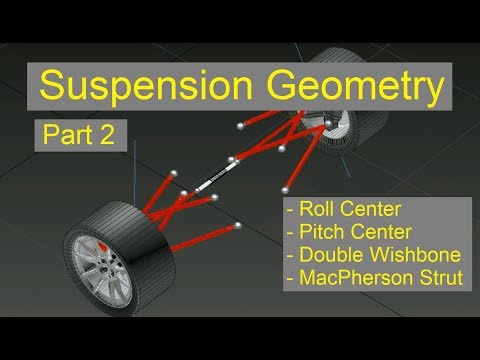
Suspension Geometry - Part 2 (Roll Center, Double Wishbone, MacPherson Strut)
Suspension Geometry: Roll Center and Pitch Center
Overview of Suspension Geometry Topics
- The video is divided into two main parts: roll center and pitch center, followed by double wishbone suspension and McPherson strut discussions. Additional topics like Ackermann steering geometry and multi-link suspension will be covered in separate videos due to time constraints.
- A future video (part three) will focus on various types of rear suspensions used in cars. The current discussion primarily addresses front suspension concepts.
Understanding Roll Center
- Roll center is defined as an imaginary pivot point around which a car's body rolls during cornering, influenced by the vehicle's suspension geometry. It plays a crucial role in how the car behaves when navigating turns.
- Pitch center functions similarly but pertains to forward pitching motion when braking; it indicates where the car's body pivots during deceleration. Both centers are vital for understanding vehicle dynamics in racing contexts.
Dynamics of Body Roll
- When a car turns left, forces act on its center of gravity (CG), causing it to roll outward towards the right side due to torque generated between CG and roll center positions. This results in body roll during cornering maneuvers.
- Adjusting the height of the roll center affects body roll; raising it closer to the CG reduces torque, leading to less body roll while cornering, potentially improving handling performance. However, this must be balanced with other factors such as jacking force from contact patches.
Jacking Force Considerations
- If the roll center is positioned above road surface level, vertical forces can lift the car during cornering—a phenomenon known as "jacking." This effect raises the vehicle’s center of gravity, increasing weight transfer to outside tires, which can negatively impact racing performance.
- An optimal balance must be struck: keeping the roll center close to CG minimizes body roll while also maintaining a low enough position relative to road surface to mitigate excessive jacking effects that could hinder stability during turns.
Practical Applications in Vehicle Design
- Most vehicles place their roll centers slightly above road surface level—this configuration helps prevent bottoming out (when suspension reaches full compression) while still managing some beneficial jacking force for improved handling characteristics during cornering situations.
Understanding Roll Center and Pitch Center in Suspension Systems
The Concept of Roll Center
- The roll center is determined by the angle of control arms on racing cars, which are not parallel. Drawing lines from their intersection to the tire contact patch helps locate it.
- While the roll center can change during cornering due to movement in control arms, it provides a useful estimation for tuning car suspension.
- Lowering a car alters the angles of control arms, resulting in a lower roll center that can lead to excessive body roll.
- Solutions like ball joint spacers or custom suspension modifications (cutting and welding) are used to adjust the roll center back to an optimal position.
- Many modern cars feature multiple suspension attachment points allowing easy adjustments for different track conditions.
Understanding Pitch Center
- Pitch center is similar to roll center but viewed from the side; it involves upper and lower control arm angles affecting wheel rotation during suspension movement.
- The design of front suspensions often includes angled upper control arms that create lifting forces when braking, counteracting front dive.
- Rear suspensions typically have forward-pointing upper control arms designed as anti-squat geometry, preventing rear-end squat under acceleration.
- Measuring pitch center involves drawing lines through ball joints similar to measuring roll center; this point indicates how the car pitches forward when braking.
Double Wishbone Suspension Explained
- A double wishbone suspension consists of two control arms (upper and lower), providing camber gains due to their size difference.
- The positioning of ball joints affects steering angles (kingpin inclination and caster angle), as well as both roll and pitch centers in relation to chassis attachment points.
- In rear suspensions, alignment adjustments are made via a knot on one rod since there’s no steering rack present at the rear axle.
Importance of Control Arm Alignment
- Proper alignment of yellow lines drawn through each control arm is crucial; they should intersect at a single point for effective suspension performance.
Control Arm Geometry and Suspension Dynamics
Importance of Control Arm Alignment
- Control arms must be aligned such that yellow lines drawn through all ball joints maintain proper geometry, ensuring effective suspension movement.
- Proper offsetting of components like the steering rod is crucial; even with offsets, maintaining correct angles ensures wheels move vertically without altering alignment.
Understanding Bump Steer
- Bump steer occurs when wheel movement alters toe angle due to incorrect geometry; a personal experience highlighted how a minor misalignment led to instability at high speeds.
- Correcting bump steer significantly improves vehicle stability over bumps, emphasizing the need for precise suspension design.
Effects of Control Arm Length on Camber Gains
- The length difference between upper and lower control arms affects camber gains; shorter upper control arms can counteract camber loss during body roll in corners.
- Extreme shortening of upper control arms may lead to excessive camber gain under braking or squatting, risking grip loss.
Structural Benefits of Double Wishbone Suspension
- Double wishbone suspensions offer structural advantages by minimizing bending forces on links, allowing for lightweight yet strong designs suitable for racing applications.
- Forces acting on control arms during braking and cornering are primarily compressive or tensile, reducing the risk of bending or twisting failures.
Material Considerations in Racing vs. Production Cars
- Racing cars utilize materials like carbon fiber for lightweight strength; despite potential impacts, these designs withstand significant stress without failure.
Understanding McPherson Strut Suspension
Overview of McPherson Strut Design
- The McPherson strut is a prevalent suspension type in modern cars, primarily used in the front due to its cost-effectiveness and simplicity.
- This design features a lower control arm similar to double wishbone suspensions but replaces the upper control arm with a direct connection from the knuckle to the strut.
Structural Components and Efficiency
- The suspension has three attachment points: two for the lower control arm and one for the strut at the strut tower, optimizing space and reducing costs.
- The steering axis is defined by a line through the top strut mounting point and the ball joint on the lower control arm, allowing for efficient movement.
Camber Gain Dynamics
- Camber gain occurs when angling the top of the strut towards the car's center; however, this gain diminishes as movement continues due to differing motion arcs between components.
- Unlike double wishbone suspensions, which provide more consistent camber gains, McPherson struts experience diminishing returns after initial gains.
Adjustability Challenges
- Altering strut angles affects both kingpin inclination and caster angle; typically, adjustments are made by moving mounting points rearward to enhance handling characteristics.
- Changes in caster also impact pitch center; thus, modifying roll centers often requires adjustments to lower control arms rather than upper components.
Limitations in Performance Applications
- Key drawbacks include insufficient camber gain compared to double wishbone designs and interdependent angle adjustments that complicate tuning for performance applications.